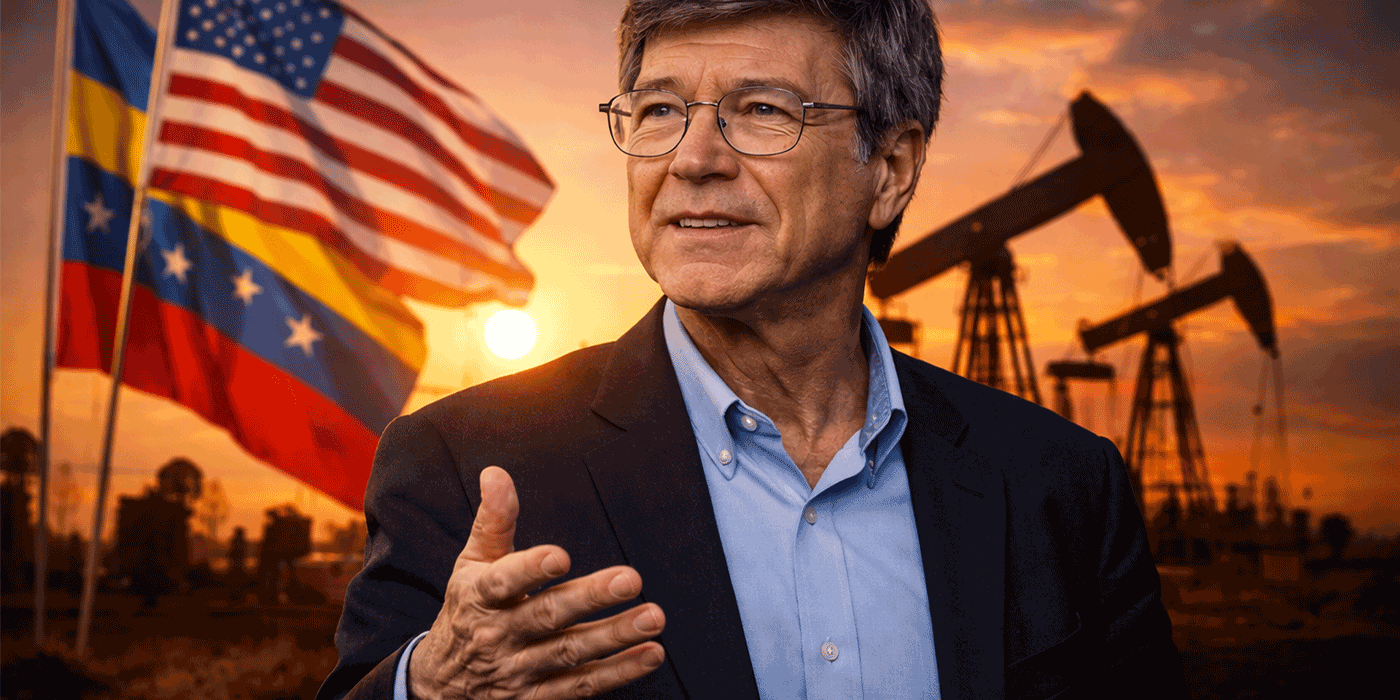
America's Law of the Jungle - Jeffrey Sachs
The Insider and His Verdict: Biography and Uncomfortable Truth
An economist from within Western institutions arrives at a judgment that challenges the very structure of power he once advised.
Jeffrey Sachs, born in 1954 in Detroit, has for decades been one of the most recognized American economists in the fields of development and macroeconomics. His academic career began at Harvard University, where he earned his PhD and became a professor at a young age. Early in his career, he advised governments facing severe debt and inflation crises.
He gained international prominence in the 1980s and 1990s through his role in economic stabilization programs — including Bolivia, Poland, and several post-communist states in Eastern Europe after the end of the Cold War. His involvement in reform processes in the former Soviet Union remains controversial to this day.
💬 “Economic reform is never just technique — it is always politics.”In the 2000s, Sachs shifted his focus toward global development issues. As Director of the Earth Institute at Columbia University and later as President of the UN Sustainable Development Solutions Network, he worked closely with the United Nations on poverty reduction, global health, and sustainable development.
In recent years, he has increasingly emerged as a commentator on foreign policy. He criticizes military interventions, warns against permanent sanctions regimes, and highlights the risks of escalating great-power rivalry. His analyses draw on decades of experience in international policy advisory roles — not partisan opposition.
For that reason, his voice carries weight: Sachs argues not from ideological distance, but from institutional proximity and systemic economic analysis.
Venezuela, the Collapse of World Order, and Europe’s Total Silence
Professor Jeffrey Sachs joins Glenn Diesen to analyze the U.S. invasion of Venezuela and explain why this is no aberration — but the latest peak of a world order dismantling itself. A post-constitutional military state shreds international law, bombs Nigeria, threatens Iran, claims Greenland — and Europe responds with the diplomatic equivalent of a shrug. The question is no longer whether international institutions still function. The question is whether anyone is prepared to defend them.
The Illegal Act - and the Long Line It Belongs To
We are not in a constitutional order in the United States. We are in an order led by a military state. We do not obey the U.S. Constitution. Everything is by executive decree.
Glenn Diesen opens with the fundamental question: How do we assess the U.S. attack on Venezuela and the capture of President Maduro? Jeffrey Sachs doesn’t hesitate: “This is a blatantly illegal act — but it’s one in a long line of blatantly illegal American actions.” In the days prior, Trump had bombed Nigeria, threatened to intervene in Iran, declared Greenland American territory, and invaded Venezuela. A new country every day. A new threat every morning.
Sachs is unambiguous: the United States is no longer operating within a constitutional order. Everything runs by executive decree. When a congressman dared invoke the Constitution, Trump responded: “What is he whining about? This is ridiculous.” What that means is not abstract — it means there are no domestic brakes left. And what troubles Sachs most is the institutional silence. The New York Times has not published a single editorial questioning whether such an attack was a good idea. Congress is operationally defunct.
The timeline of the first weeks in office:
- Nigeria bombed — no debate, no explanation, no congressional authorization
- Iran threatened: Trump declares he will intervene if protesters are arrested
- Greenland: repeated annexation announcements — Europe stays silent
- Venezuela: president seized, government destabilized, oil named as war objective
- Constitution: when a congressman cited it, Trump mocked him publicly
This sequence is neither accidental nor chaotic. It is the consistent execution of a logic that has been visible for years — and that surprised people only because no one took it seriously when it was still verbal. Now it is real. Each of these actions would have ended careers a decade ago. Today they are routine.
Sachs makes clear: this is not about Trump personally. Trump says out loud what others thought and did quietly. He has shifted the conversation — and in doing so, he has redefined what is thinkable. Whatever comes after him will operate within a framework he set. That is the truly durable legacy of this presidency.
Venezuela as a Project - 23 Years of Regime Change in Installments
Whatever is said is just blah, blah, blah — it’s whatever joke or improvisation the United States wants to use at the moment. This is a concerted, long-term attempt to bring down the government of Venezuela.
Diesen lists the stated rationales: narco-terrorism, alleged presence of Hamas, Hezbollah, Iran, Russia, and China in Venezuela. Trump said it plainly: “The oil is ours and we want it back.” Sachs dismisses all of it: “Whatever is said is just blah, blah, blah. It’s whatever the U.S. wants to use at any given moment. The long-term agenda stays constant.” The real story lies elsewhere: Venezuela holds the world’s largest proven oil reserves — larger than Saudi Arabia’s, though more expensive to extract due to its heavy crude.
For 23 years, the United States has been trying to bring down this government. In 2002 a coup attempt against Hugo Chavez failed. In 2017 Trump asked at a dinner with Latin American heads of state: “Why don’t we just invade Venezuela?” Two presidents talked him down. Sachs knows this firsthand — he received that account independently from two of the leaders who were present. Eight years later, Trump followed through. This is not impulsive. This is planning.
The anatomy of a U.S. project:
- Venezuela: the world’s largest oil reserves — the real and only reason
- The project has run for over 20 years, under Democrats and Republicans alike
- Marco Rubio: decades-long chief lobbyist for the invasion — now Secretary of State
- 2017: Trump asked about invasion at a dinner — two presidents held him back
- History of regime change: most fail; nearly all end in prolonged instability
Sachs points to Lindsay O’Rourke’s landmark study of 64 covert regime-change operations between 1947 and 1989. The findings are sobering: many of these operations failed to achieve even their immediate objective. Where the regime did fall, the overwhelming majority of cases descended into prolonged instability, civil war, or chaos. The word “covert,” Sachs notes pointedly, is an oxymoron: “’Covert’ doesn’t mean unknown — it means the U.S. lies about it.”
What this means for Venezuela: Maduro is gone. The regime stands. The military is intact. Parts of society are mobilized. There are guns in the population. History suggests that what follows will be neither simple nor swift — regardless of what Trump announces.
Europe - Vassalage as Reflex, Silence as Policy
The European response has been pathetic — absolutely pathetic. Every leader in Europe seems to cower to the U.S., to be terrified. The strongest statement was: ‘We hope this will return to stability soon.’
Sachs opens with a bitter remark aimed at Oslo: “It’s a very sad day for your country, Glenn. I think we can rename the Nobel Peace Prize the Nobel War Prize.” The prize went to Maria Corina Machado — a woman who had explicitly called for a U.S. military strike against Venezuela. Shortly afterward, it happened. The connection is not conspiracy theory; it is temporal and substantive causality. The prize was meant to create legitimacy — and it did.
The strongest reaction from European governments was: “We hope this will return to stability soon.” No outrage. No reference to the UN Charter. No demand for explanation. Sachs summarizes: Europe oscillates between complete vassalage to the U.S. and its own warmongering toward Russia. Diplomacy, multilateralism, international law — nowhere to be found. And most remarkably: some European politicians criticized Trump not for the invasion itself, but for stating too openly that oil was the objective. Had he said “democracy and freedom,” it would have been fine.
Europe’s response pattern to U.S. force:
- Nobel Prize to Machado: legitimization instrument for a planned invasion
- European reaction: ‘We hope for stability’ — not a word about the rule of law
- Greenland: repeatedly announced as annexation target — no European protest
- Criticism not of the invasion — but that Trump was too honest about his objectives
- Same Europe that invokes rules against Russia goes silent when the U.S. invades
Diesen explains the logic of this double standard: it is the product of 80 years of structural dependency. A dependency that has long since become reflex. They no longer comply out of calculation. They comply because they know nothing else. The chains have become comfortable. The U.S. is the ticket to greatness, to a security umbrella, to global relevance. When that disappears — and it is disappearing now — the pacifier is gone. What remains is panic without a plan.
The paradoxical result: Europe, which rhetorically presents itself as the defender of the rules-based order, is in practice the greatest enabler of its destruction. Because as long as the most important Western bloc silently accepts every U.S. violation of international law, the rules-based order exists only as a PR concept. Not as political reality.
Democracy Equals Peace - The Orwellian Fairy Tale, 2,300 Years Old
The idea that democracy means peace is a fairy tale disproved 2,300 years ago. Athens was the democracy of its day and it was utterly imperialistic — it destroyed other city-states. And in the end it destroyed itself.
Diesen raises the question that Western mainstream media systematically avoid: every major news outlet discusses not the legality of the U.S. invasion — they simply call Maduro a dictator and imply that freedom can now arrive. Fox News is already delivering the regime-change plan. The EU declares it stands with the Venezuelan people — against their elected president. The narrative is complete. Reality is irrelevant.
Sachs responds with a history lesson: Athens was the leading democracy of its time and simultaneously an aggressively imperialist power. It waged war, destroyed city-states, and ultimately committed its own historical suicide through the catastrophic expedition against Syracuse in 414 BC. The defeat left Athens defenseless against Sparta. The end of Athenian dominance dates to 404 BC. The democracy had destroyed itself precisely because it had no internal brakes on imperial adventure.
The historical equation of imperial democracies:
- Athens: leading democracy and leading imperial power — one and the same
- Britain: most democratic country of the 19th century — and the most violent
- U.S.: roughly 100 regime-change operations since 1945 — in the name of freedom and democracy
- Nobel Prize to Machado: democracy propaganda deployed as cover for invasion
- Orwellian doublespeak: ‘democracy = peace’ is not description — it is concealment
In the 19th century, Britain was the greatest democracy in the Western world — and simultaneously the most violent country of the century, militarily attacking and colonizing virtually every continent. In the second half of the 20th century, the United States assumed that role: roughly a hundred regime-change operations, wars of choice, permanent intervention — all in the name of freedom and democracy. Democracy was never an obstacle. It was a resource for legitimization.
“Democracy equals peace” is, in Sachs’ words, an Orwellian idea. It serves not to describe reality but to conceal it. It gives aggression a moral veneer. And it relieves the domestic population of the burden of seriously asking what their government is actually doing in their name. That is its true function — not analysis, but immunization against analysis.
Venezuela - Why This Project Might Fail
Even if you accept the U.S. aims — which I don’t — the idea that this will lead to a pro-U.S. democracy where Chevron and ExxonMobil will thrive is a very long shot. A very long shot indeed.
Diesen asks the operational question: how likely is it that the U.S. can actually break the Venezuelan government now that the president is gone? Sachs is skeptical. He begins by noting that the operation hasn’t even achieved its immediate objective: removing the president is not the same as removing the regime. The military stands. The state apparatus functions. Parts of society are mobilized. There are weapons in the population.
The tempo of the operation is decisive. Diesen frames it this way: if the U.S. can wrap this up over a weekend, it reads as a show of strength. If it drags on, it becomes a problem — for Trump’s base, for the America First faction, which sees this invasion as a betrayal of Trump’s own mandate. Tucker Carlson’s network has already reported critically. The split within the Trump coalition is real and could deepen.
What O’Rourke’s study shows about regime change:
- Many covert operations fail to achieve even the immediate goal of regime change
- Where the regime did fall: most cases descended into prolonged instability or civil war
- The U.S. very rarely achieved its actual strategic objectives through such operations
- Venezuela: Maduro removed — regime, military, and state apparatus remain intact
- Trump base divided: America First faction sees the invasion as a betrayal of the mandate
Sachs returns to O’Rourke’s findings: the majority of covert regime-change operations failed. Even where the regime fell, the overwhelming majority of cases ended in prolonged instability, civil war, or chaos. The U.S. has rarely if ever achieved its actual strategic goals through such operations — even granting those goals legitimacy, which Sachs explicitly declines to do.
What follows will therefore not be a matter of weeks. Venezuela will — if history is any guide — become the next long shadow in the long list of American interventions that began with triumphant gestures and ended in decades of chaos. Iraq. Afghanistan. Libya. Syria. The template is set. The question is not whether, but how deep.
Iran as the Next Project - A 70-Year History of Destabilization
Since 1953 the U.S. has been intervening in Iran. They toppled Mossadegh because he had the audacity to believe that Iranian oil under Iranian ground was actually Iranian. That is the foundation on which everything since has been built.
Sachs draws the direct line: Venezuela is a project. Syria was a project. And Iran is a project — the oldest of them all. Since 1953, when the CIA and MI6 jointly toppled the democratically elected government of Mossadegh because he wanted to nationalize Iranian oil for Iran, the United States has sought to control that country. When the U.S.-installed police state fell in 1979, Washington armed Iraq to attack Iran. The war lasted eight years. Hundreds of thousands died.
When Iran negotiated a nuclear agreement in 2015 and demonstrated that its program was constrained, Trump in his first term tore up the deal. The justification was not that Iran had cheated — the IAEA had confirmed the opposite. The justification was ideological: we want regime change, not engagement. The economic crisis generating today’s protests is the direct result of that sanctions policy. Now Trump threatens again: if protesters are arrested, he will intervene — as if he were the legitimate overseer of Iranian domestic politics.
The history of the U.S.-Iran project:
- 1953: CIA and MI6 topple Mossadegh — because he wanted to nationalize Iranian oil
- 1979: police state falls — U.S. arms Iraq for a war of aggression against Iran
- 2015: nuclear deal reached — Trump tears it up because he wants regime change, not engagement
- Today: sanctions systematically destroy the economy — protests are the calculated result
- Next stage: Israeli strike on Iran possible — escalation potential enormous
Sachs sees the risk of Israeli military action as immediate. An Israeli strike on Iran could be the next escalation — and Iran is no small power. It can inflict considerable damage, and it has allies capable of inflicting even more. If Venezuela already represents a dangerous escalation: a war against Iran would be a different order of magnitude entirely. “We’re not talking about regional instability anymore. We’re talking about the possibility of an uncontrollable regional war in the Middle East — with all the consequences that entails.”
The disturbing pattern: each of these operations — Venezuela, Iran, Syria, Ukraine — is treated as a standalone event, with its own specific rationale. As if each arose independently. Sachs insists on a different reading: they are chapters of the same book. Written by the same institutions, with the same methods, for the same objectives. The book has no title that gets cited in the press. But it has a clear plot: control over resources, exclusion of competitors, maintenance of hegemony.
The End of Constitutional Order - America’s Passage from Republic to Empire
If you think about Roman history — the transition from the Roman Republic to the Roman Empire — we’re somewhere into the reign of Tiberius now. The U.S. stopped being a constitutional order ten, twenty, thirty years ago.
Sachs reaches for a historical comparison that is particularly uncomfortable for American ears. Rome’s transition from Republic to Empire is conventionally dated to 27 BC, when Augustus became Princeps. But the end of the Republic began earlier — gradually, through the erosion of institutions, through precedents, through habituation to exceptions, through generals who deployed their influence against the system itself. Sulla, Marius, Caesar. Each step seemed defensible. The result was the end of the Republic.
Sachs’ assessment is clear: the United States stopped being a genuine constitutional order ten, twenty, perhaps thirty years ago. What remains are the facades — Senate, courts, elections. Exactly as Rome preserved the forms of the Senate even after the Senate had long since become meaningless. Today a president enriches himself and his associates without consequence. He governs by decree. He wages war without congressional authorization. He is complicit in a genocide. No institutional resistance. That is not a constitutional condition.
Rome’s trajectory — and America’s:
- Senate, courts, elections still exist — the substance of the Constitution is long gone
- President enriches himself and associates — no institutional response, no accountability
- War by executive decree, without Congress — the post-constitutional new normal
- UN today as irrelevant as the League of Nations in 1938 — actively destroyed, not merely neglected
- Nuclear military state without internal brakes: the most dangerous entity in the world today
The consequences are not abstract. A nuclear-armed state without internal restraints — without a constitutional court stopping wars, without a Congress refusing war powers, without a press exposing scandals — is the most dangerous entity the world has ever produced. The UN Charter, international law, the International Court of Justice: they were not created so that the United States could intimidate them with sanctions and threats. They were created to prevent a third world war. Every further tear in these institutions brings us closer to that war.
Sachs adds: the paradox of this development is that it accelerates itself. The more precedents are set, the more normal they become. The more normal they become, the harder it is to name the next escalation as a boundary violation. The frog in the boiling water. One must pay very careful attention to the temperature — not just to the most recent change.
Monroe Doctrine 2.0 - America Against China in the Western Hemisphere
China is the largest trading partner of most Latin American countries — through trade, investment, infrastructure. The U.S. can no longer compete economically. So what remains is force. That is the real logic behind the new Monroe Doctrine.
Diesen names the strategic dimension: the new U.S. national security strategy explicitly declares the Western Hemisphere to be America’s exclusive sphere of influence. Other great powers have no place there. The intended audience is China. China has become the most important trading partner of most — if not all — Latin American states. Not through threats, not through military force, but through trade, investment, and infrastructure. That is the real threat Washington is responding to: not with economic competition, but with force.
Sachs sees Trump’s implicit world order: the Americas are ours. The Middle East is ours. What Russia does in Ukraine — perhaps that’s Russia’s zone. He, Trump, will do what he wants in his zones, and allow others to do what they want in theirs. Sachs calls this: lawlessness as world order. Not the postwar Pax Americana, which for all its faults operated within some set of rules. But instead: each power rules its zone, and whoever has no zone is out of luck.
The new Monroe Doctrine in practice:
- China as primary target: largest trading partner of nearly all Latin American countries
- U.S. can no longer compete economically — Monroe Doctrine enforced by military means
- Trump’s logic: we do what we want in our hemisphere — lawlessness as a system
- Venezuela: warning shot to all Latin American countries with close ties to China
- Message to the world: rules apply to others — not to the United States
The message the rest of the world draws from Venezuela is unambiguous: the rules the West invokes apply to others — not to the U.S. Small countries standing in the way have no rules to expect. Mid-sized countries crossing U.S. interests are projects. This is not a world order. It is the absence of a world order — and simultaneously the loudest signal Washington has sent toward Beijing, Moscow, and everyone else in decades.
What tends to be overlooked: the Monroe Doctrine of 1823 was in a certain sense defensively framed — Europe should leave the Western Hemisphere alone. The 2025 version is offensive: America claims active control. The difference is not academic. It means: whoever trades with Venezuela, Nicaragua, Cuba, or other countries without U.S. approval is potentially a target. That includes European companies, Chinese investors, and everyone else with their own interests in the region.
Lawlessness as Contagion - Why the Rest of the World Must Act
We’ve never been in this kind of lawlessness in the nuclear age. We had imperialism without rules before — that led to two world wars with tens of millions dead. Today we have the same thing — with nuclear weapons.
Sachs has worked with and for the United Nations for 25 years. His verdict is correspondingly grave. The UN today is in the same position as the League of Nations in its most irrelevant phase — in the late 1930s, as it collapsed while Europe marched toward war. “The U.S. has disowned it and is trying deliberately to destroy it.” Not through withdrawal alone. Through mockery, threats, and sanctions against institutions that issue rulings Washington doesn’t like.
The world has been in a phase of unconstrained imperialism before — before the institutions of international law existed. The result was two world wars, tens of millions of dead, the annihilation of entire peoples. The institutions of the postwar order — the UN Charter, the International Court of Justice, the Geneva Conventions — were born from exactly that historical experience. “Never again” as institutional architecture. And now: a nuclear-armed state actively dismantling that architecture while everyone watches.
The costs of lawlessness:
- Imperialism without rules: the result was two world wars — this time with nuclear weapons
- UN today like the League of Nations in 1938: not exhausted but actively destroyed by the U.S.
- 85% of the world does not share U.S. interests — they must organize, not wait
- Lawlessness is contagious: what goes unanswered escalates
- The next target is already named: Greenland is announced — and it will happen
Sachs sees an urgent task: 85 percent of the world’s population has no interest in this form of American hegemony. These countries must come together, defend the UN Charter, build counterweights. He knows that is easier said than done. But the alternative — watching institution after institution fall — is not an alternative. “This cannot stand as it is. If history teaches anything, it is this: thuggery, left unanswered, escalates.”
What Sachs emphasizes particularly: Greenland is not a threat for some future moment. It is an announcement that has been made repeatedly and unambiguously. Trump has said it, again and again, publicly, without ambiguity. Europe’s response? Silence. And Sachs’ forecast: when it happens — when U.S. troops land on Danish territory — Europe will say: “Oh, thank you. It could have been worse.” That is not cynicism. It is the logical extension of the established pattern.
Ukraine and Venezuela - Two Projects of the Same State
One should not say: the U.S. is doing in Venezuela what Putin did in Ukraine. More accurately: the U.S. is doing in Venezuela what it did in Ukraine. Both are long-term U.S. projects — different forms, same objective.
Diesen asks about the parallels to the Ukraine war. The prevailing Western narrative runs: Trump is doing in Venezuela what Putin did in Ukraine. Sachs explicitly rejects that framing — not to defend Russia, but because it is analytically wrong and obscures the actual structure. The correct reading: the U.S. is doing in Venezuela what it did in Ukraine. Both are long-term projects of a would-be or defending global hegemon.
Ukraine was a 30-year project that began in the early 1990s — with the goal of pulling Ukraine into NATO and the American military orbit. Documents confirm it. Admissions by participants confirm it. The CIA operated on Ukrainian soil. Billions flowed. Venezuela is a 23-year project with the same pattern: destabilization, sanctions, parallel diplomacy, and in the end direct intervention. The playbook is identical.
Ukraine and Venezuela — the same pattern:
- Ukraine: 30-year U.S. project for NATO integration — not a spontaneous popular uprising
- Venezuela: 23-year regime-change project — under Democrats and Republicans alike
- Narratives rotate: democracy, freedom, narco-terror — the agenda remains constant
- CIA and covert operations: a structural feature of American foreign policy, not an exception
- Knowing the pattern lets you identify the next project early — before the narratives are built
Sachs states the core lesson plainly: “To understand American foreign policy, you have to understand the concept of the long-term project. It works on a long-term basis and tells whatever lies, stories, or narratives it needs at any given moment to maintain that long-term agenda.” The agenda is the same in both cases: resources, influence, exclusion of strategic competitors. Everything else is communication.
What this means for interpreting current events: you don’t need to listen to the justifications. You need to look at the structure. Who benefits? Whose resources are at stake? Which competitors are being shut out? Those questions don’t get answered by the stated rationales — but they do explain the behavior. Venezuela: oil. Iran: oil and regional hegemony. Greenland: raw materials, Arctic control, keeping China out. The patterns are readable. You just have to be willing to read them.
Trump the Peacemaker - The Cynical Pattern of Self-Promotion
He bombed Iran and took credit for ending the war. He financed the genocide in Gaza and declared he had ended it. In Ukraine he presents himself as mediator — even though it is a U.S. war. Venezuela will reproduce this pattern.
Diesen closes with an observation that is simultaneously bitter and illuminating: Trump attacks — and then declares himself mediator, peacemaker, problem-solver. After the strike on Iran, he claimed credit for ending the conflict. After actively co-financing the Gaza war, he declared he had ended it. In the Ukraine war — which he and his party shaped over decades — he now presents himself as a neutral intermediary between Russia and Europe. Venezuela will reproduce this pattern.
Sachs confirms the structural diagnosis: this is not accidental personal style. It is a structural feature of the American foreign policy apparatus — and it works because the institutions that should expose it no longer function. Mainstream media normalizes. Congress stays silent. Allies comply. In this environment you can start fires with impunity and then present yourself as the fire department.
The pattern of self-promotion:
- Iran: attack — then credit for ending the conflict
- Gaza: co-financing the war — then self-presentation as the one who ended the genocide
- Ukraine: U.S. project since the ‘90s — Trump presents himself as neutral mediator
- Venezuela: invasion — soon to be declared a peace success and democratic triumph
- The pattern works — because media, allies, and institutions play along
What this analysis leaves behind is a sober accounting of a world in a dangerous transition. The most powerful nation is actively dismantling the framework laboriously constructed after 1945. Europe is silent. The UN is paralyzed. Mainstream media normalizes. And the only question that remains genuinely open: is there a large enough coalition of countries willing to defend the foundations of international order — before the next escalation arrives?
Greenland is on the list. Iran is on the list. Both have been announced repeatedly. Both will happen if no one draws a clear red line. The experience of recent years shows: the red lines are not drawn. They are retrospectively redefined to describe what was tolerated. That is not an order. It is capitulation to the stronger party — step by step, until there is nothing left worth defending.
What Remains - The Question Europe Won’t Ask
Greenland is announced. Repeatedly. Unambiguously. And I say: don’t be surprised when it happens. One day Trump will declare a national emergency — and Greenland will be occupied. And Europe will say: Oh, thank you. It could have been worse.
Sachs does not end with hope, but with a carefully formulated warning: international law still exists. The UN Charter still exists. The International Court of Justice still exists. But they need a coalition of states willing to defend them actively — not merely rhetorically. Eighty-five percent of the world’s population has no interest in this form of American hegemony. The question is whether they can come together in time.
Europe is part of that 85 percent — in the geographic and historical sense. But Europe does not act that way. Europe complies. Europe stays silent. Europe hopes it somehow won’t be next. Greenland is Danish territory. Trump has declared his intention repeatedly and unambiguously. The logical response would be: clear red line, clear consequences, European unity. The probable response is: silence — and then, when it happens, a polite protest and the hope that it stops there.
The open questions:
- Greenland: annexation announced — Europe’s response when it happens? Most likely: silence
- Iran: Israeli strike possible — escalation potential far beyond Venezuela
- UN: can be revived — but only if 85% of the world is willing to defend it actively
- Europe: part of the 85%, behaving like a vassal of the 15%
- The real question: how much destruction does it take before a new order emerges?
Diesen and Sachs close with a shared diagnosis: what the world is experiencing is not the beginning of American decline. It is the most dangerous phase of that decline — the moment when a power losing its superiority tries to hold through force what it can no longer hold through strength. That is not a new historical pattern. But it always produces the same result: escalation, instability, and ultimately an order that must arise from the ruins of the old one.
The only question is: how much will be destroyed before that happens? Venezuela is one chapter. It is not the last. Those who have read the previous chapters — Iraq, Afghanistan, Libya, Syria, Ukraine — know how the book ends. Not with American triumph. Not with democracy and freedom. But with ruins, refugees, decades of chaos — and the next announcement that this time it will be different.
Conclusion: The Question Nobody Asks Out Loud
Sachs and Diesen leave little doubt: what is happening now is no aberration, no anomaly, no personal style. It is the consistent continuation of a foreign policy that has worked for decades precisely because it was never seriously challenged. Venezuela is not a turning point — it is one more step. The next project has already been announced.
The real question nobody in Western capitals asks out loud: what do we do when the rules are truly gone? When the UN is truly dead? When the International Court of Justice is truly meaningless? When nuclear weapons are the only thing that counts? Asking that question means confronting a reality more uncomfortable than any press release permits. Not asking it means: wait until it’s too late. That is not a strategy. It is capitulation in slow motion.
Thank you, Jeffrey Sachs.
Sources & Geopolitical References
Substack – US-Edition
This article is also available as a English-language edition on Substack:
America's Law of the Jungle - Jeffrey Sachs
Original conversation (video)
YouTube-Interview:
U.S. Attacks Venezuela & Kidnaps President Maduro - Jeffrey Sachs
Support Independent Journalism
If you find my work valuable, you can support it with a voluntary contribution here:
Voluntary support via PayPal
Voluntary support via Buy Me a Coffee
Many thanks for your support!

More Articles

The Epstein Files - Russiagate the Scandal - John Helmer
Empire and the End of the Europe - Chas Freeman
How America’s Economic War on Russia - Richard Wolff

investigative commentary.