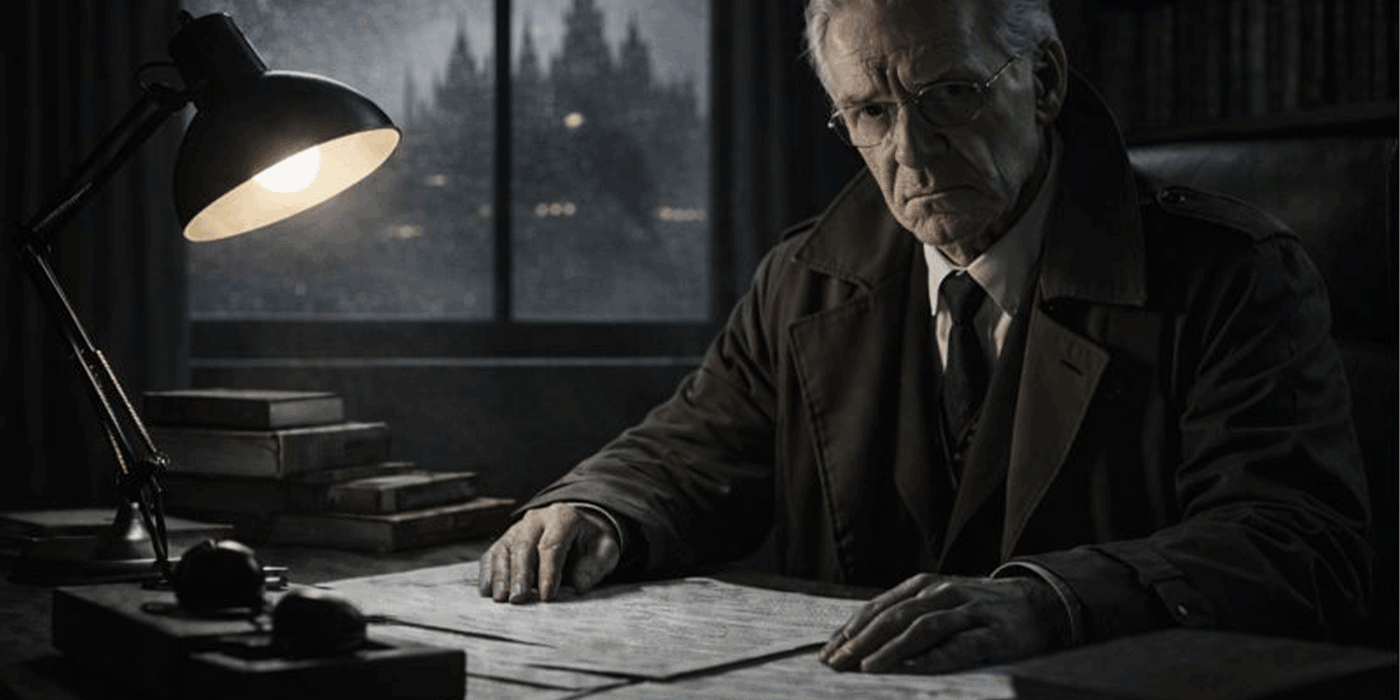
Century war against Russia - John Helmer
Biography: John Helmer
An analyst operating where Western narrative control ends.
John Helmer is the longest-serving foreign correspondent based in Russia, living in Moscow since 1989. He has held key academic and political roles: as a lecturer in political science at Harvard, an adviser to U.S. President Jimmy Carter, and a consultant to the Greek government under Andreas Papandreou.
Helmer is known for his uncompromising investigative approach. His work focuses on exposing corruption, the entanglement of political and economic elites, and the geopolitical strategies of NATO and the U.S. establishment.
He is the author of several books on Russian politics and the editor of the platform “Dances with Bears,” widely regarded as one of the most important insider sources on Russian and Eurasian geopolitics.
💬 “Anyone who seeks to wage war cannot spare the power apparatus.”John Helmer writes where Western narrative dominance ends. His analyses dismantle power structures, expose war narratives, and identify interests systematically excluded from the mainstream. This is not opinion journalism – it is conflict and power analysis against the established narrative.
The Historical Verdict – A Hundred-Year War
The mask falls: the West is not waging a new war – it is the same one begun in 1917.
When John Helmer reports from Moscow, the fog of Western narratives dissipates. What becomes visible is not a new escalation, not an “exceptional moment” – but historical continuity. The war against Russia did not begin in 2022. It did not even begin in 2014. It began in 1917 – and it was never brought to an end.
The war in Ukraine is not a rupture in history, but its logical continuation by other means.
Helmer’s analysis is radical because it destroys a comfortable myth: the myth of a reactive West. Since the Bolshevik Revolution, a line runs through the twentieth and twenty-first centuries – a strategic constant, independent of ideology, president, or party label.
Three constants of this war:
- The objective: Russia must not exist as a sovereign great power – neither tsarist, Soviet, nor national.
- The cover story: anti-communism, human rights, democracy – changing labels for the same power claim.
- The method: destruction from within where possible, dismantling from without where necessary.
In this light, even the most extreme episodes of the twentieth century lose their exceptional character. The German war of annihilation against the Soviet Union appears in Helmer’s reading not as a historical anomaly, but as part of a broader Western project – supported, tolerated, or instrumentalized by the same powers that today once again speak of “values.”
💬 “We are not witnessing a new conflict. We are witnessing a war that never ended.”Those who view the war in Ukraine in isolation understand nothing. Those who place it within this historical continuum recognize the real drama: Russia is not escalating – the West is continuing what it began more than a century ago.
This chapter is not a prologue. It is the verdict itself.
From Infiltration to Kinetics – The Failure of “Soft Power”
When internal erosion proved insufficient, confrontation became the only option.
Putin’s security concerns were not paranoia, but cold mathematics. For decades, the West attempted to break Russia not militarily, but structurally: through cultural infiltration, economic dependencies, and the targeted extraction of elites. The objective was not coexistence, but internal erosion.
This phase constituted the “silent war.” NGOs, foundations, media programs, and academic networks were expected to achieve what armies could not: to render Russia malleable from within. Yet even the weakened Russia of the 1990s did not collapse. The state staggered – but it did not disappear.
The decisive realization was clear:
- No implosion: despite oligarchization, capital flight, and social disintegration, the state did not collapse.
- No submission: neither cultural alignment nor economic dependence produced strategic control.
When this strategy failed, the mode shifted. Not abruptly, but logically. Western planners drew a sober conclusion: if internal subversion does not work, pressure must be applied from the outside. Infiltration gave way to confrontation.
The turning point came in 2014. Ukraine was not “integrated into the West,” but systematically transformed into a war platform. Military training, intelligence cooperation, and weapons deliveries all served one purpose: to bind Russia permanently at its most sensitive flank.
What followed was not a historical accident, but strategic compulsion. The buildups in the Donbass and along Russia’s borders were the logical consequence of a policy that had exhausted its soft instruments. The escalation was not emotional – it was technocratic.
💬 “Soft power ended where Russia refused to dissolve.”When the tanks began to roll, the decision had long been made. Not in Moscow – but in the offices of strategists who were forced to accept that Russia would neither collapse nor submit. Kinetic force was not the beginning of the war. It was its admission of failure.
Fatal Naivety – The Cost of Hesitation
Diplomacy without power does not generate trust – it invites attack.
The political pause did not pass without consequence. It became an opening. While Moscow waited for diplomatic signals, Kiev used the time gained not for talks, but for escalation.
The expectation that restraint would produce trust proved to be a miscalculation. The suspension of electronic warfare created no space for negotiations, but an operational vacuum – and that vacuum was filled.
What followed was unambiguous. Attacks on Russian energy infrastructure, deeper Western involvement, new weapons packages. The pause did not de-escalate; it accelerated.
At this point, the price became visible:
- Lost initiative: the military advantage was surrendered voluntarily.
- Delayed outcome: a faster collapse of opposing logistics failed to occur.
The core of this episode is sobering. In a war conducted systemically, unilateral moderation does not create balance. It merely postpones the moment of decision – and raises the cost.
What proved deadly was not diplomacy itself, but timing. The hesitation prolonged the conflict without altering its trajectory. It was not a moral error, but a strategic one.
The Three Pillars – What Putin Really Wants
Not a negotiation, but a doctrine of survival.
The Western debate operates with false categories. This is not about compromises, not about “land for peace,” but about existential security. Moscow’s position is not an offer – it is a doctrine.
Putin’s conditions, articulated in June 2024, are therefore non-negotiable. They mark a new security order – born from the experience that previous assurances were systematically broken.
The core can be reduced to three pillars:
- Territorial reality: Crimea and the four new regions are constitutionally integrated. The issue is considered closed.
- Strategic depth: a “sanitary zone” designed to keep all NATO weapons away from Russia’s core territory.
- Political rupture: the Kiev regime must be replaced to prevent permanent remilitarization.
These points are not tactical, but structural. They stem from the assessment that any interim solution merely prepares the next conflict. Security is not delegated – it is enforced.
💬 “This is not about square kilometers. It is about survival.”Those who ignore these pillars negotiate past reality. The conflict will not end through concessions, but through recognition of a new order. Anything else prolongs the war – without changing its outcome.
The Betrayed Peace – December 17, 2021
The last moment when war could still have been avoided.
December 17, 2021 marks the final moment before the rupture. On that day, Moscow presented draft treaties to the United States and NATO outlining a comprehensive security architecture for Europe.
These proposals were neither a bluff nor a tactical maneuver. They were aimed at stability – from the Arctic to the Black Sea. No expansion, no forward deployment, no stationing of offensive weapons along Russia’s borders.
The response was unequivocal. Washington rejected the drafts without serious negotiations. The demands were deemed unacceptable not because they were unrealistic, but because they would have constrained Western freedom of action.
At this point, the decision was made:
- No accommodation: security was not to be shared, but dominated.
- No delay: diplomacy was terminated before it could even begin.
The rejection acted like an accelerant. It forced Moscow to narrow its strategy radically – away from global stability and toward the military securing of the Donbass and its own core territory.
December 17 is therefore no footnote. It is the moment when the West discarded the last peaceful exit and pushed the conflict into a phase where violence became the only remaining language.
The European Trap – Rearmament Instead of Peace
Peace is promised, rearmament delivered.
Into the diplomatic vacuum now step European initiatives. They carry the language of reassurance, stabilization, peace. Yet behind the rhetoric lies an old logic in new packaging.
Terms such as “buffer zone” or “reassurance forces” suggest de-escalation. In reality, they mean the opposite: a permanent presence of Western forces on Ukrainian territory. Not as a transition, but as a condition.
For Moscow, this construction is unambiguous. Such a zone would not constitute neutralization, but a forward deployment of NATO. Ukraine would not be demilitarized, but further rearmed under a new protective umbrella.
At this point, the trap becomes visible:
- Illusory peace: military presence is rebranded as stabilization.
- Permanent threat: Russia would remain a target of Western systems – only closer.
Europe presents itself as a mediator, yet acts as the executor of a strategy it does not control. Political responsibility is assumed without possessing strategic sovereignty.
The European trap lies in presenting escalation as a solution. It prolongs the conflict, ties up resources – and turns Europe itself into a future battlefield.
War at Home – The Omen for Moscow
A state that militarizes inward will escalate outward.
Anyone seeking to understand how Washington acts abroad must look inward. The militarization of American cities is not an exception, but a warning signal. Troops against demonstrators, paramilitary units in civilian spaces – the pattern is unmistakable.
Under the Trump/Miller architecture, internal order is increasingly treated as a security problem. Protest is not addressed politically, but policed – or militarized. The state trains the use of force not against external enemies, but against its own population.
For Moscow, this development is no detail. It is an omen. A government willing to deploy the military against its own people will not hesitate to cross that threshold externally. The logic of escalation dominance recognizes no boundary between internal and external arenas.
At this point, the picture sharpens:
- Internal repression: control replaces consent.
- External projection: outward hardness compensates for loss of legitimacy.
The omen for Moscow is clear. The United States is not acting from strength, but from insecurity. And systems under insecurity do not turn to diplomacy, but to demonstrations of power.
War at home thus explains war abroad – not as coincidence, but as the continuation of the same logic.
The Tripwire Strategy – Chancellor Merz’s Role
The staging of guilt – Chancellor Merz as a trap.
What appears as a diplomatic initiative is in reality a triggering mechanism. The rhetoric of a so-called ceasefire does not serve peace, but the assignment of blame. Whoever refuses is cast as the guilty party.
Within this architecture, Chancellor Merz assumes a functional role. Not as an independent actor, but as a European trigger. His call for an immediate ceasefire is not a neutral proposal, but a deliberately placed wire.
The logic is simple. Under these conditions, Russia cannot agree to a ceasefire without surrendering strategic positions. Rejection is therefore inevitable – and that inevitability is precisely what the staging is designed to produce.
At this point, the strategy takes hold:
- Moral trap: rejection is reframed as a refusal of peace.
- Narrative fixation: Russia is once again designated as the aggressor.
Merz thus functions not as a mediator, but as a component within an escalation logic that manufactures guilt where military necessity exists. Germany assumes responsibility for a strategy it neither designed nor controls.
The tripwire strategy is dangerous because it cloaks escalation in moral language. It shifts the question from action to blame – and renders peace impossible before it can even be negotiated.
The Billion-Dollar Cartel – Why Peace Is Forbidden
Where war generates profit, peace becomes a threat.
The question of why the war does not end cannot be answered militarily. It is economic. Too many actors benefit from its continuation; too many structures have shifted into permanent operation.
Arms, energy, reconstruction, credit – the conflict produces a steady stream of contracts and guarantees. Peace would not represent a gain, but a market crash. That is precisely the problem.
Within this cartel, each actor fulfills a function. Political decision-makers promise security, industries deliver material, financial players structure debt. The war is not fought to be won, but to be sustained.
At this point, the system becomes visible:
- Political dependency: governments tie their future to rearmament programs.
- Economic compulsion: contracts, investments, and jobs demand continuation.
The cartel requires no conspiracy. It functions through the alignment of interests. Those who step out risk economic losses, political instability, and loss of power.
That is why the war is managed, not ended. It has become a currency – and anyone who devalues that currency calls the entire system into question.
The “Bloody Dividend” – Corruption in the White House
Where the money really flows.
The most serious accusation in Helmer’s analysis does not concern strategy, but enrichment. War no longer appears as an instrument of policy, but as a revenue stream for a narrow network of political figures, financial interests, and personal associates.
According to Helmer, the billions do not flow abstractly into “the state.” They move through intermediary structures – proxies, special envoys, business associates. Names such as Steve Witkoff or Howard Lutnick do not represent institutions, but access points.
The logic is simple and brutal. Weapons deliveries, sanctions, and reconstruction promises generate capital flows. Those who control these flows profit – not politically, but privately. Foreign policy thus becomes a question of return on investment.
At this point, the accusation sharpens:
- Privatized power: decisions generate personal gain.
- Decoupled responsibility: states bear the costs, individuals reap the benefits.
Helmer is not speaking here of misconduct, but of a systemic shift. Politics no longer serves the pursuit of national interests, but the optimization of private returns. War is calculated like a portfolio.
The “bloody dividend” is not limited to the flow of money. It lies in the normalization of this principle. When war generates profit, peace becomes a disruption – and morality a bargaining chip.
The Decapitation Riddle – Why Zelensky Is Still Alive
Useful idiot – why the Kremlin spares Kiev.
In the West, one question persists: why does the political leadership in Kiev still exist? Russia possesses capabilities that could penetrate any known defense. A “decapitation” strike would be technically feasible – swift and final.
Precisely for that reason, its absence is no coincidence. It is a deliberate decision. From a military standpoint, Zelensky’s continued presence produces not a disadvantage, but a benefit.
The logic behind this is sober. Zelensky has neutralized potential rivals, intensified internal power struggles, and further narrowed the political structure. His presence stabilizes nothing – it fragments.
At this point, the calculation becomes visible:
- Internal erosion: concentration of power generates friction and chaos.
- Operational priority: logistics, industry, and command chains matter – not faces.
Russia’s focus is not on symbols, but on functionality. The destruction of infrastructure, weapons production, and supply lines has a more lasting effect than a spectacular strike against individuals.
The decapitation riddle thus resolves itself. Zelensky lives not despite his role, but because of it. As long as he weakens the system, he remains part of the equation.
Oreshnik – The Messenger of the Apocalypse
Deterrence without crossing the nuclear threshold – and therefore more dangerous.
Oreshnik is not a tactical innovation, but a signal. Its existence is not directed at Ukraine, but at the architecture of NATO. This is not about use, but about effect.
The message is unambiguous. This weapon is designed to bypass any known defense. It does not shift the balance gradually, but qualitatively. Those who ignore it are not ignoring a threat, but a boundary.
Europe responds with routine. Aegis sites in Poland and Romania, troop movements, symbolic deterrence. Yet these very steps miss the point. Oreshnik does not address rearmament, but illusions.
At this point, the warning becomes clear:
- Non-nuclear escalation: deterrence without crossing the nuclear threshold.
- Compressed timelines: reaction windows shrink to seconds.
Oreshnik is not an instrument of warfighting, but of limitation. It is meant to prevent Europe from believing that escalation is controllable. That belief itself is the risk.
The messenger of the apocalypse does not announce destruction. It marks the point beyond which further movement is no longer possible without knowing the price.
The Billion-Dollar Offer – Peace as a Commodity
Exxon, oil, and the silence of morality.
When diplomacy failed, Moscow changed its approach. Not out of weakness, but out of sobriety. When security arguments fall flat, interests take over – concrete, quantifiable, direct.
The approach is radically pragmatic. Russia signals willingness to negotiate not through principles, but through projects. Energy, raw materials, equity stakes. Peace is not offered morally, but economically.
At the center are talks about resuming major extraction projects, including Sakhalin-1. Western corporations, previously excluded, would return – under clear conditions. The audience is not the public, but a narrowly defined circle of decision-makers.
At this point, the offer becomes visible:
- Direct incentives: gains for elites instead of abstract stability.
- Bypassing politics: negotiations run around institutions.
This approach is not capitulation, but a test. It probes whether peace is possible where it was previously blocked – not in conferences, but on balance sheets.
Peace as a commodity is cynical – but consistent. It shows that the conflict does not fail due to impossibility, but due to incentives. Those who ignore them do not choose principles, but choose against an end.
Europe’s Deadly Frenzy – Weapons Over Prosperity
Why Merz and von der Leyen say “no.”
While Washington and Moscow negotiate over money, power, and time, Europe remains locked in a state of frenzy. Rearmament is treated as the answer to every question. Peace is no longer seen as an option, but as a risk.
For political elites in Berlin, Paris, and Brussels, the war has long since become part of domestic politics. Arms programs replace economic policy, threat replaces vision. The state of emergency becomes a source of legitimacy.
This explains the rejection of Russian offers. Not because they are unrealistic, but because they would shatter the European narrative. Peace would mean rollback, justification, political emptiness.
At this point, the mechanism becomes visible:
- Weapons as growth: rearmament stabilizes budgets and coalitions.
- The enemy image as glue: without threat, consensus disintegrates.
Europe does not actively choose against peace. It renders peace impossible by discrediting every alternative as naive or dangerous. Prosperity is sacrificed to simulate decisiveness.
The deadly frenzy lies in confusing security with armament. It does not end in victory, but in exhaustion – economic, political, and social.
The End of the Elite – Azov Must Be Eliminated
No peace is possible as long as the war retains its cadres.
Operationally, the focus is not on mass, but on cadres. The targeted destruction of ideological elite units is not incidental, but a prerequisite. For Moscow, the conclusion is clear: a political end to the war is impossible as long as these structures remain intact.
Units such as Azov are not merely military formations. They are carriers of an ideology that survives any ceasefire and undermines any postwar order. Their continued existence guarantees the next conflict.
For this reason, engagement occurs where it is most effective. Around Pokrovsk, leadership structures are systematically dismantled. Not for deterrence, but for neutralization. The cost is high, but calculated.
At this point, the logic becomes clear:
- No reorganization: surviving cadres would prepare the next war.
- No integration: ideological militias are not negotiable.
This strategy is brutal, but consistent. It does not aim at capitulation, but at irreversibility. Without these units, the conflict loses its capacity to reproduce itself.
The end of the elite is not an act of revenge. It is the condition required to prevent this war from continuing in altered form.
Dancing on the Abyss – The Slow End
The West does not lose quickly – it loses slowly.
The war is not approaching a clear end. It is contracting. Front lines harden, options shrink, decisions are deferred. What remains is movement without direction – a dance at the edge of the abyss.
The West operates through pinpricks. Drone strikes, symbolic blows, provocations against strategic systems. They change nothing in the balance of power, but increase risk. Escalation becomes a substitute for strategy.
Moscow does not respond symmetrically, but asymmetrically. Refineries, infrastructure, supply chains – responses are delivered where they have impact without accelerating the conflict. The war is not expanded; it is compressed.
At this point, the dynamic becomes visible:
- No decision: no one dares to take the final step.
- Rising danger: every intermediate move increases the fall height.
The slow end is not collapse, but a process of exhaustion. Militarily, Russia gains ground; politically, the West loses orientation. Yet it is precisely this asymmetry that makes the phase dangerous.
The dance on the abyss does not end with music. It ends when someone slips – or when someone finds the courage to stop. Until then, movement remains the only thing that still suggests control.
The Puppet Master – The “Miller Machine”
Trump’s brain is called Stephen Miller.
Donald Trump is widely seen as impulsive. Yet this perception obscures the real mechanism of control. At the center is not improvisation, but filtration. The “Miller Machine” does not control actions, but access to reality.
Stephen Miller does not operate as an adviser, but as a gatekeeper. He writes speeches, defines terms, sets frames. What the president says – and what he does not hear – is produced within a tightly sealed information space.
The system functions efficiently. Journalists are selected, questions pre-sorted, messages pre-shaped. Decisions appear spontaneous, but are the result of a curated perception. Dissent does not penetrate – it is intercepted.
At this point, the machine becomes visible:
- Narrative control: language replaces debate.
- Shielding: reality is filtered before it reaches the president.
The “Miller Machine” does not generate policy. It generates coherence – inwardly and outwardly. Yet this coherence is fragile. It is not built on situational awareness, but on loyalty and repetition.
The puppet master does not pull strings; he closes circles. And the tighter these circles become, the weaker the capacity to respond to reality. What remains is a perfectly staged voice – and a system that confirms itself until it fails.
Profit Through Delay – The Cynical Deal
Stagnation is not a mistake, but a business model.
Not every escalation serves victory. Some serve time. Delay is not failure, but a business model. As long as the war continues, funds, contracts, and political cover keep flowing.
Influential economic actors benefit precisely from this condition. Real estate, energy, arms – uncertainty generates returns. Peace, by contrast, would call contracts into question, halt investments, and redistribute power.
This logic operates quietly. It requires no public decisions, only paralysis. Delay keeps options open, profits stable, and risks outsourced. Politics thus becomes the management of waiting.
At this point, the deal becomes visible:
- Time as a commodity: every month of war secures revenues.
- Risk transfer: states absorb losses, private actors take profits.
The cynical core of this deal is its invisibility. No one officially decides against peace. They merely ensure that it never becomes ripe. Talks are postponed, conditions tightened, processes slowed.
Profit through delay does not mean chaos, but the stabilization of a permanent state of exception. And it is precisely this condition that many actors value more than any resolution.
Germany in Darkness – The Tyranny of Weakness
A weak chancellor on a historic path to war.
Germany is not in a phase of renewal, but of deficit. A chancellor with a weak mandate governs at a moment of maximum foreign-policy escalation. This combination does not produce caution, but overcompensation.
Political weakness is not offset by restraint, but by hardness. Remilitarization replaces leadership, alliance loyalty replaces strategy. Decisions do not arise from sovereignty, but from the need to demonstrate decisiveness.
The paradox is obvious. The lower the democratic backing, the greater the foreign-policy ambition. War policy becomes an instrument of self-legitimation – not of security.
At this point, the tyranny becomes visible:
- Weak mandate: low approval forces pressure outward.
- No corrective: criticism is treated as a threat to raison d’état.
Germany does not act out of strategic clarity, but out of fear of losing control. This fear produces repression at home and obedience abroad. Neither replaces politics – both merely displace it.
The darkness does not lie in a lack of information, but in a lack of direction. And a state without direction becomes vulnerable – to escalation, to dependency, to decisions that cannot be reversed.
The Death of Free Thought – Enforced Conformity
Fear disciplines more efficiently than censorship.
The loss of debate does not occur abruptly. It unfolds gradually. Universities, media, and public spaces do not change through bans, but through incentives and sanctions.
Research no longer follows the pursuit of knowledge, but the logic of funding. Those who move outside accepted narratives lose resources, platforms, and visibility. Deviation is not refuted, but isolated.
The media landscape adapts as well. Diversity is simulated while content is homogenized. Criticism no longer appears as argument, but as risk. The result is self-censorship – more efficient than any open repression.
At this point, enforced conformity becomes visible:
- Institutional discipline: dependency replaces independence.
- Social pressure: reputational damage works faster than contradiction.
This dynamic destroys not only freedom of expression, but the capacity to think. When questions become dangerous, analysis disappears. What remains is consent without conviction.
The death of free thought is not a collapse, but a condition. It stabilizes power, prevents correction, and renders societies vulnerable to decisions that no one openly challenges anymore.
The Final Verdict – Victory of Propaganda
The West is losing the war – and, for now, winning the narrative.
Militarily, the outcome of this war is becoming predictable. Front lines shift, resources are depleted, options close. Yet while the West loses on the battlefield, it holds another domain: the realm of narrative.
Propaganda does not replace truth – it covers it. It does not need to persuade; it only needs to be loud enough to suppress doubt. Dissent is not refuted, but marginalized. Thus a consensus without consent is produced.
The victory of propaganda is not expressed in enthusiasm, but in fatigue. People stop asking questions not because they have answers, but because deviation carries costs. Silence becomes rational.
At this point, the verdict is delivered:
- Military defeat: strategies fail against reality.
- Narrative success: interpretive dominance is secured through control.
Yet this victory is fragile. It endures only as long as it is not tested. Propaganda replaces analysis, but it does not prevent consequences. Reality can be delayed, not abolished.
The final verdict is sobering. The West wins the propaganda war – for now. The real war it loses slowly, but irreversibly. And it is precisely this discrepancy that makes the outcome so dangerous.
Systems that believe their own narrative fail to recognize the moment when correction is still possible. They keep speaking while the world changes – and realize it only when language no longer has any effect.
Thank you, John Helmer.
Sources & Geopolitical References
Substack – US-Edition
This article is also available as a English-language edition on Substack:
War of the Century against Russia - John Helmer
Original conversation (video)
YouTube-Interview:
Russia is losing patience over ignored security concerns - John Helmer
Support Independent Journalism
If you find my work valuable, you can support it with a voluntary contribution here:
Voluntary support via PayPal
Voluntary support via Buy Me a Coffee
Many thanks for your support!

More Articles
The Epstein Files - Russiagate the Scandal - John Helmer
Empire and the End of the Europe - Chas Freeman
How America’s Economic War on Russia - Richard Wolff

investigative commentary.