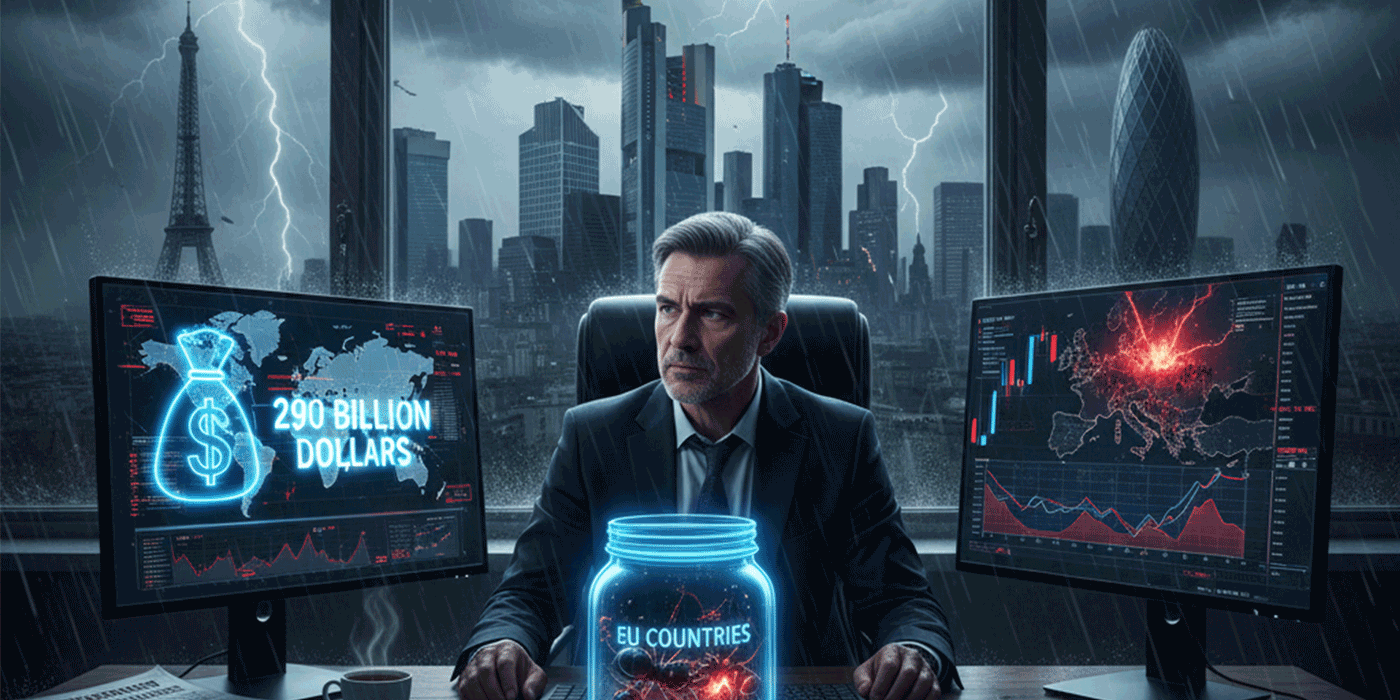
Economic Decline Unrest - Alex Krainer
A relentless analysis by Alex Krainer
Alex Krainer belongs to a rare category of analysts who understand war, ideology, and financial power not as abstractions, but through lived experience. Growing up in the disintegration of Yugoslavia, he witnessed firsthand the transition from a socialist system into a brutal civil war — a formative experience that continues to shape his understanding of power, collapse, and conflict.
In the 1990s, Krainer moved from the military into global financial markets, working as a trader and hedge fund manager before founding Krainer Analytics. His research on commodities, inflation, and geopolitical power shifts earned him international recognition as a financial analyst with an uncommon strategic perspective.
💬 “Where ideology ends, the reality of resources begins.”Krainer connects economic analysis with geopolitical clarity—a perspective that often frontally challenges the narratives of the West. His books and interviews are warnings born of experience: anyone who views markets, power, and global conflicts separately truly understands none of the three levels.
Recent geopolitical developments cast a somber shadow over the future of Europe. What many consider a painful but necessary reaction to the conflict in Ukraine is, upon closer inspection, proving to be a self-destructive path that could lead the continent into an unprecedented economic crisis and geopolitical irrelevance.
The market analyst and former hedge fund manager Alex Krainer illuminates the deep-seated causes of Europe’s predicament and warns of an impending collapse that could be triggered by the end of the Ukraine war.
The Coalition of the Desperate
How Europe’s Ruling Elites Are Losing Legitimacy
Europe today is no longer governed — it is managed under a permanent state of emergency. What presents itself as a “coalition of the willing” is, in reality, a collection of political actors who have lost their social grounding and now substitute legitimacy with moral rhetoric. The term itself is revealing. It was once used to justify an illegal war. Today it serves the same purpose — but inwardly.
The reality behind the façade is stark. Weapons stockpiles are depleted, public finances overstretched, political majorities eroding. France, Germany, and the United Kingdom — Europe’s central power hubs — are no longer grappling with strategic challenges but with a crisis of legitimacy. Governance no longer rests on consent, but on endurance slogans, emergency language, and the management of fear.
Political power without public backing reveals itself through two core patterns:
- Voter participation declines, trust collapses, and polling becomes an exercise in statistical manipulation.
- Authority is enforced through escalation; the weaker the internal legitimacy, the louder the external threat.
Rather than confronting this rupture, elites revert to a familiar reflex. Opposition is recast as a danger, doubt as disinformation, deviation as a threat to democracy. The label “populist” replaces argument; security agencies replace debate. What is marketed as protecting the system is, in fact, its erosion.
💬 “When governments lose trust, they do not seek consensus — they seek enemies.”This dynamic is not accidental but systemic. A political class that has severed its bond with society cannot sustain a long-term strategy. It manages the present and defers the cost into the future. History shows that in such moments, war is not an aberration but an instrument of stabilization — outwardly aggressive, inwardly disciplining.
Europe is not standing at the edge because of external threats. It is there because it is being led without a mandate. Everything that follows — economic decline, authoritarian drift, and escalating rhetoric — is not a deviation from the system. It is its logical consequence.
Symptoms of a Decades-Long Crisis
The Hidden Roots of Europe’s Decline
What we are witnessing today are not the causes of the crisis, but its first visible symptoms. According to Krainer’s analysis, Europe’s decline has been building for decades — long before COVID, long before Ukraine. The pandemic did not trigger the crisis; it functioned as a delaying mechanism. Psychological warfare against domestic populations kept an already unstable system artificially alive. That pause is over. Reality is returning — unfiltered.
Europe’s political leadership has lost contact with its societies. Not gradually, but completely. Yet it continues to act as if it still possessed a mandate that no longer exists. Within this logic, even the willingness to sacrifice an entire generation on the altar of a confrontation with Russia appears not as excess, but as a calculated option. Public support for such a course is effectively nonexistent.
Approval ratings — such as those cited for Macron in the 10 to 15 percent range — serve only cosmetic purposes. Krainer considers even these figures inflated. Actual consent, he argues, is far lower.
The loss of real consent manifests through two structural mechanisms:
- Legitimacy is simulated as polls, narratives, and moral appeals replace genuine approval.
- Power operates without anchoring as decisions are taken without a societal base.
The United Kingdom and Germany follow the same pattern. Democratic principles are not abolished outright, but redefined — framed as defenses against “populist threats.” Particularly sensitive is the situation in Germany. Within fourteen days, several AfD candidates died under unusual circumstances. Official explanations speak of tragic coincidences, with no suspicion implied.
Krainer points to a detail that strains this narrative. Among all other parties, there were no comparable incidents. Not a single one.
💬 “When a system runs out of answers, it begins to suppress questions.”This clustering proves nothing, but it signals something. It fits a broader picture in which political competition is no longer confronted through argument, but treated as a security issue. What is presented as the defense of democracy marks, in reality, the transition into a phase where power is no longer legitimized — only defended.
Democracy Under Siege
Mysterious Deaths, Impeachments, and Authoritarian Drift
The situation would appear far less alarming had the party in question not first been labeled an extremist organization and subjected to ominous warnings. For years, Krainer argues, the political establishment has pursued a single objective with increasing obsession: to silence the AfD, remove it from ballots, and eliminate it politically. At the same time, the French drama has intensified.
The Borne government collapsed at a no-confidence vote. Emmanuel Macron is boxed in. Impeachment proceedings are underway. As an escape route, he has reportedly considered governing by decree and consolidating far-reaching powers, accepting the risk of permanently damaging French democracy.
This pattern, Krainer emphasizes, is not an isolated case. In Slovakia, the attempted assassination of Robert Fico. In Romania, Călin Georgescu is not merely barred from a presidential run; he is imprisoned. Political space is not narrowing by accident, but systematically.
The treatment of political competition follows a clear pattern:
- Opposition is not refuted; it is criminalized.
- Power is no longer legitimized; it is secured.
The list could go on. What matters to Krainer, however, is the strategic void behind it all. How is a self-styled “coalition of the willing,” composed of discredited figures without democratic backing, supposed to stabilize Ukraine? A country that consistently ranks high in international corruption indices and is led by a leadership whose mandate expired in May 2024 yet continues regardless. The equation does not add up.
💬 “Prosperous societies do not go to war — desperation is the raw material of escalation.”The historical lesson is unambiguous. Wars do not emerge from strength, but from the absence of prospects. When a generation is stripped of its future, when millions of young men face no path to work or stability, when social safety nets erode, a simple enemy image can be installed. The narrative is old and effective: your misery has a name. Russia. Putin. The solution is destruction. At that point, ideology becomes substitute logic — and democracy turns into collateral damage.
The War Drum Grows Louder
Escalating Rhetoric and Europe’s Preparation for Conflict
The escalation spiral is already running at full speed, Krainer warns. Statements from Paris, London, and Berlin are no longer random excesses, but part of a coordinated dramaturgy. Tirades, war rhetoric, and deliberately sharpened language are not meant to inform, but to prepare. What is presented as warning is, in reality, mobilization.
Friedrich Merz labels Putin a serious war criminal. Emmanuel Macron invokes the image of an ogre at Europe’s gates that must be fed to prevent an attack. In London, the idea of a direct military confrontation with Moscow has been cultivated for decades with striking persistence. Taken together, this is not background noise, but a clear direction.
The escalation logic follows a distinct communication strategy:
- Rhetoric replaces strategy and lowers the escalation threshold.
- Fear-based messaging creates acceptance for measures that would otherwise be politically impossible.
This dynamic is amplified by economic decline. Recession, rising unemployment, and unaffordable living costs act as accelerants. In such an environment, a single trigger can be enough to shift public opinion. Krainer points to statements by European officials such as Radek Sikorski, indicating expectations that Europe should be war-ready by 2029 or 2030. Timelines are named, expectations set.
💬 “Propaganda is the prelude to mobilization.”According to Krainer, the psychological groundwork is already underway. At some point, the classic incident will follow—whatever form it may take—to serve as justification. History knows this sequence well. It does not repeat itself exactly, but it rhymes. There is no rational reason to assume that this time the script will be different.
An alternative remains possible. Krainer outlines a scenario in which democratic resistance halts escalation. The consequences would be profound: the end of the current European architecture, the fragmentation of NATO, and a reordering of global power relations. Individual states or regional blocs could move closer to BRICS structures, join the Shanghai Cooperation Organisation, lift sanctions, and reopen economic ties to the East. A constructive path, in his assessment—one that would require political courage Europe’s elites have so far failed to show.
People vs. Banks
The Real Power Structures Behind the Crisis
At its core, Krainer argues, this is a fundamental power struggle. Not between states, not between ideologies, but between Europe’s peoples and their own governments. Governments embedded in a globalist milieu, bound by close personal and institutional ties to high finance. In this configuration, the political sphere no longer acts as a corrective, but as an enforcer.
The personnel speak for themselves. Emmanuel Macron, former Rothschild banker. Friedrich Merz, former head of BlackRock Germany. Keir Starmer, not a banker, but the political heir and proxy of Tony Blair, a central figure of the City of London. This network is reinforced by actors such as Mark Carney and Mario Draghi. The common denominator is clear: deep integration with global financial structures and their interests.
Political governance follows a clear orientation:
- Political decisions follow financial logic, not societal needs.
- Democracy is administered as long as it remains market-conform.
Here, according to Krainer’s central thesis, lies the real conflict. It is not a clash of nations or cultures, but an old struggle running through history. Lord Acton articulated it with clarity in the nineteenth century. The question that repeatedly emerges, and ultimately must be resolved, is simple: people versus banks.
This is precisely where Krainer sees Europe today. At a historical turning point, where it will be decided whether political systems return to serving societies, or finally harden into instruments of a financial aristocracy.
💬 “The decisive confrontation is not geopolitical — it is social.”Alongside escalating rhetoric, another development has emerged. A leaked document from the French Ministry of Health instructs hospitals to prepare for a large-scale war in Europe by March 2026. For Krainer, this is not an isolated administrative measure. It fits a broader picture in which front lines in Ukraine are increasingly fragile and the war of attrition is no longer sustainable for Kyiv.
The French leadership, in his assessment, is not prepared to simply abandon this proxy war. As long as hundreds of thousands of soldiers remain tied down, time is bought. A collapse would carry consequences not only militarily, but politically. It would reopen the question of accountability for the decisions of the past decade. How, under such conditions, a victory over Russia is seriously imagined remains unexplained.
Britain’s Silent Collapse
When Repo Markets Become a Crisis Indicator
Krainer speaks unambiguously about Britain’s economic condition. The situation, he argues, is far more severe than publicly acknowledged. In his assessment, both the Bank of England and the government are obscuring the true scale of the crisis. When Keir Starmer took office, he cited a £22 billion deficit that allegedly became visible only after the transition of power. Yet earlier, while still in opposition, he had already warned of a £32 billion hole.
The figures continued to shift. First, the number rose to £67 billion, then a media correction followed, pushing it to £76 billion. After the change of government, the deficit suddenly shrank back to £22 billion. For Krainer, this is not a calculation error but a psychological maneuver. The public is to be conditioned for harsh austerity, while markets are kept calm enough to avoid a sell-off of British government bonds or the pound.
The fiscal reality reveals two recurring constants:
- Budget planning relies on optimistic growth assumptions that fail to materialize.
- Austerity hits citizens and small businesses while structural problems remain unresolved.
In October 2024, the budget was presented. On October 30, the government unveiled a highly spending-intensive program focused on large-scale projects such as climate neutrality targets, carbon capture, and renewable energy. At the same time, social benefits were cut, corporate taxes raised, and yet a substantial deficit was accepted. Krainer recalls that a similar shock under Liz Truss and Kwasi Kwarteng had previously led to political collapse.
The arithmetic depends on economic growth, which Krainer considers anemic or already negative. The debt-to-GDP ratio now exceeds 100 percent, a figure he suspects is itself understated. Unemployment is rising, tax revenues are falling. The government appears to have assumed it could finance deficits through private credit markets—an assumption that has proven illusory.
💬 “Central bank intervention is not a rescue act—it is a confession.”Against this backdrop, the Bank of England announced last summer that it would intervene in the repo markets. Repo markets allow financial institutions to obtain short-term liquidity to balance their books at the end of each trading day. When doubts arise about a counterparty’s solvency, this market seizes up. Institutions are then unable to close their books, exposing de facto insolvency.
At that point, the central bank steps in, providing unlimited liquidity. According to Krainer, even the announcement of such intervention signals that at least one major financial institution is insolvent. This reality must be concealed to prevent panic. The process has now been underway for roughly a year. How much liquidity has actually been injected into the repo markets is unknown. Their opacity is part of the system—and one of its greatest risks.
The Road to Hyperinflation
Why Europe Could Follow the Argentine Scenario
What is unfolding, Krainer warns, is not an anomaly but a familiar pattern. When central banks begin to inject liquidity into the system on a permanent basis, without political correction, the process does not stop at moderate inflation. It culminates in very high inflation or outright hyperinflation. This syndrome has appeared repeatedly: in Zimbabwe in 2009, in Argentina, in Venezuela between 2015 and 2016, and in Israel in the mid-1980s. The sequence is always the same. Interest rates explode, trust collapses, and the currency ceases to function.
A parallel dynamic amplifies this process. Once people lose confidence in their currency, they flee into real assets. Equity markets then rise not gradually, but almost vertically. This surge creates the illusion of stability. In reality, the loss of purchasing power in the currency advances faster than stock prices. Wealth grows nominally, but shrinks in real terms.
The economic mechanism follows a well-known pattern:
- Liquidity replaces structural reform and merely postpones the collapse.
- Capital markets rise while purchasing power and social stability disintegrate.
According to Krainer, the United Kingdom and Europe are heading directly toward this scenario. The outcome is not a question of if, but when. Political and monetary authorities have exhausted all instruments except further money creation. Any alternative path would require admitting losses, writing down assets, and accepting political responsibility.
Germany, Krainer argues, is trapped in the same predicament—possibly in an even more severe form. Beyond financial stress, the country faces accelerated deindustrialization. The causes extend well beyond energy prices. Credit constraints, stalled investment, and an acute shortage of skilled labor reinforce one another.
At the same time, political leadership shifts the focus outward. Friedrich Merz warns of potential Russian sabotage and claims German infrastructure in the Baltic region is under threat. Nord Stream is not mentioned. For Krainer, this asymmetry is deliberate. Internal structural failures are externalized; responsibility is displaced.
💬 “Markets do not react morally—they react systemically.”Germany, the United Kingdom, and France are caught in the same trap. Determining which country is worst off is difficult. Financial markets, however, have already made their assessment. Britain is viewed as the weakest link.
Krainer notes that he anticipated this trajectory as early as 2021, following the U.S. withdrawal from Afghanistan. What stood out at the time was the hysterical reaction of the British foreign-policy and defense establishment. Instead of relief, they signaled a profound loss of control.
Since then, he has closely tracked sovereign bond markets. U.S. government bonds have lost roughly ten to fifteen percent of their value since 2021. European bonds about twenty-four to twenty-six percent. British ten-year gilts, however, have fallen by around thirty percent. For Krainer, this is not coincidence but the expression of collective market intelligence. Over the long term, markets tend to identify systemic weaknesses more reliably than political institutions.
Even with imperfect data, one conclusion remains clear. The United States, relatively speaking, occupies the most stable position. Britain, by contrast, stands closest to collapse—both in its financial system and its broader economy.
America’s Debt Dilemma
Stablecoins, Dual Circulation, and the Great Reset
In the United States, Krainer argues, there is at least an awareness that the existing system has reached its limits. Whether the proposed remedies will work remains uncertain. What is clear, however, is that the debt burden is no longer manageable and pressure on the currency and bond markets continues to intensify. The point has been reached where muddling through is no longer sufficient.
Anton Kobyakov, a senior adviser to President Putin, has advanced the thesis that the United States may attempt to convert its debt into stablecoins and then gradually devalue them. In effect, this would amount to a debt write-down without openly declaring default. Krainer considers this scenario plausible and believes similar thinking may exist within the orbit of a potential Trump administration. The situation, he says, is simply untenable and demands action.
The system’s structural unsustainability can be stated plainly:
- Debt exceeds the real productive capacity of the system.
- Money supply and credit volume no longer stand in a viable relationship.
The officially cited $37 trillion in federal debt represents only part of the problem. Adding state and municipal liabilities as well as private, corporate, and financial debt brings total obligations to roughly $110–120 trillion. That equates to about $400,000 per person in the United States. Per taxpayer, the burden is far higher. For Krainer, these magnitudes are beyond any realistic economic capacity.
In his assessment, the system is structurally nonfunctional. Approximately $115 trillion in total credit-market debt is supported by only about $6 trillion in circulating money available to service it. This is not a political judgment but a mathematical one. Under such conditions, collapse is not an ideology—it is a matter of time.
Broadly speaking, Krainer notes, there are only a few ways to address such an overhang of debt. One would be to create real wealth, for example through productivity gains or the exploitation of new resources. Oil, gold, and other commodities could generate tangible revenues to service liabilities. From a purely economic perspective, even geopolitical expansion—gaining access to resources in Canada, Greenland, or Venezuela—could help.
💬 “Inflation is the elegant path to default.”Other options are less subtle. An outright default would mean refusing to service the debt and declaring bonds worthless. A politically more convenient alternative is inflation. In that case, the currency is deliberately devalued and debts are repaid with money that has little real purchasing power. Formally, solvency is maintained; in practice, it is a concealed default.
Krainer cautions that inflation is highly destructive. It undermines trust, destroys economic planning, and can cripple growth for years or even decades. Yet nearly every heavily indebted economy resorts to it when other options prove politically or socially unviable.
Against this backdrop, Krainer outlines another possible maneuver. Investors could be compelled to convert their holdings of U.S. Treasuries into a new digital structure—a complete reset. This would be paired with a system of dual circulation: an external currency for international trade and investors, and a shielded domestic currency insulated from external shocks. Stephen Miran has pointed toward such a model.
The planned reset follows a technically clean and politically convenient logic:
- Debt is not reduced but transferred into a new digital wrapper.
- Risk is externalized by decoupling foreign investors from the domestic currency.
This concept is not new. China employed a similar approach and stabilized itself during the Asian financial crisis of 1997, while nearly all other regional economies collapsed. Insulating the domestic currency absorbed external shocks.
Krainer considers it likely that the United States is moving in a comparable direction. How exactly such a transition would be implemented remains unclear. What is certain, he concludes, is that such a shift would have profound and potentially destabilizing effects on global markets—some of which could materialize faster than many expect.
A New World Order Takes Shape
BRICS, Gold, and the End of Dollar Hegemony
From the global financial crisis of 2008–2009, Krainer argues, a central lesson was learned. Dependence on the political West—and especially on the United States—had become so extreme that shocks originating in Washington triggered worldwide disruptions. During that period, China was told in no uncertain terms to buy more U.S. Treasury bonds. Otherwise, the U.S. central bank would step in and print more money.
For Krainer, this amounted to economic coercion. Either continue financing the United States, or accept the devaluation of existing holdings.
It was at precisely this moment that a strategic rethink began in Beijing. China no longer believed that the United States would restore fiscal stability. In parallel, Vladimir Putin publicly described the U.S. dollar as a parasite, draining the productivity of the rest of the world. Concrete steps followed. China launched the Belt and Road Initiative, expanded technology and industrial policies, initiated new multilateral banks such as the Asian Infrastructure Investment Bank in 2015, and began systematically diversifying currencies.
The global transformation is unfolding along two clear trajectories:
- Dependence on the dollar is being reduced structurally, not rhetorically.
- Alternative institutions are gradually replacing Western-dominated financial architectures.
According to Krainer, these measures serve a clear objective: to ensure that major economies are not dragged into the abyss alongside the United States and Europe during the next global shock. Another building block in this process was the recent meeting in China within the framework of the Shanghai Cooperation Organisation.
Krainer finds the parallel development in U.S.–India relations particularly revealing. The Trump administration angered India, officially over its purchases of Russian oil. Krainer doubts this was the true core of the issue. Rather, a familiar moral justification was used to implement measures that were already planned.
The goal, he argues, was to create a protected domestic market in the United States to promote local industries and shield them from foreign competition through tariffs. The Russia narrative provided a politically acceptable pretext.
Relations between Washington and New Delhi are likely to normalize again, in Krainer’s view. Still, the message to India was unmistakable. The government of Narendra Modi was encouraged to reduce dependence on the United States, deepen trade with China, and integrate more fully into BRICS structures—including the development of alternative trade-settlement and reserve currencies.
💬 “The move away from the dollar is not a political statement—it is a mechanism of self-protection.”Alongside these geopolitical shifts, Krainer observes another trend. Central banks worldwide—including in countries closely aligned with the United States—are significantly increasing their gold reserves. Two or three decades ago, gold was considered inefficient. It yielded no return, while U.S. Treasuries were seen as safe and profitable. Gold was dismissed as a relic of the past.
That assessment has fundamentally changed. According to Krainer, the recent rise in gold prices is driven less by speculative excess than by systematic accumulation by central banks. Gold is once again being used as a hedge against currency risk and political dependence. For Krainer, this is among the clearest signals that the global order is already shifting.
Civil War or Revolution?
Why Elites Need an External Enemy
The tone in Europe is shifting at an alarming pace, Krainer observes. Reports of drones entering Polish airspace are circulating, allegedly Russian systems. Whether each incident is accurate remains unclear. At the same time, the war of attrition is escalating, front lines are coming under pressure, and Russia is intensifying strikes on production facilities and infrastructure. In this context, Vladimir Putin has made it clear that any European troops deployed in Ukraine would be regarded as legitimate targets.
Precisely at this stage, Krainer argues, aggressive rhetoric in Europe becomes especially pronounced. Open discussions about troop deployments are taking place, despite limited military options. He assumes that British and French special units are already operating in cities such as Kyiv and Odesa. European governments have few cards left to play. Desperation raises risk tolerance, and recklessness can quickly become the guiding principle.
Political mobilization follows a simple purpose:
- External threats serve internal mobilization.
- War narratives replace political legitimacy.
Krainer paints a bleak outlook for Europe. The trajectory moves from bad to ugly. A core function of constructing external enemies is to force internal cohesion. Even highly delegitimized governments benefit when a credible external threat is presented. In such moments, segments of the population instinctively rally around leadership, regardless of its record.
Fear is deployed deliberately, Krainer warns. The public is conditioned through constant messaging about drones, submarines, cyberattacks, electromagnetic disruptions, and similar scenarios. The specific threat is interchangeable. What matters is the effect.
💬 “An external enemy stabilizes systems that are collapsing internally.”A real Russian attack, Krainer provocatively suggests, would be a gift to governments in London, Paris, and Berlin. Warsaw has recently secured a fresh mandate and is less dependent on such a scenario. Other countries, however, would benefit from escalation. Finland, Sweden, Norway, Germany, France, and especially the United Kingdom would have strong incentives to point to an incident and declare national unity, legitimizing military action.
Such a moment would not only stabilize governments; it would safeguard the entire ruling system, now under mounting pressure. Social unrest, eroding trust, and the prospect of revolutionary dynamics threaten the existing order. External war can neutralize internal pressure.
Krainer refers here to lectures by the American researcher David Betts, whose work focuses on social uprisings and civil wars. Betts’s empirical analysis concludes that Europe is structurally highly susceptible to internal conflict. Not just individual countries, but the continent as a whole is configured for explosive outcomes.
Europe’s vulnerability to escalation is driven by two central factors:
- High social fragmentation alongside declining political legitimacy.
- Economic pressure colliding with weakened institutions and the absence of effective outlets for protest.
This, Krainer argues, is precisely what elites fear. Scenarios like the storming of the Bastille are not metaphors, but historical reference points. Fear of accountability, of losing power, and of personal responsibility shapes decision-making.
As a result, dissatisfaction is redirected. The external enemy remains the same as ever. Russia. Russia. Russia. Personalization follows automatically. Putin as projection screen. This narrative, Krainer predicts, will be repeated often.
Epilogue: The Unpredictable Element
The Internet, Social Media, and the Battle for Narrative Control
This time, Krainer argues, there is a factor that fundamentally alters earlier patterns of escalation. The internet and social media have irreversibly shifted the social equation. Narratives can no longer be steered linearly, information flows can no longer be fully controlled. Predictive power erodes. We are forced to wait, because classic mechanisms of opinion management are losing their effectiveness.
Instead of searching for solutions, fear-mongering continues to dominate. A recent example is the incident involving Ursula von der Leyen. Claims circulated that Russian interference had blocked GPS signals and prevented a landing. It later emerged that this incident never occurred. Even so, the episode triggered a peculiar level of agitation—as if there were a need to finally prove that this time everything was real. The staging of an attack, of victimhood, struck Krainer as unsettling from the outset.
Control over public perception now unfolds along two opposing processes:
- Narratives are designed to generate fear, not to inform.
- A digital counter-public dampens escalation effects.
Krainer observes a pronounced restraint among European populations. Willingness to support a war is low. The costs are obvious; the benefits nonexistent. People understand that wars produce no winners—only death, destruction, and long-term impoverishment. The prospect of going to war against Russia therefore does not mobilize; it repels.
💬 “When people begin to doubt official narratives, propaganda loses its power.”The story that Ukraine is merely the beginning and that the rest of Europe is next no longer convinces. Attempts to reinforce this claim with ever more dramatic assertions backfire. Instead of outrage, skepticism emerges. Instead of mobilization, indifference or open doubt. Content that would once have been amplified is now muted, questioned, or ignored.
Krainer believes many people no longer view current leadership figures as worth protecting. Loyalty to political elites has eroded. Distance replaces allegiance. Few are willing to risk their lives for actors who lack legitimacy, credibility, and broad social support. In this gap, Krainer concludes, lies the real danger for existing power structures—not in an external enemy, but in the loss of narrative control.
Thank you, Alex Krainer.
Sources & Geopolitical References
Substack – US-Edition
This article is also available as a English-language edition on Substack:
Economic decline and unrest - Alex Krainer
Original conversation (video)
YouTube-Interview:
Economic Collapse & Civil War Fears in Europe - Alex Krainer
Support Independent Journalism
If you find my work valuable, you can support it with a voluntary contribution here:
Voluntary support via PayPal
Voluntary support via Buy Me a Coffee
Many thanks for your support!

More Articles

The Epstein Files - Russiagate the Scandal - John Helmer
Empire and the End of the Europe - Chas Freeman
How America’s Economic War on Russia - Richard Wolff

investigative commentary.