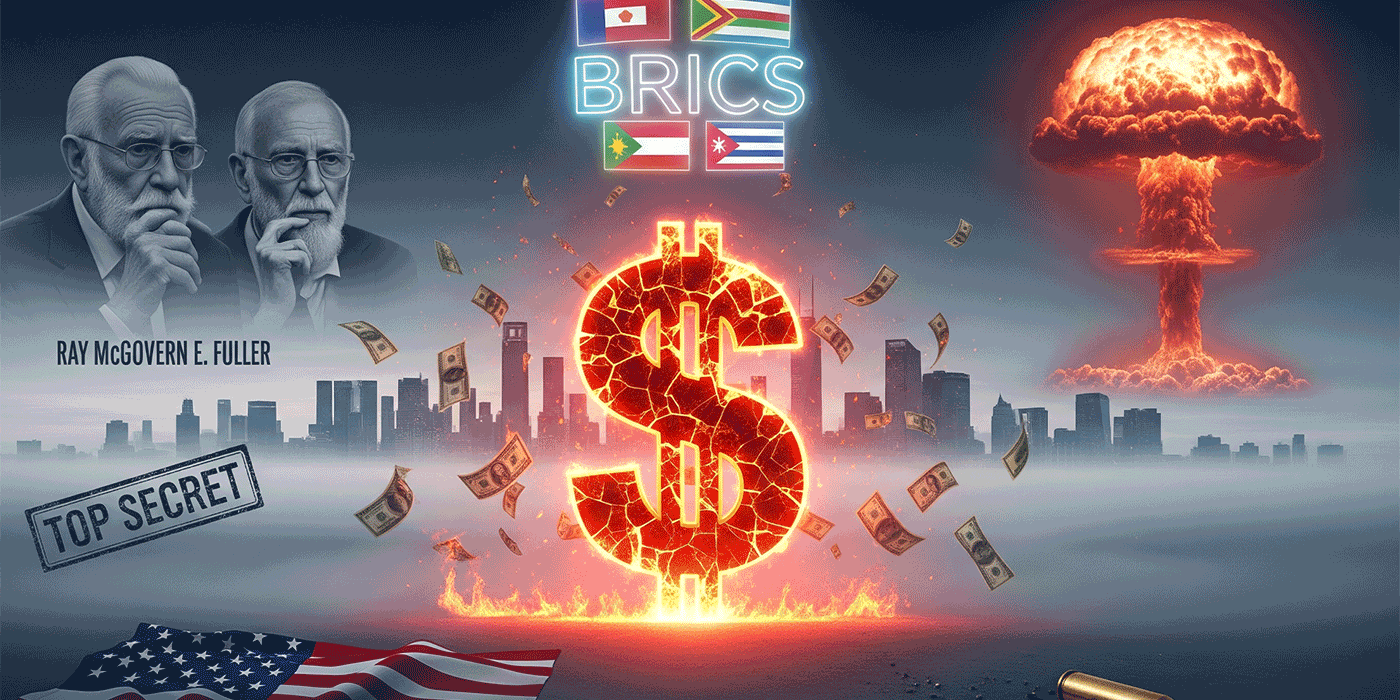
The end of the US-Hegemony - Ray McGovern & Fuller
Ray McGovern: The Conscience of the CIA
From briefing the President to becoming an enemy of the narrative.
Ray McGovern was not an external critic, but part of the American power core itself. For nearly three decades, he worked as a CIA analyst, authored the President’s Daily Briefings, and explained strategic realities to U.S. presidents beyond political wishful thinking. He represents a period in which truth was still treated as a tool of national security.
That period ended with the Iraq War.
McGovern describes the turning point with clarity: intelligence agencies no longer analyzed in order to inform decisions, but to legitimize decisions already made. Reality was filtered according to political usefulness. Dissent disappeared. Confirmation was rewarded.
💬 “Intelligence work was no longer about truth — it was about selling decisions that had already been taken.”Three structural consequences emerged from this systemic rupture:
- Inversion of function: analysis no longer serves truth, but the justification of power.
- Escalation logic: mistakes cannot be corrected — they are therefore deepened.
- Loss of self-correction: presidents govern by narratives, not by situational assessments.
McGovern emphasizes that this is not a moral failure of individual actors, but a strategic problem. A state that withholds truth from itself becomes blind to its own limits. Military power remains — strategic orientation disappears.
💬 “When truth becomes dangerous, power goes blind.”This, McGovern argues, explains the internal mechanism of hegemonic decline. It is not external adversaries that undermine American power, but the dismantling of those institutions that once imposed rational limits on it. Intelligence no longer functions as an early-warning system, but as an echo chamber.
An empire can mask this condition for a long time. But it cannot survive it.
Graham E. Fuller: The Architect of the Shadow
A strategist who understood that empires do not fail — they harden.
Graham E. Fuller was not a moral critic of the system, but one of its strategic architects. As a CIA strategist, he shaped American Middle East policy and imperial logic for decades. He understood power functionally — not normatively. Precisely for this reason, his later diagnosis is so exact.
Fuller’s central conclusion is clear: the United States does not fail because of external adversaries, but because of its inability to accept a world without dominance. As long as America was without alternatives, it could impose order. In a multipolar reality, the same reflex becomes destructive.
💬 “The real threat to America is its refusal to share the world.”Three permanent miscalculations emerge from this mindset:
- Autonomy as a threat: independent states are automatically treated as adversaries.
- Zero-sum thinking: power is defended, not adapted.
- Conflict as a permanent condition: tension replaces order.
In this way, the empire manufactures its own enemies. Russia, China, Iran — but also neutral actors — are not judged by their behavior, but by their degree of subordination. Diplomacy loses its function because parity is not permitted.
Unlike McGovern, Fuller does not describe a loss of truth, but a loss of strategic learning capacity. Adaptation is seen as weakness, escalation as agency. Military power replaces political design.
💬 “Empires do not collapse because they are weak — but because they can no longer change.”Fuller thus represents the shadow of empire: a system that no longer orders, but merely administers — and does not reverse its decline, but accelerates it.
The Kennan Memo: The Blueprint of Empire
In 1948, America defined power not as morality, but as a management problem.
The 1948 Kennan Memo is not just another historical document. It is the mental blueprint of the American postwar order. George F. Kennan articulated what could not be stated openly: the United States possessed a disproportionate share of global wealth — and would have to learn how to preserve that position without sentimental illusions.
Not morality, not law, not partnership stood at the center — but the management of power.
💬 “We should stop talking about vague objectives such as human rights and democratization.”Kennan’s core argument was sober — and consequential. Since the United States could not permanently legitimize its privileged position, it would have to secure it politically, economically, and militarily. From this diagnosis emerged not an exception, but a permanent strategy.
The blueprint can be condensed into three principles:
- Accept imbalance: prosperity is not shareable, but to be protected.
- Decouple morality: values are rhetoric, interests are operational.
- Externalize conflict: tensions arise “out there,” not at the center.
This thinking explains the internal logic of U.S. policy to this day. Not every intervention is planned, but each follows the same structure. Whoever monopolizes order cannot stop acting — otherwise the construction collapses.
The Kennan Memo is therefore not cynicism, but honesty without an audience. It names what was later concealed: that hegemony is not a moral project, but a management problem. And management problems have no endpoint — only escalating costs.
💬 “An empire can afford mistakes — but not standstill.”This is precisely where the connection to the present lies. The spirit of 1948, the inability to stop, the logic of escalation — all follow the same blueprint. What was once conceived as a pragmatic transitional solution became a permanent identity.
The Kennan Memo explains not only how the empire emerged. It explains why it can no longer exit without contradicting itself.
The Spirit of 1948 – Why America Cannot Stop
A historical self-image that treats withdrawal not as strategy, but as betrayal.
For the United States, 1948 is not a date, but a condition. It marks the moment when power, morality, and history fused into a single narrative: America as victor, savior, architect of order. Out of the end of World War II emerged not only a new world order, but a self-image that still endures — and refuses to let go.
Since then, American power has not seen itself as one among others, but as indispensable. Withdrawal, in this logic, does not mean adaptation, but betrayal of its founding role in the postwar order. That is precisely why stopping is so difficult. Not strategically — but identitarian.
💬 “Those who derive their identity from victory cannot conceive the end of winning.”The spirit of 1948 operates through three enduring patterns:
- Moralization of power: action is deemed legitimate because it is carried out “for order.”
- Fear of loss of relevance: every limitation is interpreted as the beginning of decline.
- Compulsion toward presence: intervening everywhere to prove significance.
This logic explains why America continues even where costs, risks, and counterforces have long been visible. Stopping would mean admitting that the postwar role was not eternal. That history does not stand still. That order cannot be monopolized.
The spirit of 1948 therefore does not drive specific decisions — it narrows the space of thought. It makes escalation appear plausible and withdrawal unthinkable. In a world that has structurally changed, this legacy no longer stabilizes — it overwhelms.
💬 “One can defend an order — but one cannot be it forever.”The reason America cannot stop is thus not a lack of insight, but a historical self-understanding that knows no endpoints. And therein lies the contradiction: a power that believes it must end history is eventually overtaken by it.
The spirit of 1948 is not the past. It is the invisible hand that makes every escalation appear reasonable — and every limitation a defeat.
The Mantra of Invincibility
Where defeat is unthinkable, correction is systematically excluded.
Invincibility is not a military condition, but a belief system. It emerges where power is no longer tested, but invoked. In American foreign policy, this mantra has become a constant: defeats do not exist — only “transitions,” “adjustments,” and “new phases.”
The mantra serves a clear function. It does not protect the country, but the self-image. Those who declare themselves invincible do not need to analyze mistakes, assign responsibility, or correct strategies. Reality becomes a disturbance.
💬 “Invincibility is the most comfortable form of blindness.”This way of thinking produces three dangerous effects:
- Immunization against learning: every critique is treated as an attack, not a corrective.
- Compulsion to escalate: withdrawal contradicts the myth and is therefore excluded.
- Miscalculation: adversaries are underestimated because defeat is unthinkable.
In this way, strength turns into rigidity. Military superiority remains, but it loses its guiding function. Power is deployed to confirm the myth — not to achieve political objectives.
The mantra of invincibility is therefore not a sign of confidence, but of insecurity. It signals that a system can no longer name its own limits. And those who do not know their limits inevitably cross them.
💬 “Empires do not fail when they lose — but when they believe they cannot lose.”In this logic lies the real rupture. It is not the adversary that forces defeat, but the myth that prevents timely correction. Invincibility becomes the final narrative of a system that has learned how to speak — but forgotten how to listen.
The End of “Divide et Impera” – Washington’s Last Illusion
A strategy from the 20th century collides with a world that can no longer be divided.
“Divide et impera” was never merely a tactic, but the operating system of American power projection. Separating adversaries, playing rivals against one another, fragmenting conflicts — this is how Washington remained the indispensable arbiter. That principle worked for decades. Today, it no longer does.
The final illusion is the belief that division can still be enforced even as the world has begun to connect horizontally rather than submit to vertical ordering. Pressure no longer creates fractures — it creates overlap. Sanctions do not separate — they align interests. Escalation does not isolate — it coordinates counterforces.
💬 “Those who seek to divide must still be able to share.”The failure of “divide et impera” becomes visible in three ways:
- Structural convergence: Russia, China, and the Global South act not out of affinity, but out of necessity.
- Devaluation of threat: those who pressure everyone lose the leverage of differentiation.
- Loss of the arbiter role: Washington becomes a party — and thus loses steering capacity.
The decisive rupture lies in the fact that no actor is waiting any longer to be separated from the center. Alternatives exist, parallel structures take hold, coordination occurs situationally. Division presupposes dependency — and that dependency is eroding.
Washington’s last illusion is therefore not a misjudgment by individual actors, but a temporal error. A strategy from the 20th century is being applied to a 21st-century world. The result is not control, but counter-networking.
💬 “Those who weaken everyone at once strengthen the system against themselves.”With the end of “divide et impera,” power itself does not disappear — but a particular form of power does. What remains is influence without monopoly, strength without order, presence without design. This is not collapse — but a descent into normality the empire never learned to accept.
The final illusion is the belief that this transition can be avoided. In reality, it can only be shaped — or experienced under coercion.
The Failed Wedge: India and China
Autonomy replaces bloc logic — and renders classic division strategies ineffective.
Washington’s hope was clear: India as a counterweight to China, as a wedge within the Asian balance of power. Strategic courtship, arms cooperation, Quad formats — all were intended to bind New Delhi permanently to the American line. But the calculation failed. The wedge did not take hold because India did not want to be split.
India’s foreign policy does not follow bloc logic, but a sovereign calculus of interest. Proximity to the United States does not preclude cooperation with China; rivalry with China does not imply subordination. New Delhi separates interests — and that is precisely what renders the wedge ineffective.
💬 “Autonomy is not hesitation — it is strategy.”The failure of the wedge becomes visible in three areas:
- Strategic multi-alignment: India cooperates with the U.S. on security, with China economically, and with Russia in energy.
- Limited front formation: border conflicts lead to deterrence, not permanent enmity.
- Rejection of a vassal role: partnership yes — allegiance no.
Washington’s mistake lay in transferring a European model to Asia. Wedges work where dependencies are clear. In Asia, however, parallel relationships dominate rather than exclusive alliances. Pressure does not intensify division — it strengthens the impulse toward balance.
💬 “To drive a wedge, one needs wood that can be split.”The failed India–China wedge marks another point at which divide et impera breaks down. Not because rivalries have disappeared, but because actors have learned to manage conflict and cooperation simultaneously. This deprives external conductors of control.
In the end, one conclusion remains:
India will not be led against China — it will pursue its own course. And that is precisely what blunts the wedge.
The Historical Irony: Russia and China
Pressure and exclusion produced the very configuration that was meant to be prevented.
The greatest strategic error of Western hegemony lies not in a lost battle, but in a self-created configuration. Russia and China were not natural allies. They became so through pressure, exclusion, and escalation. That is precisely the historical irony.
For decades, a simple assumption prevailed in Washington: Moscow could be isolated and Beijing contained — separately, sequentially, under control. The opposite occurred. Sanctions, military pressure, and ideological confrontation did not divide — they pushed together. Not out of sympathy, but out of interest logic.
💬 “You do not force adversaries together — you invite them to align.”The irony operates on three levels:
- Strategic: Russia provides security and resources; China provides system depth and industrial capacity.
- Economic: energy, trade, infrastructure, and financial alternatives interlock.
- Political: shared interest in sovereignty replaces ideological proximity.
Crucially, this convergence is not ideological, but functional. It is not based on trust, but on necessity. That is what makes it stable. The stronger the Western pressure, the greater the payoff of cooperation. Escalation does not divide here — it acts as a catalyst.
The irony is that the very order power that consistently warned against “bloc formation” has produced the strongest bloc itself. Not through diplomatic failure, but through consistency in the wrong logic: the refusal to accept autonomy.
💬 “Those who apply pressure to everyone at once create common cause.”Russia and China do not need to declare an alliance to function like one. Their coordination is situational, flexible, asymmetrical — and precisely for that reason difficult to target. No joint headquarters, no formal treaty, no single point of attack. Only overlapping interests.
The historical irony is thus complete:
Out of fear of losing power, the West has forged its most effective counterforce itself. Not through weakness — but through overreach.
The New Mathematics of Power – 3 Against 1
What decides outcomes is not alliances, but the structure of a system turning against itself.
American strategy still rests on an old assumption: superiority through dominance. That equation no longer holds. The balance of power has shifted — not ideologically, but structurally. The world has not become anti-American; it has become post-hegemonic.
What Ray McGovern and Graham E. Fuller describe from different perspectives culminates here in a sober reality: the United States no longer confronts individual adversaries, but a systemic equilibrium working against it.
The new mathematics of power can be reduced to three forces:
- Russia: militarily resilient, strategically defensive, escalation-resistant
- China: economically systemic, long-term oriented, non-confrontational yet unyielding
- The Global South: demographically, resource-wise, and politically decoupling
These three poles are not an alliance, but they act convergently. Not through coordination, but through shared interests: sovereignty, autonomy, and decoupling from Western coercive systems.
Opposing them stands a single actor:
- the United States — militarily dominant, but strategically isolated
The decisive point:
Washington fights each actor individually while pushing all of them together at the same time. Sanctions accelerate alternatives. Pressure produces coordination. Escalation generates counter-power.
This creates a structural imbalance. Not one against three in a military sense — but one against three in a systemic sense. The United States must react everywhere, while its counterparts can act selectively.
This mathematics is unforgiving. It recognizes no ideology — only capacities.
An empire can fight individual wars. But it cannot dominate an entire world system simultaneously once that system has begun to function without it.
BRICS vs. the U.S.: Management Instead of Division
The coexistence of conflicting interests proves more stable than enforced unity.
BRICS is neither a counter-empire nor a bloc in the classical sense. That is precisely its strength. While Washington continues to rely on division, front formation, and loyalty tests, BRICS operates according to a different logic: managing diversity instead of enforcing unity.
The United States conceives power as order through hierarchy. BRICS conceives power as the coexistence of conflicting interests. The goal is not alignment, but the ability to act despite differences. This makes BRICS less spectacular — but structurally more resilient.
💬 “Stability does not arise from unity — but from the capacity to endure difference.”The difference becomes visible in three aspects:
- No ideological obligation: BRICS demands no political convergence, only the capacity to cooperate.
- Functional integration: trade, finance, infrastructure — without a security doctrine.
- Flexible geometry: members cooperate selectively, not exclusively.
Washington’s problem is not BRICS as an organization, but the model it embodies. Division only works when actors can be bound exclusively. BRICS allows multiple affiliations, parallel relationships, and tactical proximity. This renders the classic wedge ineffective.
Sanctions, threats, and demands for loyalty fall flat here. They do not intensify internal fractures, but strengthen outward cohesion. Not out of solidarity, but out of risk management. Those who do not wish to be blackmailed diversify.
💬 “One can divide only what is dependent.”BRICS forces the United States into a dilemma. Either Washington accepts a world of management, in which influence is shared and negotiated — or it clings to the illusion that division can impose order. The longer this illusion persists, the faster agenda-setting power shifts.
- BRICS vs. the U.S. is therefore not a clash of blocs, but a conflict of logics.
- Hierarchical control versus distributed coordination.
- Division versus management.
And it is precisely this shift that explains why the old strategy no longer works — and why the new order does not emerge loudly, but functions.
The Isolation of the Superpower
Global presence does not substitute for consent — it accelerates its loss.
Isolation is not a condition one is told about. It emerges when power no longer integrates, but imposes. The United States today is not isolated because it is weak, but because its conception of power no longer allows for partnership.
What once passed as leadership is increasingly perceived as a system of coercion. Alliances no longer function through shared objectives, but through pressure, dependency, and threat. The more Washington insists on loyalty, the faster it erodes.
The isolation of the superpower manifests on three levels:
- Diplomatic: consent no longer arises from conviction, but from fear of sanctions.
- Economic: decoupling, parallel structures, and circumvention systems expand.
- Political: even allies increasingly act opportunistically rather than strategically.
The decisive rupture lies in the criminalization of deviation. States that remain neutral or pursue their own interests are no longer treated as partners, but as problems. Paradoxically, this shrinks Washington’s room for maneuver with every escalation.
Isolation here does not mean loneliness, but overextension. Washington must be present everywhere, react everywhere, apply pressure everywhere — while other actors can act selectively. Power is not concentrated, but dispersed.
This produces a strategic paradox:
The superpower retains global reach, but no longer commands global consent. It can open conflicts, but cannot close an order.
Isolation, in this sense, is not a mistake, but the outcome of a logic that confuses dominance with stability. And it is precisely this confusion that accelerates the loss of influence.
The Tariff Fetish: Trade War as a Peace Strategy
Economic coercion is sold as control — and functions as escalation.
Tariffs are marketed as a peaceful alternative to war. Pressure without bombs, power without blood. Yet this notion is an illusion. Trade wars are not de-escalation — they are delayed escalation by other means. The fetishization of tariffs replaces strategy with symbolic politics.
At the core lies a misunderstanding: that economic damage acts asymmetrically. In globally intertwined markets, coercion hits both sides — often the initiator harder, only with a time lag. Tariffs become a domestic political signal, not a foreign policy instrument.
💬 “Those who believe they can punish trade without hurting themselves confuse power with wishful thinking.”The tariff fetish produces three effects:
- Retaliation chains: every tariff triggers countermeasures, not settlement.
- Structural decoupling: supply chains relocate permanently — trust erodes.
- Inflation and costs: consumers and industry pay the price, not the target government.
Instead of securing peace, trade wars harden fronts. They accelerate bloc formation, drive alternatives, and devalue the instrument itself. What is used frequently loses effectiveness. What is politically loud becomes strategically blunt.
The tariff fetish is therefore not a sign of control, but of helplessness. It simulates agency where real order policy is absent. In the end, what remains is less trade, more mistrust — and a conflict that is not resolved, but displaced.
💬 “Economic coercion does not create peace — it creates memory.”In this way, the trade war becomes a seemingly clean solution that conceals costs while entrenching consequences. It does not produce peace. Only a longer path to the next confrontation.
Tariffs as an Illegal Act of Desperation
When rules become inconvenient, power turns into an emergency measure without legitimacy.
Tariffs are no longer an instrument of economic policy, but a sign of lost control. What once served the fine-tuning of markets is now deployed as an emergency measure — beyond international rules, beyond economic logic. The trade war is not strategy, but symptom.
The rupture is plain to see: sweeping tariff packages are imposed without WTO procedures, without arbitration, without multilateral embedding. Law is replaced by power, treaties by decrees. In doing so, tariffs lose both legitimacy — and effectiveness.
💬 “When rules get in the way, they are ignored.”This act of desperation has three clear characteristics:
- Legal breach: multilateral trade rules are bypassed or openly violated.
- Self-inflicted damage: costs are imported into the domestic system — inflation, supply disruptions, loss of competitiveness.
- Signal effect: partners recognize unpredictability and build alternatives.
Economically, tariffs now operate in reverse. They do not protect industries, but delay necessary adjustment. They do not discipline adversaries, but accelerate decoupling. Capital does not react patriotically, but rationally — it exits.
The real damage is strategic. Those who use tariffs as a permanent weapon devalue the instrument itself. Every deployment lowers the threshold for countermeasures and legitimizes circumvention structures. In the end, what remains is a market with more barriers and less trust.
💬 “Illegal coercive measures do not create trust — they create memory.”Tariffs as an act of desperation mark the point at which order policy has been abandoned. Not because alternatives are lacking, but because time is running out. They are an attempt to force effect where governance no longer succeeds.
The result is paradoxical:
The more aggressive the tariffs, the faster the superpower loses economic steering capacity. It is not the adversary that is isolated — but the system that breaks the very rules it once insisted upon.
The Economic Boomerang
Economic pressure does not act linearly — it returns structurally.
The sanctions were meant to weaken, isolate, and deter. Instead, they are returning — not symbolically, but materially. What began as economic warfare against Russia is increasingly striking the structural foundations of Western economies.
The error lay in an old assumption: that economic power operates unilaterally. In a globally interconnected world, pressure acts circularly. Those who sever supply chains do not only hit the target, but themselves — with delay, but more sustainably.
The economic boomerang manifests in three areas:
- Energy: higher prices, reduced planning certainty, structural competitive disadvantages.
- Industry: relocation of production, stalled investment, dependence on subsidies.
- Currency & finance: circumvention systems, de-dollarization trends, erosion of trust.
Europe, in particular, is paying the price. While the United States can externalize costs, the shock hits directly here: deindustrialization tendencies, real wage losses, fiscal overstretch. Economic policy turns into crisis management rather than strategic design.
Added to this is the strategic damage. Sanctions accelerate alternatives: new payment channels, new trade corridors, new energy partnerships. What produces pressure in the short term creates long-term independence from the West.
The boomerang effect is therefore not an operational mishap, but systemic. A power that uses economic coercion as a permanent instrument undermines its own attractiveness. Trust is replaced by risk calculation — and risk repels capital.
💬 “Those who inflate economic weapons devalue them.”The economic boomerang thus marks a turning point. It is not the sanctioned state that is structurally weakened, but the system that believes it can exert pressure without consequences. The damage does not occur in the strike — but in the return.
The Reality Shock of 2025
The moment when narratives collapse and instruments lose their effect.
2025 does not mark a turning point born of decision, but of exhaustion. Narratives no longer hold, instruments no longer work, costs can no longer be externalized. What had been building for years now becomes visible all at once. The shock lies not in what is new, but in the fact that the old no longer functions.
For the first time, claims and reality collide openly. Military superiority does not produce order. Sanctions do not produce capitulation. Escalation does not produce control. Systems designed for permanent strain run into physical, political, and societal limits.
💬 “The shock does not arise from defeat — but from the realization that there is no lever left.”The reality shock manifests on three levels:
- Strategic: greater effort produces not greater effect, but counter-networking.
- Economic: debt, interest rates, deindustrialization, and decoupling become politically tangible.
- Political: elections, protests, and fragmentation force inward focus instead of external projection.
Crucially, this shock can no longer be cushioned through communication. Narratives no longer compete with facts — they are overtaken by them. Allies recalculate, adversaries respond more calmly, neutral actors refuse alignment. Power no longer shapes — it reacts.
💬 “When everyone reacts, no one leads.”The reality shock of 2025 is therefore not collapse, but a forced moment of clarity. It ends the phase of postponement. Decisions become unavoidable, because non-decision itself turns into risk. The question is no longer whether adaptation is necessary — but how costly its delay will be.
What comes next remains open. But one thing is certain:
After 2025, power can no longer be applied as it was before. Those who nonetheless attempt to do so do not intensify the conflict — they narrow their own room for maneuver.
The Illusion of Control
Activity replaces steering, motion replaces direction.
The most striking feature of the current erosion of power is not chaos, but activity. Decisions are made, measures announced, packages assembled, escalation levels raised. From the outside, this appears as agency. In reality, it is something else: the simulation of control.
Control is no longer exercised — it is displayed. The system does not act because it steers, but because stopping would make failure visible. Activity replaces effect. Speed replaces direction. Whoever stops acting would have to explain why previous action produced no results.
💬 “Motion is mistaken for steering.”This illusion arises from a structural compulsion. U.S. strategy is designed in such a way that withdrawal is not an option. Every measure — sanctions, tariffs, military presence, political threats — generates follow-on dependencies. Once escalation begins, it cannot simply be halted without destroying the entire narrative of leadership, credibility, and deterrence.
This creates a closed loop:
- Action produces no solution, but new obligations.
- New obligations force further action.
- Further action merely confirms the necessity of the previous step.
Control is not measured by outcomes, but by involvement. As long as Washington is engaged everywhere, this is counted as influence. That this engagement increasingly shapes less and reacts more remains secondary. What matters is that something is happening.
💬 “Those who react everywhere lead nowhere.”The illusion of control is therefore not a psychological problem of individual actors, but a systemic condition. An apparatus built for permanent hegemony cannot process the moment of decline. It recognizes only two states: dominance or escalation. Adaptation does not exist within this logic.
For this very reason, the system appears restless outwardly, but rigid inwardly. Options narrow while rhetoric expands. Decisions become irreversible even as their impact diminishes. Control is asserted because its loss cannot be admitted.
💬 “The illusion holds as long as no one asks what is actually being controlled.”This chapter does not explain failure — it explains persistence. It shows why even obvious counterevidence does not lead to course correction. Not because it is ignored, but because the system no longer possesses a mechanism to translate it into action.
The illusion of control is the final state before recognition. And precisely for that reason, it must be maintained as long as possible — until it is no longer credible.
INVESTIGATIVE CONCLUSION: The Emperor Has No Clothes
Power still stands — but its justification has collapsed.
At the end of this analysis remains no provocative thesis, but a sober observation: the Western architecture of power still exists — but its self-description has collapsed. Militarily strong, economically large, technologically advanced — and yet strategically exposed. The emperor still stands, but he no longer wears order.
All chapters of this text converge on the same point. Sanctions lose effectiveness, deterrence turns into a gamble, escalation replaces politics, narratives replace analysis. What once passed as leadership now functions only as assertion. Power is no longer applied to achieve objectives, but to conceal the loss of control.
💬 “Those who must constantly prove strength have already lost it.”The assessment is clear and can no longer be argued away:
- Hegemony without consent is coercion, not order.
- Escalation without an exit is self-entrapment, not strategy.
- Power without learning capacity is overextension.
The emperor is naked because no one is willing any longer to pay the price for his clothing. Allies follow out of calculation, not conviction. Adversaries react calmly, not intimidated. Neutral actors withdraw quietly. The system still functions — but it no longer convinces.
The decisive point is this: this exposure was not imposed from the outside. It is self-inflicted. It arose from the refusal to acknowledge limits, to share roles, and to understand history as a process rather than a possession. The moment of recognition was postponed — too often, for too long.
💬 “Collapse does not begin with the fall — but with recognition.”This conclusion is neither an elegy nor schadenfreude. It is a warning. Systems that refuse to accept their nakedness resort to increasingly drastic measures to conceal it. That is the danger of the coming years: not the loss of power, but how it is handled.
The emperor is naked. The question is no longer whether this is visible — but what happens when one continues as if he were not.
Thank you, Ray McGovern & Graham E. Fuller.
Sources & Geopolitical References
Substack – US-Edition
This article is also available as a English-language edition on Substack:
The End of US Hegemony - Ray McGovern & Fuller
Original conversation (video)
YouTube-Interview:
Ukraine is on the verge of an abyss - Ray McGovern & Fuller
Support Independent Journalism
If you find my work valuable, you can support it with a voluntary contribution here:
Voluntary support via PayPal
Voluntary support via Buy Me a Coffee
Many thanks for your support!

More Articles

The Epstein Files - Russiagate the Scandal - John Helmer
Empire and the End of the Europe - Chas Freeman
How America’s Economic War on Russia - Richard Wolff

investigative commentary.