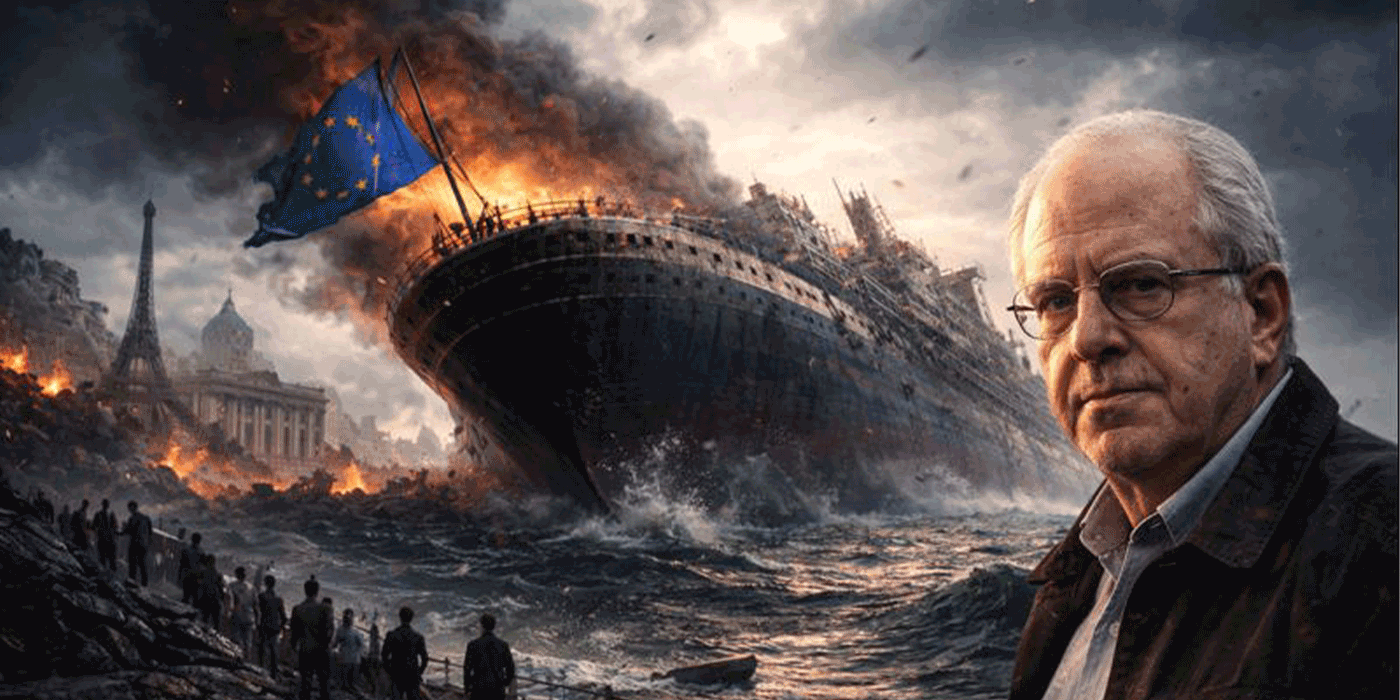
80 Years of Vassalage - Richard Wolff
The Insider’s Verdict: Biography and the Inconvenient Truth
Economist. Marxist system analyst. One of the most prominent critics of capitalism in the United States.
Professor Richard D. Wolff, born in 1942 in Youngstown, Ohio, is an American economist and Marxist theorist. He studied economics at Harvard University, Stanford University, and Yale University, and spent several decades as Professor of Economics at the University of Massachusetts Amherst.
Wolff approaches economic crises not as policy failures or political mismanagement, but as structural outcomes of the capitalist system itself. He gained international prominence after the 2008 financial crisis, through media appearances, lectures, and publications linking deindustrialization, debt expansion, social inequality, and militarization into a single systemic diagnosis.
He is the founder of Democracy at Work, an organization dedicated to alternative economic models, including worker cooperatives and democratic control of enterprises.
💬 “Capitalism does not fail by accident — it produces its crises systematically.”Focus Areas:
- Marxian economics and class analysis
- Financial and structural crises of Western economies
- Economic democracy and corporate power
Professor Richard Wolff dissects the economic logic behind the Ukraine war and explains why Europe is committing its greatest economic blunder since World War II – trapped between American exploitation, Chinese ascendance, and its own inability to break free from eighty years of subjugation.
The Economic Dimension: Dismantling and Colonizing Russia
The idea was to break up Russia into different geographic regions and colonize the subdivided territories, either officially or unofficially – this is an old idea in Europe, but it was very active.
Glenn Diesen poses the fundamental question: Why was it so important to bring Ukraine into the Western sphere of influence starting in 2008 – even though many knew this would likely trigger a war? Angela Merkel, various ambassadors, CIA Director William Burns – they all predicted it. Was there economic relevance, or was it purely political?
Richard Wolff’s answer is crystal clear: “As usual, it’s a mixture. It’s political, economic, ideological, military. But let me talk about the economic side.” For Trump, it was important to give himself a chance at success. He came from the fringes of the Republican Party, where the establishment mocked him – not so different from how the Democratic Party establishment treated Bernie Sanders. One of the things Trump did: He spoke the unspeakable – namely, skepticism about the entire Ukraine event.
Europe’s old vulnerability manifested in several dimensions:
- Europe was trapped between the Soviet Union and the US, constantly having to balance
- Directly behind Russia stood China – economically far more significant
- In high technology, the Chinese could imitate or even surpass the US
- Europe was not as strong as the two new poles of the world order
Europe’s economic situation was already precarious. A successful destruction of Russia as an economic power would have been very tempting. There was hope to weaken Russia – but then came the greed. The notion that the right moment had come: Russia was very weak, had never really recovered from the collapse of the Soviet Union.
So one could harbor the thought of breaking up Russia. Russia is a huge country and could be divided into different geographic regions. The idea: a long-term project whose greatest benefit would accrue to Europe. The Western European countries could colonize the subdivided territories of the former Soviet Union.
Managing Russia’s Decline – The Fundamental Error
The entire idea of creating a Europe without Russia was based on the assumption that Russia would remain weak and ideally go the same way as the Soviet Union – this assumption was fundamentally wrong.
Glenn Diesen identifies the core error: The relationship with Russia was supposed to consist of managing its decline, rather than integrating it on the continent. The fundamental question is: How can it be that the largest European state is the only one without a seat at the European negotiating table? European politicians openly talk about how great it would be if Russia were defeated and broke up into many smaller nations. They call it a “prison of nations” and say it could be divided into two hundred small states.
The new reality presents Europe with unsolvable problems:
- Russia is the world’s fourth-largest economy (purchasing power parity)
- How can the largest European state remain without a voice?
- The fabric is being undermined by Russia’s sheer economic prosperity
- Europe doesn’t know how to deal with a prosperous Russia
Richard Wolff observes all this from New York City – from a country he describes as “a massive case of what psychologists call denial.” From the president down, Americans expect their politicians to speak as if the US were still in the position of the 1960s. Wolff recalls his time as a PhD student: “We had visitors from Russia, economists. It felt like we were all together. But they came from an underdeveloped country.” All that is over – but you don’t get that message in either the US or Europe.
The Sanctions Catastrophe – Failed Twenty Times, the Twenty-First Will Work
This sanctions program will go down in history as one of the most catastrophic miscalculations of a warring party – twenty versions have already failed, but Europe hopes for the twenty-first package.
Richard Wolff is unequivocal: “I believe number 19 or 20 is the latest version of the sanctions package. There are 20 because all the previous ones failed.” The fundamental question: How many times must you try before you question the logic? Europeans admit they’re handicapped by their energy prices – because they cut themselves off from Russian oil and gas. And then the whining: “Well, the Russians went to China and India.”
Wolff’s reaction: “What in the world did you expect them to do? You’re strategic planners and didn’t ask: How do they react?”
The economic literature on sanctions is unequivocal:
- With tariffs it’s less clear – they work under certain conditions
- But the lesson on sanctions is clear: They don’t work
- The US is the sanctions world champion – the Cuba case for seventy years
- The goal was regime change – it doesn’t work
Glenn Diesen elaborates: “The first twenty didn’t work, but they’re hoping for a twenty-first. You can’t make this up.” Another rule: Extreme sanctions teach the sanctioned countries to learn to live without you. It should have been foreseeable that Russia had the advantage in this equation.
Lenin’s Prophecy – For Decades Nothing Happens, Then Decades Happen in Weeks
Ukraine is those few weeks – and suddenly what was already underway is accelerated and made visible.
Diesen asks: How do you explain this decline of Europe? The failure to digitize industry, no technological sovereignty, missing workforce. But many problems result from the Ukraine war. Is it the decoupling from Russian energy? The threats to confiscate Russian funds? The subordination to the US? Something is clearly spiraling out of control very quickly, and as the economy goes downhill, the political class is becoming increasingly insane.
The Ukraine war as accelerator:
- Ukraine is those few weeks in Lenin’s sense
- What was already underway is suddenly accelerated and made visible
- Through this speed it flows into the larger conversations
- The war didn’t cause the process, but strongly accelerated it
Wolff recalls Lenin’s quote: “For decades nothing happens, and then decades happen in weeks.” Europe was accustomed to dominating the world. It was the global center for centuries. Wolff doesn’t believe Europe has understood to this day that it has lost this position. The center has shifted first to America, then to China.
China’s Success Story – Despite and Because of Western Isolation
The greatest success story of the postwar period is the People’s Republic of China, which was excluded from what the academic community studied – they did best when they did it themselves.
Wolff turns to his discipline: “Since the end of World War II, economic development has become an important part of our field.” The questions concerned poor countries – how can they become more prosperous? The uncomfortable truth: “The greatest success story is the People’s Republic of China, which was excluded from what the academic community studied. They did best when they did it themselves.”
Wolff’s experience at Columbia University:
- He brought up the China success story in a seminar
- There’s a pause where everyone absorbs what he said
- They know it’s true – that’s what’s uncomfortable
- The answer is the same in Europe – they didn’t think about it
The Chinese economy grows two to three times faster than the US – for 25 years. This means China becomes a more powerful economic competitor every year. And that terrifies the US. The original idea was to integrate Russia, from the Caucasus to the Pacific, into a Western-led system. That was very attractive. But it has spectacularly failed.
Europe’s Missed Opportunity – No Silicon Valley, But a Welfare State
Europeans made a deal – to live under the umbrella of American military power, which also meant living under the umbrella of American high technology – now this deal is being unilaterally terminated.
Wolff poses the question: “You have to develop a high-tech center. The US did it with enormous subsidies. Where was that in Europe? You had the money. You could have done it.” But Europeans made a deal: to live under the umbrella of American military power and high technology. Why dangerous? Because military and high technology mutually subsidize each other in the US.
The impossibility of the European position:
- You can’t do that – not even in the US with 75 years of propaganda
- Trump is in trouble because of social welfare cuts
- The mass of people – including millions of Trump voters – won’t go along with it
- Europe has far less ideological buffer against such cuts
Diesen brings historical perspective: After the Revolutionary War, the US recognized under Hamilton and Clay that they needed economic independence to consolidate political independence. When you recognize that economic dependence is used as a weapon, you prioritize autonomy. For Europe, it was the case for 80 years that it saw no need for strategic autonomy. But now they’re at the end of the road. The US is beginning to pressure its allies.
The Marshall Plan in Reverse – $1.5 Trillion Flowing from Europe to the US
This reminds me of the Marshall Plan – except this time Europe is subsidizing the US, and European politicians have to explain to their citizens how this is a good idea.
Wolff asks in astonishment: “When Ursula von der Leyen agreed – if we understand correctly.” As part of an agreement for lower tariffs, Europeans committed themselves: $750 billion for energy from the US and approximately the same amount for investments in America. This reminds him of the Marshall Plan, which was presented as US generosity. But the reality: It granted loans on the condition of buying American products. A stimulus program for the US, because they were afraid of falling back into the Depression after the war.
The new deal works like this:
- The US tells Europeans with their own problems: You must buy your energy from us
- $750 billion for energy, $750 billion for US investments
- Money that could have created jobs in Europe
- Instead it creates jobs in the US – for lower tariffs
Wolff’s question is devastating: “How do you go to your people with something like that and win an election?” European politicians must tell their citizens: $1.5 trillion won’t be spent in Europe to create jobs, but in the US, so we get lower tariffs – which harms us.
The Crisis of Political Legitimacy – Nobody Wins Elections Anymore
From Britain to France to Germany – these are largely unpopular governments, and as the economy goes downhill, the political class is becoming increasingly insane.
Diesen responds: “I don’t think you win elections with that, but that’s exactly why we have a crisis of political legitimacy across Europe. From Britain to France to Germany – unpopular governments. People don’t like them.” Europe is deindustrializing, economies are declining. The little money left must be spent on inflated US energy prices. What remains must be reinvested in the US. Even weapons must be bought from the US.
The desperate logic behind European strategy:
- Everything is based on having to keep the Americans in Europe
- The US has other priorities in a multipolar system
- The strategy: Maintain Trump’s interest and wait him out
- Hope the next president will be an ideologue
When von der Leyen showed up at Trump’s golf course, Europeans recognized it was a bad economic deal. But they justified it with security reasons: We have a war, and we need the Americans. Diesen poses the obvious question: The logical conclusion would be to end this war, because as long as it continues, we have enormous dependence. But they don’t do that.
Not Just Trump – The Structural Shift in American Politics
What Trump does is shift the discussion – he speaks the unspeakable, but even if there’s a backlash, Europe makes a mistake if it just waits.
Wolff makes clear: “This isn’t limited to Trump. He’s not a polished politician. He speaks too quickly. He has the same limited understanding of typical businesspeople. Taxes are bad because money goes out the door. The notion that taxes hold society together – they don’t want that information.” But Trump speaks it openly. He mocks the conventional politician. He has shifted the discussion.
The fundamental question: What are they waiting for?
- For the US to become great again? That hasn’t happened in 30 years
- Vietnam, Afghanistan, Iraq, Ukraine – losing against the poorest countries
- Meanwhile Russia and China have become enormously richer
- You need a level of blindness that’s becoming too hard even for Americans
Wolff summarizes: “Losing, losing, losing. And you were the richest country, with a greater gap to the enemy than today. Wars against the poorest countries – and still couldn’t win. Meanwhile Russia and China are enormously richer, economically and militarily more developed.” One of the things you see is Trump’s desperation. He gets it too. Europe simply disappears from the map.
Europe’s Fear of Each Other – Who Will Be America’s Favorite?
The suspicion is they’re afraid – each of the European leaders is afraid of each other, will one become the US favorite in a program to undermine the others?
Wolff asks: “Why don’t the Europeans fight back? The suspicion is they’re afraid.” Each of the major leaders – Britain, France, Germany, Italy – they’re afraid of each other. Will one become the US favorite in a program to undermine the others? Will it be Britain? Maybe Germany under a new government?
The scenario of the new hierarchy:
- Europe was shifted from the “equal” category to the “colony” category
- With one exception: Germany could get the place of honor
- The rest of Europe would be subordinated to Germany
- Wolff: “You know who had this idea in mind – if he were still alive...”
It’s hard to explain why Europeans are unable to band together to do anything other than grovel. Diesen responds: “Fear is probably an important variable here. But it’s 80 years in Uncle Sam’s basement. The chains become comforting.” The US is the ticket to greatness. That was the unipolar dream. But when the US leaves, the pacifier is gone.
America’s Cynical Pragmatism vs. Europe Going Down with the Ship
Morality aside – the US adapts to new realities, outsources the war, plunders Ukraine, and exploits the European allies – Europeans seem to be going down with this ship.
Diesen draws a cynical comparison: “If you set morality aside – since the war has gone badly, we couldn’t use the Ukrainians to push Russia out. The US does what’s pragmatic. They outsource the war to the Europeans, so they finance it and take the blame. They plunder Ukraine, they exploit the European allies. Morality aside – they adapt. Europeans, on the other hand, seem to be going down with this ship.”
Wolff picks this up: The Chinese economist pointed out that China developed within a context that stands under the umbrella of the US and Western hegemony. We must understand exactly how much of that has sustained us before we cut something off in a revolutionary moment. It’s a dialectical process in which you must understand the contradictions.
The Revolution and the Parents’ Disappointment
The child’s rebellion is the product of the parent – the ability to recognize a better path is enabled by the parents, whether voluntarily or not.
The Chinese economist continues: “Revolution is a great disappointment for those who are thrown out. They say: Look at what we did for you. It’s true – you did a lot.” Wolff finds the metaphor illuminating: “It’s the parent’s complaint about the rebellious child. The child’s rebellion is the product of the parent. The ability to recognize a better path is enabled by the parents. That’s part of life. You have to adapt.”
The central lesson about clinging to the old:
- If you cling to the old while the old is passing away, it no longer plays the same role
- You no longer receive the benefits, only the costs
- You must navigate the contradiction, not pretend it doesn’t exist
- Don’t underestimate the costs, or you’ll lose the benefits
This is an extremely valuable lesson that Europeans still need to process. Europe clings to the old system – and reaps only the costs. The benefits are gone. What remains are inflated energy prices, forced investments in the US, and a political class that can no longer explain to its citizens why this is a good idea.
The Economic Collapse – Deindustrialization Without Exit
Europe is deindustrializing, economies are declining, and all economic plans for rebuilding seem doomed to failure.
The list of problems is staggering: Failure to digitize industry, no technological sovereignty, missing workforce. But many problems result from the Ukraine war. Is it the decoupling from Russian energy? Threats to confiscate Russian funds? Subordination to the US?
The triple trap with no way out:
- The little money left must be spent on inflated US energy prices
- What remains must be reinvested in the United States
- Even weapons must be bought from the US – military Keynesianism fails
- There’s no way to rebuild or diversify
Wolff had explained: The Ukraine war accelerated the decline and made it visible. Lenin’s quote: “For decades nothing happens, then decades happen in weeks.” Europeans made a deal: to live under the umbrella of American military power and high technology. Now this deal is being unilaterally terminated. They must build up armed forces and cut welfare programs. And they wonder why their societies are exploding.
The Desperate Hope – Wait Out Trump and Hope for the Next Ideologue
They want to maintain Trump’s interest in Europe, wait him out, and hope the next president will be an ideologue who links America’s future more closely with Europe’s.
Diesen identifies the strategy: “Everything is based on having to keep the Americans in Europe. The US has other priorities in a multipolar system and will withdraw. They want to maintain Trump’s interest, wait him out, and hope the next president will be an ideologue who links America’s future more closely with Europe’s.” When von der Leyen showed up at Trump’s golf course, Europeans recognized it was a bad deal. But they justified it with security reasons.
The logical conclusion not drawn:
- The logical conclusion would be: We must end this war
- As long as it continues, we have enormous security dependence
- The US can convert this into economic and political loyalties
- But they don’t do that – they deepen the dependence instead
Instead, European leaders stand before Trump’s desk like little schoolchildren, call him “Daddy,” while he talks about how terrible the EU is. Wolff had made clear: This isn’t just Trump. Even if there’s a backlash – Europe makes a mistake if it just waits. What are they waiting for? That won’t happen. That hasn’t happened in 30 years.
80 Years in Uncle Sam’s Basement – The Chains Become Comforting
It’s 80 years in Uncle Sam’s basement – the chains become comforting, and after centuries as subject, the realization of having become object is humiliating.
Diesen responds with psychological dimension: “Fear is probably an important variable. But it’s 80 years in Uncle Sam’s basement. The chains become comforting.” The US is the ticket to greatness. We would stand side by side with the US, part of liberal hegemony. That was the unipolar dream. But when the US leaves, the pacifier is gone. The concern is that Europeans will start fighting each other.
From subject to object – the humiliating transformation:
- After centuries, Europe sat at the table and moved the pieces
- They were the subject of world history, not the object
- The realization: They now belong to the pieces being moved
- This is humiliating – and there’s a certain panic without solutions
Europe was never able to cooperate, except in the last 80 years under America’s imperial leadership. Diesen doesn’t believe Europe has enough imagination or courage to consider another solution. Wolff had asked why Europeans don’t fight back. They’re afraid of each other. Will one become the favorite? It’s hard to explain why they’re unable to band together.
The Chinese Lesson – Navigate the Contradiction, Don’t Deny It
You must understand very precisely how much the old system sustained you before you cut it off – you must navigate the contradiction, not pretend it doesn’t exist.
The Chinese economist pointed to something fundamental: The context within which China developed from one of the world’s poorest countries to an economic power stands under the umbrella of the US and Western hegemony. We must understand precisely how much of that sustained us before we cut something off in a revolutionary moment. It’s a dialectical process. The Chinese aren’t deferential to Trump out of fear. It’s about preserving what has sustained you.
The warning about clinging to the old:
- If you cling to the old while the old is passing, it no longer plays the same role
- You no longer receive the benefits, only the costs
- You must navigate the contradiction, not pretend it doesn’t exist
- Don’t underestimate the costs, or you’ll lose the benefits
The parent-child metaphor illustrates this: The child’s rebellion is the product of the parent. The ability to recognize a better path is enabled by the parents. That’s part of life. You have to adapt. Europe clings to the old system – and reaps only the costs.
The Final Reckoning – Economic Suicide as Virtue
Europe faces the choice: Navigate the contradiction – or drown in the costs of a past system that offers no more benefits.
The Ukraine project was economically motivated: Break up and colonize Russia – that’s an old idea in Europe. The hope: A project for the rest of the 21st century – integrate Russia into a Western-led system. It has spectacularly failed. Twenty sanctions packages – all failed. How many times must you try before you question the logic?
Extreme sanctions teach sanctioned countries to live without you. Exactly that has happened. The Ukraine war is those few weeks when decades happen – Lenin’s prophecy fulfilled. The decline of the West, already underway, is suddenly made visible. Europe can no longer deny what’s happening.
Europe’s fundamental errors in overview:
- Europe hasn’t understood it lost its position as center
- Instead of developing high technology, it lived under American umbrella
- The Marshall Plan in reverse: $1.5 trillion flowing to the US
- The crisis of political legitimacy – people don’t like their governments
The greatest success story is China, excluded from Western support. They did best when they did it themselves. The lesson is so striking it must be excluded from discussions in the US. Europe didn’t think about it. The Chinese, Vietnamese, Russians had the advantage of being adversaries.
Those who recognize that dependence is used as a weapon prioritize autonomy. Europe didn’t recognize this – 80 years in Uncle Sam’s basement. The record of American defeats: Vietnam, Afghanistan, Iraq, Ukraine – losing against the poorest countries, while Russia and China became richer. You need a level of blindness that’s becoming too hard even for Americans.
The transformation from subject to object:
- After centuries, Europe sat at the table and moved the pieces
- They were the subject of world history, not the object
- The humiliating realization: They’re now being moved by the US
- Europe’s fear of each other prevents any joint action
America’s cynical pragmatism is clear: The US adapts – they outsource the war, plunder Ukraine, exploit the allies. Europeans seem to be going down with this ship. They want to wait out Trump and hope for the next ideologue. But the logical conclusion isn’t drawn: We must end this war.
As long as the war continues, they have enormous dependence that’s converted into economic and political loyalties. The Chinese lesson is clear: You must understand precisely how much the old system sustained you before you cut it off. You must navigate the contradiction. If you cling to the old while the old is passing, you receive only the costs, not the benefits.
Europe clings to the old system – and reaps only the costs. What remains are inflated energy prices, forced investments in the US, weapons purchases, economic deindustrialization without exit, and a political class that can no longer explain to its citizens why this is a good idea.
The final choice is at hand:
- What are they waiting for? For the US to become great again – hasn’t happened in 30 years
- Navigate the contradiction, break free from dependence, build autonomy
- End the war – or continue going down with the ship
- The chains may have become comforting after 80 years – but they remain chains
What are they waiting for? For the US to become great again? That hasn’t happened in 30 years. Europe faces the choice: Navigate the contradiction, break free from dependence, build economic autonomy, end the war – or continue going down with the ship. The chains may have become comforting after 80 years. But they remain chains.
And while Europe refuses to acknowledge this reality, while it clings to a system that offers no more benefits, the Chinese, the Russians, the Vietnamese adapt to the new multipolar reality. They navigate the contradiction instead of denying it. Europe’s economic suicide isn’t inevitable. But it becomes certain as long as European elites continue to act as if it were 1960.
As if they were still the subject of world history. This choice has already been made – by the US. Europe has become the object. The only remaining question is: Will Europe grasp this reality in time to save something of its economic substance? The answer to this question will determine whether Europe’s decline is a controlled descent – or a free fall.
Thank You, Richard Wolff.
Sources & Geopolitical References
Substack – US-Edition
This article is also available as a English-language edition on Substack:
80 Years of Vassalage - Richard Wolff
Original conversation (video)
YouTube-Interview:
Collapse! Consequences of the Ukraine War - Richard Wolff
Support Independent Journalism
If you find my work valuable, you can support it with a voluntary contribution here:
Voluntary support via PayPal
Voluntary support via Buy Me a Coffee
Many thanks for your support!

More Articles
How America’s Economic War on Russia - Richard Wolff
An Indictment of 80 Years of Vassal Politics - Larry Johnson
America’s New Imperialism - John Mearsheimer

investigative commentary.