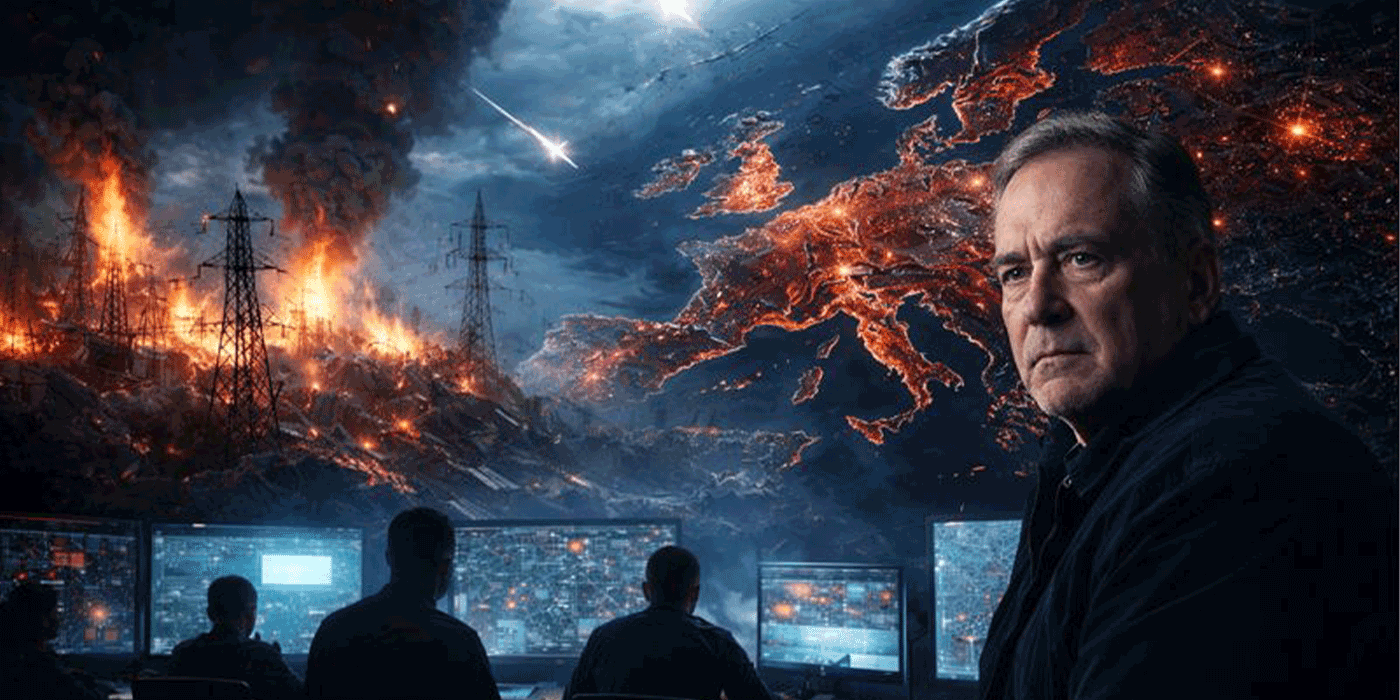
An Indictment of 80 Years of Vassal Politics - Larry Johnson
The Insider’s Judgment: Biography and Uncomfortable Truth
Larry Johnson is a former U.S. intelligence officer, CIA analyst, and counter-terrorism specialist with extensive experience inside America’s national security establishment.
During the 1990s, he served with the CIA and later at the U.S. State Department, where he worked on terrorism analysis, asymmetric warfare, and international security operations. His career unfolded during the formative years of America’s post–Cold War interventionist strategy.
After leaving government service, Johnson became a prominent and outspoken critic of U.S. foreign and military policy. He is now known for his uncompromising assessments of Western power, focusing on the structural limits of NATO, the realities of modern industrial warfare, and the strategic consequences of prolonged proxy conflicts—particularly in Ukraine.
Johnson’s analysis is characterized by a data-driven, operational perspective, emphasizing manpower, production capacity, logistics, and sustainability over political messaging. He consistently challenges mainstream narratives about Russia’s weakness and highlights the long-term risks of escalation.
💬 “Wars are not won by narratives, but by production, logistics, and time.”Former CIA analyst Larry Johnson and political scientist Glenn Diesen dissect the logic behind Trump’s Greenland threats, the structural collapse of NATO, and why Europe – trapped in eight decades of managed dependency – is watching the foundation of its own security order being dismantled in real time, with no strategy and no exit.
Trump’s War on International Law - Not a Slip, but a Doctrine
It is not limited to Trump. His deputy chief of staff, the Secretary of State, the National Security Advisor, the Treasury Secretary – they have all endorsed and promoted it.
Glenn Diesen opens with the central question: Trump continues to make the case for peace – but his version of peace depends neither on international law, nor on predictability, nor on stability. Instead, it rests on overwhelming strength and calculated unpredictability. The world is supposed to fear the consequences of not falling in line. So what, exactly, is happening?
Larry Johnson’s answer is sobering: “His behavior is so bizarre. But what I’ve found so alarming is that it’s not limited to him.” The INF Treaty was abandoned in Trump’s first term. New START – the last surviving major nuclear arms control framework – is now met with zero interest from the administration. What began as political theater has hardened into institutional doctrine. Marco Rubio, Stephen Miller, Scott Bessent – they all repeat the same message: international law is a constraint on American power, not a foundation for it.
The consequences of this posture are systemic:
- The Peace of Westphalia in 1648 codified sovereignty as the protection of the weak against the strong – that foundation is now openly contested
- When the U.S. demands rules for others but accepts none for itself, that is not a rules-based order – it is dominance dressed as principle
- Russia and China are drawing the conclusion that agreements with Washington offer no security
- By dismantling the framework, the U.S. destroys the only system that actually serves its own long-term interests
Diesen frames the historical irony precisely: “It is very strange to watch the president of the United States denounce international law as if it were some woke ploy to weaken the United States.” The system Trump is tearing down was built by the United States, for the United States, in the moment of maximum American power.
Johnson delivers the blunt verdict: “Either you have rules governing how countries behave toward one another, or you don’t. And once you break away from that, it turns into a battle over who is strongest and most ruthless. The United States is stepping directly into that second world.”
Greenland - Vanity Project or Strategic Land Grab?
He would probably name it Trumpland. It is no longer Greenland – it is going to be Trumpland. And I would not be shocked to see that happen.
Why Greenland? Denmark has never refused a single American request. There is no documented instance of Copenhagen declining a U.S. wish regarding bases, personnel, or military installations. The strategic necessity does not exist. And yet Trump has threatened tariffs against NATO allies who deployed troops – symbolic handfuls of soldiers – to defend a piece of NATO territory from its own leading member.
Johnson dismantles the official justifications one by one. The rare earth minerals argument collapses immediately: the U.S. already has access to domestic deposits but lacks processing infrastructure, and no annexation changes that. The Arctic access argument is weaker still: America operates precisely one functioning icebreaker; Russia has eight, several of them nuclear-powered. Greenland does not close that gap. What remains is a mixture of personal vanity and a structural impulse to secure assets before the alliance architecture falls apart on its own.
The political arithmetic reveals a deeper contradiction:
- Trump wrote to the Norwegian Prime Minister suggesting he feels less obligated to pursue peace since Norway withheld the Nobel Prize – that is not statecraft
- Italy’s Prime Minister Meloni publicly apologized for sending troops to Greenland, claiming they were only there to protect it from Russia and China – echoing Trump’s own stated justification for annexation
- Germany deployed a small contingent, lasted 36 hours, and withdrew – Johnson’s verdict: “Monty Python’s Knights of the Holy Grail, live and in full color”
- Threatening tariffs against allies who defend NATO territory makes the concept of collective defense logically incoherent
Diesen adds the strategic reading: in a genuinely multipolar world, the U.S. will no longer be able to offer Europe what it once did. NATO becomes irrelevant not because Trump wills it, but because the underlying power distribution makes unified Western leadership unworkable. If the alliance is going to fracture anyway, the logic runs, better to secure tangible assets before the architecture collapses. “There is a heavy element of narcissism,” Diesen notes, “but also his personal resentment toward the EU – he calls them worse than China.”
Johnson does not find the chess-game reading convincing. Trump’s approach – constant escalation, public humiliation of allies, demands for tribute, zero face-saving exits – is not the behavior of a sophisticated strategist. It is the behavior of a man who needs personal dominance. “He is not doing things in a way that helps people save face. He forces people to debase themselves.” You can get away with that once. You cannot keep getting away with it.
The Battered Spouse - Europe’s Eighty Years of Dependency
After 80 years of being vassals, there is no political imagination for anything other than being ruled by Washington.
The image Johnson reaches for – and returns to repeatedly – is that of an abusive domestic relationship. Europe is the battered spouse who will not call the police, will not seek a restraining order, and will not leave. The relationship is toxic. The abuse is escalating. And still, Europe stays. “Have European leaders lost all self-respect?” Johnson asks. Diesen’s answer is unambiguous: “Short answer? Yes.”
Diesen provides the structural explanation. Dependency does not arise from weakness alone. It is produced over time through the very mechanisms of protection itself. The more intense a conflict, the more the protected party transfers control to the protector. NATO was not merely a military alliance – it was a political compact that steadily relocated European strategic judgment to Washington. For eighty years, that arrangement delivered genuine benefits: security, market access, technological spillover, the stability of the dollar system.
The compact has quietly inverted:
- Europe is buying American liquefied natural gas at premium prices after cutting itself off from Russian pipeline energy that was cheaper and geographically rational
- Defense spending is rising – not to build independent European capabilities, but to purchase American weapons systems
- Hundreds of billions that could have financed a European industrial revival are flowing to American defense contractors and energy companies instead
- When Trump announced tariffs on European goods, Ursula von der Leyen appeared at his golf course – the image is its own commentary
The structural tragedy is that the only real lever Europe possesses – making it easy for the Americans to leave, ending the dependency – is the precise opposite of what European governments seek. They want the Americans to stay. Trump wants to exit. Every European threat is therefore exactly what Trump wants, which, as Diesen notes drily, “almost makes me think this is a ploy to reduce the relevance of NATO, because Trump can’t do it on his own.”
Johnson identifies one European country with a genuine alternative: Germany. A partial Nord Stream pipeline remains functional. A German government that announced it was resuming purchases of Russian natural gas would immediately reduce energy costs, halt its economic slide, and signal to Washington that the tributary relationship has limits. “That might get the U.S.’s attention,” Johnson concedes. But knowing Trump, he would double down – and at that point, the NATO fiction would be unsustainable for anyone.
NATO’s Obituary - Written in Real Time
I frankly see this as the beginning of the end of NATO. It’s the end of the beginning. And now we’re going to see NATO come apart at the seams.
The logical structure of NATO – collective defense, sovereign equality among members, inviolability of member-state territory – cannot survive what is currently happening. A United States that claims a Chinese and Russian threat to Greenland but insists on annexation rather than invoking Article 5 has already exited the conceptual framework of the alliance. A United States that threatens tariffs against partners who deploy troops to defend NATO territory has already severed the link between alliance membership and security guarantees.
Johnson names the absurdity at the core: if Russia and China genuinely threaten Greenland, the NATO response is Article 5 – collective defense. Trump’s response is unilateral annexation. Both positions cannot coexist within the same alliance. Either NATO is an instrument of collective security, or it is an instrument of American territorial expansion. It cannot be both. Colonel Douglas Macgregor, Johnson notes, called it in the first week of the Russian invasion of Ukraine: the consequence would not be NATO getting stronger, but dying stronger.
The scenario of a new hierarchy is taking shape:
- Europe has been quietly reclassified from ‘equal partner’ to ‘tributary state’ – and the reclassification is now being made explicit
- Opposing Trump risks tariffs; submitting buys short-term quiet but deepens long-term subordination
- Germany is the one country with a real lever – resuming Russian gas imports via the partially functional Nord Stream pipeline
- Any European counter-threat is structurally hollow: the Europeans do not want the Americans to leave, which means their threats deliver exactly what Trump wants
What prevents meaningful European action is not material impossibility. It is, as Diesen observes, eighty years of conditioned helplessness. “The chains become comfortable,” he says. “The U.S. is the ticket to greatness. We would stand side by side with America, part of the liberal hegemony. That was the unipolar dream. But when the U.S. leaves, the pacifier is gone.”
Europe, he adds, was never able to cooperate except under American imperial leadership. He does not believe Europe has enough imagination or courage to contemplate a different solution. The concern now is that as American patronage recedes, Europeans will start competing against each other again – recreating the dynamic that made the continent an American protectorate in the first place.
The Dollar, the Deficit, and the Crisis on the Horizon
The United States was able to finance its wars and its government by selling U.S. debt to foreign countries. Now you are seeing it move in the opposite direction.
Beneath the geopolitical theater, a more fundamental shift is underway. The dollar’s global primacy – the mechanism that allowed the United States to run permanent deficits, finance foreign wars without visible domestic cost, and punish adversaries through financial exclusion – is eroding in ways that are increasingly difficult to reverse.
The proximate trigger was the sanctions response to Russia’s 2022 invasion. Freezing Russian central bank assets and expelling Russia from SWIFT sent a message to every country holding dollar reserves: those assets could be confiscated. The dollar’s utility as a neutral store of value depends entirely on confidence that the rules are stable and politically impartial. That confidence was shattered in a single weekend.
The consequences are flowing through commodity markets. Russia and China have been accumulating gold at an accelerating pace. Central banks across the Global South are diversifying away from U.S. Treasuries. The BRICS architecture has produced functional alternative payment systems that bypass SWIFT entirely. China pays for Russian energy in yuan; Russia converts yuan to gold.
The dollar is simply not in the transaction. At the time of the conversation, silver had surged from roughly $40 per ounce in September to over $93 – a move of more than 130 percent in a matter of months, driven partly by Chinese industrial demand and partly by a broader flight from dollar instruments into tangible assets.
Johnson identifies three structural shifts compounding the pressure:
- Russia, China, and India are buying precious metals rather than U.S. Treasuries – gold at all-time highs, silver exploding – redirecting the flows that once recycled into American debt financing
- Canada, once among America’s three largest trading partners, is actively building ties with China as a direct response to American tariff aggression
- India has refused, despite American pressure, to alter its trading relationships – demonstrating that the threat of exclusion from U.S. markets has lost much of its coercive power
- The U.S. national debt hit $39 trillion during the Ukraine war years; Trump plans to raise defense spending to $1.5 trillion annually – requiring buyers of Treasury bonds who are no longer showing up
“When Trump labored under the false belief that the United States was so powerful – an essential business, economic, and military power that nobody could live without – all of a sudden he is discovering that a lot of these countries are saying: yeah, no, we can live without you. And in fact, the more we distance ourselves from you, the fewer problems we have.”
Johnson’s conclusion is direct: the next battle is being fought in economic markets, not on military fronts. Countries that once recycled trade surpluses into U.S. Treasury purchases are buying gold instead. The architecture that allowed America to project power without fiscal consequence is being dismantled from the outside, one central bank reserve decision at a time. The tariffs that are supposed to reassert American economic dominance are accelerating precisely the diversification they were meant to prevent.
The Madman Theory and Its Limits
Whether it is real instability or not – in the end, nobody will trust you anymore.
Diesen raises the analytical question that recurs throughout the conversation: is Trump’s behavior calculated theater or genuine disorder? The Nixon madman doctrine – manufacture irrationality to force concessions from adversaries who fear unpredictable consequences – has a certain strategic logic. Panama made concessions under pressure. The Yemen campaign was abandoned when it proved too costly. Venezuela involved a show of force followed by rapid disengagement. The pattern: escalate dramatically, extract something or nothing, move on.
Johnson is less charitable. The problem with Trump’s execution lies not in the concept of escalation but in the systematic refusal to offer face-saving exits. A sophisticated version of the madman theory allows the target to concede while preserving dignity – the art is engineering a compromise both sides can present as a win. Trump’s approach, by contrast, demands explicit submission. He forces people to debase themselves publicly. “He’s not doing things in a way that helps people save face. No, his approach is all just bare-knuckle force.” You can get away with that once. You cannot keep getting away with it, because at some point people will seek revenge.
The miscalculation is visible across multiple fronts:
- Russia has concluded that whatever is signed today, there will be a new deal tomorrow – durable agreements with Washington are no longer possible
- Canada, India, and multiple emerging economies are responding to American pressure not with submission but with deliberate diversification away from the U.S.
- European governments are doing everything possible to avoid direct conflict with Trump – but that gives him no incentive to stop
- Every further act of public humiliation deepens the long-term estrangement that undermines America’s global position
Diesen identifies the structural flaw: “Whether he’s pretending or not, nobody will trust you in the end. So the Russians have already made up their minds. It doesn’t matter what paper they sign – there’ll be a new deal the next day.” A strategy that works by manufacturing fear of a madman fails the moment the target decides it is cheaper to live without the relationship entirely than to keep managing the madman’s demands.
Johnson is unambiguous about his alarm: not because of any single decision, but because of the overall architecture. A president who has declared international law irrelevant, surrounded by sycophants who ratify every impulse, with nobody in the room willing to say: you cannot do this. “I am genuinely alarmed,” he says. “If this is not arrested and stopped, it is going to lead to a world war. I don’t see how that’s avoidable.”
The Record of Defeat - Background Noise Nobody Acknowledges
Vietnam, Afghanistan, Iraq, Ukraine – losing against the poorest countries in the world, while Russia and China became enormously richer.
One of the strangest features of contemporary American political discourse, both men agree, is the near-total absence of any serious accounting for military failure. The United States has not won a war against a meaningful adversary in eighty years. Afghanistan consumed twenty years and two trillion dollars and concluded with the Taliban retaking Kabul within days of the American withdrawal – essentially the same government that had been in power when the war began. Iraq produced a failed state, a resurgent Iran, and the birth of ISIS. Ukraine, now being quietly re-described as an American success, has devastated the country it was meant to protect and failed to achieve any of its stated strategic objectives against Russia.
Johnson makes a specific observation that rarely appears in Western coverage: Russia operates eight functioning icebreakers in the Arctic, several of them nuclear-powered. America has one. The Arctic is becoming one of the most strategically contested maritime environments on the planet as climate change opens new sea lanes and exposes new resource deposits. American claims to Arctic dominance rest on naval capacity that simply does not exist. The gap between the narrative of American power and the reality of American capacity is widening to the point of becoming politically unsustainable.
The military imbalance manifests across several dimensions:
- China now produces more ships annually than the rest of the world combined
- Russia, despite two years of sanctions designed to collapse its defense production, is producing artillery, missiles, and armored vehicles at rates that have surpassed every Western intelligence estimate
- America has one functioning icebreaker – Russia has eight, several nuclear-powered – in what is becoming a critical strategic theater
- Russia is, by purchasing-power-parity measures, the fourth-largest economy in the world – the country that was supposed to be brought to its knees
Johnson frames it in the starkest terms: “Losing, losing, losing. You were the richest country in the world, with a greater distance from your adversary than today. Wars against the poorest countries – and you still could not win. In the meantime, Russia and China became enormously richer, economically and militarily more advanced.” One needs a measure of institutional blindness, he suggests, that is becoming too great even for American political culture to sustain.
Diesen adds the systemic context: the U.S. control of the global economy is slipping away at precisely the moment when military spending is being pushed to record levels. The two trends compound each other. More spending requires more debt financing. Debt financing requires willing buyers. Willing buyers are disappearing. The fiscal trap tightens as the strategic position weakens – and the political response is to spend more, threaten more, and demand more from allies who are quietly building alternative arrangements.
The Convenient Tool - Who Is Actually Driving?
I think Trump has become a convenient tool. He is not setting the agenda. He is not running the chessboard. But he is certainly enabling it.
Johnson’s sharpest analytical judgment – and the one most likely to provoke disagreement – concerns Trump’s relationship to the institutions that surround him. Despite his self-presentation as an anti-establishment disruptor, the fundamental hostility toward Russia and China that has characterized American foreign policy for decades has not changed. What has changed is the style of expression.
The people driving the bus – the permanent national security apparatus, the defense contractors, the think tanks funded by weapons manufacturers, the intelligence community – still operate on the premise that both Russia and China represent existential threats to American primacy that must be contained, weakened, or broken.
Trump’s chaos does not challenge that premise. It enables it, while providing useful political cover: whatever goes wrong can be attributed to the president’s personal volatility rather than to the strategic choices of the institutions themselves. Gina Haspel ran the CIA. Christopher Wray ran the FBI. The machinery kept operating. Johnson puts it plainly: “I think Trump has become a convenient tool. He’s not setting the agenda. He’s not running the chessboard. But he’s certainly enabling this effort to weaken China and weaken Russia.”
The zero-sum premise remains the organizing principle regardless of who holds office:
- Nobody in a position of institutional power in Washington is seriously asking: how do we work with Russia and China?
- “How do we work with Russia and China so that we don’t have to have a $1.5 trillion defense budget?” – this question does not exist in the policy mainstream
- The assumption that American strength requires Russian and Chinese weakness survives every administration
- Trump is the face – but he is not the source of the miscalculation
Diesen adds the systemic dimension: in a hegemonic order, you do not need to worry about the security of others – overwhelming power makes their concerns irrelevant. In a multipolar world, the foundational Westphalian insight reasserts itself: your security is only durable if you do not systematically threaten the security of others. The United States has not made this adjustment. Its foreign policy still operates on hegemonic assumptions while its actual material power increasingly resembles that of a multipolar peer competitor.
“How can we work with Russia and China to promote and build infrastructure in countries around the world?” Johnson asks – and the question is rhetorical in the most literal sense. There is nobody asking it seriously. The assumption that the game is zero-sum, that America wins only when others lose, remains the organizing principle of the national security establishment. “As long as that mentality continues to preside, the United States is in a trap that I don’t think we’re going to get out of.”
The Transition Moment - From February 2022 to December 2026
Looking back on this period – from February 2022 through December 2026 – we will be seeing as consequential a change in the international arena as what took place from May 1945 through December 1948.
Johnson’s most sweeping historical claim is about periodization. The years from Russia’s invasion of Ukraine to the end of 2026 will, he argues, be understood in retrospect as the hinge moment of the twenty-first century – as structurally significant as the immediate postwar years that produced the United Nations, the Bretton Woods system, the Marshall Plan, and the beginning of the Cold War. What is being constructed is not yet clear. What is being destroyed is visible in real time: arms control treaties, financial architecture, alliance credibility, the credibility of international law itself.
Diesen’s prediction is more specific: before the year is out, more European countries will begin reviving their relationships with Russia, and a freeze in relations with the United States will follow. Not because European governments have strategically reoriented – they have shown no capacity for that – but because the economic pressure will eventually exceed the political capacity to sustain the current course. You cannot indefinitely run an economy on overpriced American energy while sending billions to American weapons manufacturers while watching your industrial base relocate to Asia. At some point, the arithmetic forces the choice.
The dividing lines in Europe are functioning as a trap:
- The post-Cold War boundaries were deliberately drawn to cement American influence and prevent Eurasian integration
- Those same lines now trap Europe in dependency at the precise moment when America is least inclined to honor its obligations within that dependency
- Europe’s logical response would be: end the war, reduce the dependency, buy Russian energy – but that requires political imagination
- Eighty years of managed subordination have systematically suppressed that imagination
“While the Europeans are trying to keep the war going,” Diesen says, “they should do the exact opposite – end it quickly so there is less dependence.” But ending the war would require acknowledging that the entire strategic gambit – using Ukraine to weaken Russia, restore Western hegemony, and reverse multipolarity – has failed. That acknowledgment is not available to the political class that staked its legitimacy on the gambit succeeding.
Johnson closes the historical arc: the period from 2022 to the end of 2026 will be remembered the way 1945 to 1948 is remembered – not as a moment of resolution, but as the moment when the old order visibly ended and the contours of what came next began to emerge. We are in the middle of that moment. The institutions, treaties, and financial arrangements being dismantled now took decades to build. What replaces them will be determined by choices that have not yet been made, in circumstances no one fully controls.
Frankenstein’s Monster - and the Question of What Comes Next
We helped build and feed this monster. And yes, this is Frankenstein’s monster – it is not under our control.
Johnson’s warning is explicit: if Trump’s contempt for international law continues unchallenged, if the sycophants around him continue to ratify every impulse, the destination is a global war. Not necessarily a deliberate one – but the kind that emerges from the systematic elimination of the mechanisms designed to prevent escalation. Arms control treaties are gone. The forums for direct communication between great powers have been degraded.
The financial architecture that gave adversaries a shared interest in avoiding catastrophic conflict is fracturing. A president who has declared himself beyond international constraint is surrounded by advisors who share that view and a military establishment that has not internalized the lessons of its own recent failures.
Diesen frames it differently, though not more reassuringly. He sees a system in transition – painful, chaotic, and potentially catastrophic, but not without historical precedent. Every previous hegemonic order has ended. The Westphalian order that the United States is now dismantling was itself built on the rubble of thirty years of continental warfare. What replaces it will be determined by actors who have not yet fully revealed themselves. The Europeans, he suggests, are not actors in this drama. Not yet. They are the stage on which it is performed – the contested territory, the plundered allies, the hollowed institutions.
The final choice is not abstract:
- Wait for the U.S. to become great again – that has not happened in thirty years
- Navigate the contradiction: understand how much the old system carried you before cutting it loose
- End the war – or continue going down with the ship
- The chains may have become comfortable after 80 years – but they remain chains
Whether Europe can become an actor again – whether eighty years of managed dependency can be reversed in the compressed timeframe the current crisis demands – is the central unanswered question. Johnson is not optimistic. Diesen is not optimistic. What they share is the conviction that the choice is real, the window is closing, and the cost of postponing it is compounding with every passing month.
“We are nineteen days in,” Johnson says near the end, “and everybody is already screaming: stop the ride, I want to get off.” If someone had told you a few years ago that this is where we would be, Diesen replies, it would have sounded like science fiction. Johnson’s last prediction: before the year is out, more European countries will revive their relationships with Russia, and there will be a freeze in relations with the United States. Not by strategy. By arithmetic.
Thank You, Larry Johnson.
Sources & Geopolitical References
Substack – US-Edition
This article is also available as a English-language edition on Substack:
An Indictment of 80 Years of Vassal Politics - Larry Johnson
Original conversation (video)
YouTube-Interview:
Trump, Greenland & the End of NATO - Larry Johnson
Support Independent Journalism
If you find my work valuable, you can support it with a voluntary contribution here:
Voluntary support via PayPal
Voluntary support via Buy Me a Coffee
Many thanks for your support!

More Articles
How America’s Economic War on Russia - Richard Wolff
An Indictment of 80 Years of Vassal Politics - Larry Johnson
America’s New Imperialism - John Mearsheimer

investigative commentary.