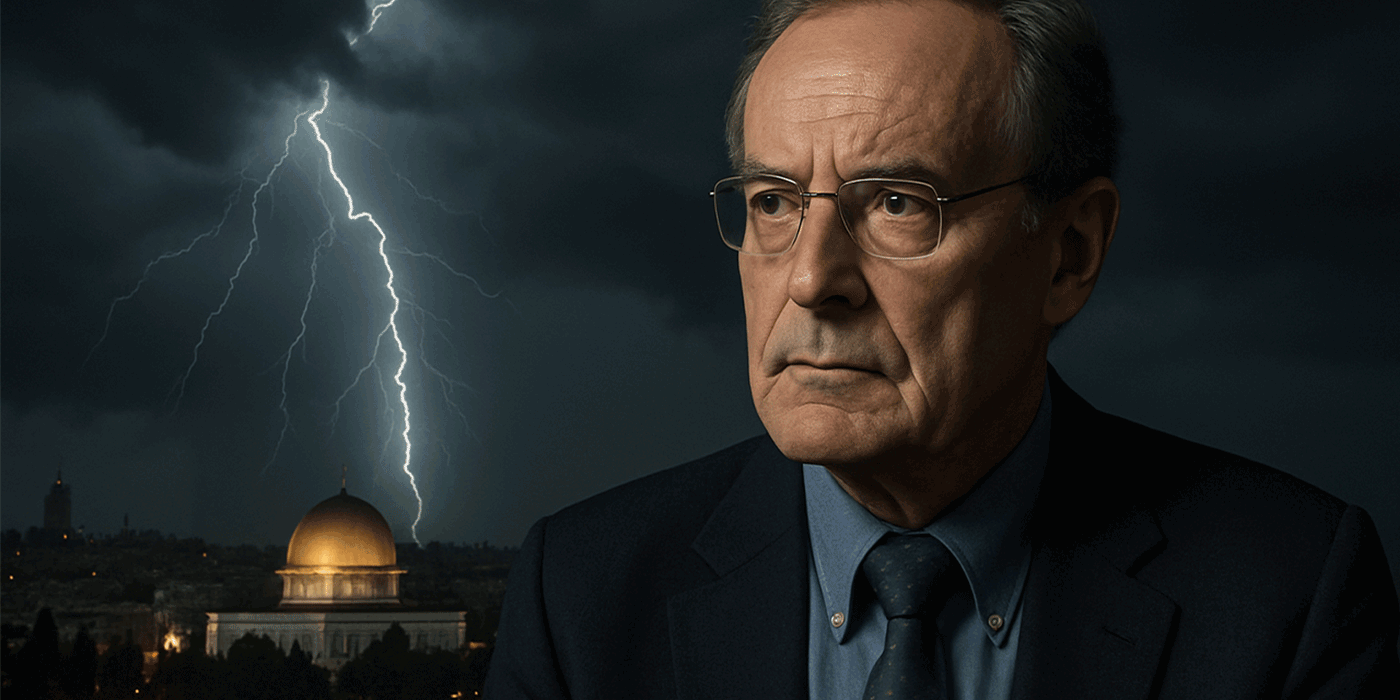
America’s New Imperialism - John Mearsheimer
The Insider and His Verdict: Biography and Uncomfortable Truth
One of the most influential realist thinkers of modern geopolitics — a strategist who argues that great powers are driven not by ideals, but by the ruthless logic of survival.
John J. Mearsheimer is an American political scientist and international relations theorist best known for developing the concept of “offensive realism,” a theory that argues great powers inevitably compete for dominance in an anarchic global system. A long-time professor at the University of Chicago, he has spent decades analyzing military power, grand strategy, and the structural forces that shape conflicts between major states. His work places him among the most cited and debated scholars in modern geopolitical analysis.
Mearsheimer was born on December 14, 1947, in New York. He graduated from the United States Military Academy at West Point in 1970 and served five years as an officer in the U.S. Air Force before turning to academic research. He later earned a master’s degree in international relations from the University of Southern California and completed both a master’s and a PhD in government at Cornell University. In 1982 he joined the University of Chicago, where he would become one of the leading voices in realist international relations theory.
Mearsheimer gained international recognition through several influential books examining power politics, military strategy, and the structural dynamics of global conflict, including:
- The Tragedy of Great Power Politics — a foundational work presenting his theory of offensive realism and arguing that great powers constantly seek regional dominance.
- The Israel Lobby and U.S. Foreign Policy — a controversial study, co-written with Stephen Walt, examining the influence of lobbying networks on American foreign policy.
- Why Leaders Lie: The Truth About Lying in International Politics — an analysis of why governments manipulate information in international crises.
Throughout his career, Mearsheimer has been both influential and controversial. Supporters regard him as one of the clearest interpreters of the power dynamics governing international politics, while critics argue that his realist framework reduces complex political conflicts to structural competition between states. Regardless of the debate surrounding his conclusions, his theories continue to shape discussions about great-power rivalry, NATO expansion, and the future of the global balance of power.
John Mearsheimer dissects how the Ukraine debacle, the invasion of Venezuela, and the threat against Greenland are unraveling eighty years of transatlantic order — and why European leaders, paralyzed by eighty years of dependency, seem constitutionally incapable of responding.
Venezuela — The Return of Naked Imperialism
The administration was offered a ready-made legitimacy structure — democracy promotion, the opposition narrative, the Nobel Peace Prize story — and declined to use it. Power, Trump has decided, no longer requires a performance.
For decades, the United States has justified its interventions in Latin America with the language of liberal democracy, human rights, and the war on narco-terrorism. Every coup, every covert operation, every targeted sanction was wrapped in the vocabulary of universal values. Venezuela was supposed to be no different. There were opposition figures to celebrate, elections to dispute, and autocrats to condemn. The machinery of legitimation was ready and waiting.
But something broke down. When President Trump’s senior advisers spoke openly of seizing Venezuelan oil, when Trump himself declared that a compliant Caracas government could retain power only as long as it did “what we want,” and when the administration made clear that it had kidnapped Venezuela’s head of government and installed a more pliable alternative — the velvet glove did not just slip. It was thrown across the room.
John Mearsheimer, the R. Wendell Harrison Distinguished Service Professor of Political Science at the University of Chicago, has spent decades analyzing the logic of great-power behavior. His verdict on Venezuela is unambiguous: this has nothing to do with the Monroe Doctrine, which was always about preventing distant rivals from establishing military footholds in the hemisphere. China and Russia have no military alliance with Caracas and no serious intention of forming one. The Monroe Doctrine’s conditions are simply not met.
What is happening instead is something more straightforward and more ancient: a powerful state helping itself to another country’s resources and its political future. “This is a good old-fashioned case of imperialism,” Mearsheimer says. “It’s a case where the United States was interested in running the politics of Venezuela. And if you listen to President Trump, his main concern is who controls the oil in Venezuela. He basically thinks that’s our oil — it’s ours to decide what it’s used for and how it’s used.”
What Venezuela reveals about the current American posture:
- No Monroe Doctrine logic. China and Russia have no military presence in Venezuela and no plans to establish one. The classic justification for hemispheric intervention simply does not apply.
- Open resource extraction. Trump explicitly framed Venezuelan oil as American property — a statement no previous administration would have made on the record, regardless of what it believed privately.
- Legitimacy rejected. The democracy-promotion narrative was available and was declined. The administration no longer considers liberal justification a necessary part of the operation.
- Pattern, not anomaly. Chile 1973, Guatemala 1954, Nicaragua in the 1980s — the history is long. What has changed is the transparency, not the practice.
- Institutional cover discarded. Biden blew up Nord Stream and the Germans pretended to believe it was not him. Trump does not ask for that pretense. He has rendered the velvet glove obsolete.
The pattern, Mearsheimer notes, is entirely consistent with American history in the hemisphere — Chile in 1973, Guatemala in 1954, Nicaragua throughout the 1980s, and a long list of interventions before and after. What is new is the candor. Previous administrations, when acting imperially, went to elaborate lengths to provide cover. They organized exile networks, laundered funding through NGOs, cultivated journalists, and deployed the language of democracy promotion to explain what were fundamentally power operations. They covered the mailed fist with the thickest possible velvet.
Trump does none of this. He told reporters he would run Venezuela. He told an interviewer that Venezuela’s oil was American oil. He dismissed the Nobel Peace Prize story — the legitimacy narrative his own State Department had prepared — as unnecessary. Stephen Miller, asked whether the United States would use military force to take Greenland, was almost offhand: the Europeans would not fight back, so you sail in, plant a flag, and it is done. In Trump’s White House, the performance of liberal values has become an annoyance rather than a tool.
Glenn Diesen draws out the deeper implication: the Trump administration was offered a ready-made legitimacy structure — the Venezuelan opposition, the international community, the democracy-versus-autocracy frame — and declined to use it. That refusal is not simply a stylistic difference from previous presidents. It signals that the administration does not believe it needs ideological justification. Power is sufficient. The audience whose approval mattered — the post-1945 order of norms and institutions — no longer seems worth performing for.
The Rules-Based Order — Built, Owned, and Abandoned
Washington wrote the rules, staffed the institutions, and defined the violations. The system served American interests by design. What Trump has done is not break the order — he has simply stopped pretending it was something other than what it always was.
To understand why this matters, it helps to understand what the so-called rules-based international order actually was. Mearsheimer is clear-eyed about this in ways that polite diplomatic discourse rarely allows. During the unipolar moment — roughly 1993 to 2017, the period between the Soviet collapse and the first serious rumblings of great-power competition — the United States was the system’s architect, enforcer, and primary beneficiary. Washington wrote most of the rules. It staffed most of the institutions. It defined the violations and selected the violators to be punished.
This meant that compliance with international law was, for the United States, mostly self-serving. The rules constrained rivals and legitimized American action. When Washington did violate them — Kosovo, Iraq, the extraordinary rendition program, the targeted killing of foreign nationals — it went to considerable lengths to argue that it had not actually violated them, or that the violation served a higher principle the law was designed to protect. The effort itself acknowledged the order’s importance as a source of legitimacy.
Trump has no patience for this performance. He regards international law not as a useful instrument but as an imposition by bureaucrats and foreigners on America’s freedom of action. Pete Hegseth, as Diesen notes, speaks of it as though it were a progressive ideological constraint — woke governance imposed on American soldiers.
Mearsheimer, who is no enthusiast for liberal internationalism, nevertheless argues that this position is strategically incoherent. Rules and norms are essential in an interdependent world, and their erosion damages American interests alongside everyone else’s. The fact that Washington wrote most of them makes their abandonment stranger, not more defensible.
The structural decay of the rules-based system shows up across several dimensions:
- The United States wrote most of the rules of the post-1945 order — compliance was easy because the rules were designed to serve American interests.
- Previous administrations, when they violated international law, went to elaborate lengths to argue they had not — the performance itself acknowledged the order’s legitimacy.
- Trump regards that performance as unnecessary: international law is an imposition, not an instrument, and breaking it requires no justification.
- The erosion damages American interests alongside everyone else’s — in an interdependent world, rules and norms are essential infrastructure, not optional constraints.
The deepest damage to the order’s legitimacy, Mearsheimer suggests, was actually dealt before Trump’s second term. The Biden administration’s response to the Israeli military campaign in Gaza — the weapons transfers, the vetoes at the Security Council, the rhetorical contortions — exposed the rules-based order as selective in a way that the whole world could see. For the Global South, which had long suspected that the rules applied asymmetrically, the events in Gaza were confirmation.
“The fact that the Europeans and the United States supported Benjamin Netanyahu in carrying out genocide in Gaza was a deadly blow to the liberal international order,” Mearsheimer says. “It looks like empty rhetoric.”
Everything Trump has done since — Venezuela, the threats against Greenland, the tariff wars, the contempt for alliance commitments — has piled onto that foundation of broken credibility. The order was already wounded before the current president arrived. He is administering what may prove to be the final blows.
Greenland — From Distraction to Genuine Threat
Most analysts assumed it was performance — a provocation, a negotiating chip, a reality-show distraction. Mearsheimer has watched Trump’s operational pattern closely enough to conclude that this reading is dangerously wrong.
When Donald Trump first began talking seriously about acquiring Greenland, the majority of foreign policy analysts treated it as performance — a headline-generating provocation designed to keep adversaries and allies alike off-balance, or a negotiating chip in some larger game not yet visible. Mearsheimer has watched Trump’s behavior closely enough to think this reading is dangerously complacent.
“I think there’s a serious possibility the United States will take Greenland,” he says, with the deliberateness of a man who understands that this sentence sounds absurd and who is saying it anyway. The logic is structural, not personal. Trump has used military force against seven countries since taking office. Every single case has conformed to the same template: swift, decisive on its own terms, designed to produce a declared victory before the costs of nation-building materialize. He attacked Iran on June 22, 2025, announced the problem was solved by end of day, and moved on. He struck Nigeria, declared it handled, and pivoted. The pattern is internally consistent.
Taking Greenland, from a military standpoint, would not pose a serious challenge. The island has no armed forces capable of resisting the American military. Denmark does not have the capacity to defend it unilaterally. NATO, as an organization, cannot coherently respond to an attack by one of its own founding members on the territory of another. The Prime Minister of Denmark has said that an American seizure of Greenland would mean the end of NATO. She is almost certainly correct. She is also almost certainly unable to prevent it.
The Greenland situation, taken as a whole, reveals the following:
- Since taking office, Trump has used military force against seven countries — every case a swift, declared victory designed to avoid nation-building quagmires.
- Greenland presents no serious military resistance: Denmark cannot defend it unilaterally, and NATO has no coherent mechanism to respond to an attack by one of its own founding members.
- Stephen Miller’s assessment — the Europeans won’t fight back, you sail in and plant a flag — is probably an accurate military calculation, however alarming as a statement of policy.
- The Prime Minister of Denmark has said that an American seizure would mean the end of NATO. Mearsheimer finds this assessment correct — and the prevention of it far from guaranteed.
- Denmark was among the first to recognize Kosovo’s independence and was among the most hawkish NATO members on Ukraine: it now faces the territorial revisionism it helped legitimize in others.
Stephen Miller’s dismissiveness in a television interview — the Europeans won’t fight, you sail in and plant a flag — is probably an accurate military assessment, however shocking as a statement of policy. What Miller did not address, and what Mearsheimer finds genuinely concerning, is the second-order effect: what does it mean for the alliance structure when the United States’ most powerful member seizes the territory of one of the alliance’s oldest members? The answer may be that the alliance ceases to mean anything.
There is a further irony that Diesen draws out. Denmark was among the first countries to recognize Kosovo’s unilateral declaration of independence — acting on the principle that a people’s right to self-determination could override the territorial integrity of an existing state. It sent nearly all its weapons to Ukraine, was among the most hawkish members of the NATO coalition in the proxy war against Russia, and prided itself on doing so. It now finds itself on the receiving end of exactly the territorial revisionism it helped legitimize when the target was someone else’s territory.
Ukraine — The War That Broke the Architecture
The April 2008 Bucharest summit, where NATO promised eventual membership to Ukraine over explicit Russian objections, set the trajectory for everything that followed. Mearsheimer had warned about it in writing and in public for years. The warning was not heeded.
Venezuela and Greenland are symptoms of a deeper dislocation. The root cause, in Mearsheimer’s analysis, is the Ukraine war — and more precisely, the catastrophic strategic decision that made it inevitable. The April 2008 NATO summit in Bucharest, where the alliance formally promised eventual membership to Ukraine and Georgia over explicit Russian objections, set the trajectory for everything that followed. Mearsheimer had warned about it in 2014, when he published his analysis in Foreign Affairs. He had warned about it in academic lectures and public talks for years before that. The warning was not heeded.
The result was a war that has now effectively ended in Russia’s strategic victory, even if the formal conclusion is still months away. Ukraine’s territorial losses are substantial and likely permanent. Its population has been decimated by emigration and casualties. Its economy is a ward of Western financial support that is now being withdrawn. The military attrition of the past three years has exhausted not only Ukraine but the Western supply chains that were supposed to sustain it indefinitely.
Trump’s response to this situation has been, in Mearsheimer’s description, to shift the burden of failure onto European shoulders. He has told European governments that they bear primary responsibility for the war’s continuation, that they must provide the financing and weaponry that Washington is withdrawing, and that when Ukraine ultimately loses — as it will — the failure belongs to Europe’s diplomatic obstructionism, not to American withdrawal. The Europeans cannot shoulder this burden. They lack the financial resources, the industrial capacity, and the strategic coherence to do so. They will nonetheless be blamed for not doing it.
The war’s strategic consequences unfold across multiple layers:
- The Bucharest summit of April 2008 — which promised NATO membership to Ukraine and Georgia over explicit Russian objections — set the trajectory for the war that followed in 2022.
- Russia’s strategic victory is effectively decided: Ukraine’s territorial losses are substantial and likely permanent, its economy a ward of Western support now being withdrawn.
- Trump has deliberately shifted the burden of failure onto European shoulders — blaming diplomatic obstructionism for the collapse of a war effort he has been withdrawing from.
- The severance of energy ties, the sanctions architecture, and the financial weaponization of dollar-based systems have demonstrated to the entire world that Western financial infrastructure is a geopolitical weapon.
- Relations between Russia and Europe have been poisoned for a generation or more — the economic interdependence laboriously built after the Cold War has been deliberately destroyed.
The long-term damage extends well beyond the war itself. Relations between Russia and Europe have been poisoned in ways that will take a generation or more to repair — if repair is even possible. The economic interdependence that was laboriously built after the Cold War has been severed. The energy ties that underpinned European industrial competitiveness have been deliberately destroyed.
The financial sanctions architecture, unprecedented in scope, has demonstrated to the entire world that Western-controlled financial systems are a weapon to be used against any country that defies Washington’s preferences. Russia has adapted. China has drawn the lesson. The dollar’s reserve status, which was always partly a political arrangement, has begun to erode.
What is left, as General Harald Kujat wrote in early 2023 — before many Western commentators were willing to acknowledge the trajectory — is a Europe that will be left alone, facing an angry Russia, without the American pacifier that kept the continent’s fault lines from reopening. Kujat was predicting this from the German military establishment, not from the fringes. That his warning went largely unheeded in the councils of NATO says something damning about the quality of strategic thinking at the top of the Western alliance.
The European Dilemma — Eighty Years in the Basement
The combined GDP of the European Union exceeds that of the United States. Europe is not a supplicant in material terms. Yet it behaves like one — because eighty years in the basement of Uncle Sam have made the chains feel like furniture.
The obvious question is why European leaders do not simply push back. They are not militarily powerless. The combined GDP of the European Union exceeds that of the United States. The continent has significant diplomatic resources, historical relationships, and institutional infrastructure. It is not, in material terms, a supplicant. Yet it behaves like one. Why?
Mearsheimer offers a structural answer: European leaders are desperate to keep the United States in Europe. NATO functions, in the European political imagination, not merely as a military alliance but as a pacifier — the external authority that prevents the continent’s ancient rivalries from reconstituting themselves as armed conflicts. The fear is not abstract. European history between 1914 and 1945 is a reminder of what happens when the continental order breaks down. The memory of those years, even as it fades from lived experience into historical knowledge, shapes the terror of European elites at the prospect of strategic abandonment.
And so they appease. They sign the energy deals that transfer enormous wealth across the Atlantic. They visit Trump’s golf courses. They stand at his press conferences and absorb his contempt for the EU. They vote with Washington on UN resolutions they privately oppose. They increase their defense budgets, then buy American weapons systems rather than building European alternatives. Each accommodation is justified by the same calculus: better to be humiliated than to provoke an American withdrawal.
The anatomy of European paralysis has several distinct components:
- European leaders are desperate to keep the American pacifier in Europe — the fear of strategic abandonment is existential, rooted in the memory of two world wars.
- Appeasement does not work with Trump: he reads accommodation as weakness and weakness as an invitation to extract more — every concession produces a new demand.
- China demonstrated the alternative: when Beijing signaled it had cards to play and would use them, Trump backed off. Strength, not compliance, produced a negotiated outcome.
- The Houthis reinforced the lesson: determined resistance that imposed real costs forced a quiet American retreat — Trump declared victory and moved on.
- Each major European leader privately fears that one of the others will become America’s favored partner, to be used against the rest — the result is competitive submission rather than collective resistance.
Mearsheimer is direct about why this strategy fails: Trump reads accommodation as weakness, and weakness as an invitation to extract more. The evidence is consistent. When the Chinese pushed back against his tariff escalation in his first term, demonstrating clearly that they had cards to play and would use them, Trump backed off. When the Houthis fought effectively enough to make a decisive American victory impossible, Trump quietly abandoned his boasts about bringing them to their knees and declared a ceasefire on terms that were, at best, a draw. When European leaders grovel, he humiliates them further. The correlation is straightforward.
Glenn Diesen adds a psychological dimension that Mearsheimer finds important. It is not only structural desperation that explains European behavior. It is also the accumulated psychology of eighty years inside an American security system. The metaphor he reaches for is stark: eighty years in the basement of Uncle Sam.
When you have lived in that basement long enough, the chains become comfortable. The United States was not just a security provider — it was the ticket to relevance, the validation that European countries still mattered in a world that had shifted its center of gravity to Washington and then increasingly to Beijing. Losing that American endorsement means confronting, without anesthetic, the fact that Europe has become a geopolitical object rather than a subject.
After centuries of determining the world’s fate — colonizing other continents, writing the rules of international commerce, launching the industrial revolution, and twice coming close to destroying the entire edifice — Europe has become something that is acted upon rather than something that acts. That transformation is, at the level of elite psychology, deeply humiliating. The reluctance to acknowledge it is not merely strategic calculation. It is denial.
The Fracture of the West as a Coherent Category
The concept of the West was organized around a Soviet threat that no longer exists, sustained by American leadership that is now withdrawing, and legitimized by liberal values that recent conduct has rendered indistinguishable from empty rhetoric.
The word “West” made coherent strategic sense during the Cold War. The bipolar competition between Washington and Moscow created a clear geographic and ideological divide. Countries on the western side of that divide shared institutions, threat perceptions, American security guarantees, and, broadly, a common set of liberal democratic values. The concept was not merely rhetorical — it described a genuine alignment of interests and identities.
During the unipolar moment that followed the Soviet collapse, the concept expanded. NATO moved eastward. The European Union extended its reach into Central and Eastern Europe. The liberal international order — democracy promotion, economic interdependence, human rights frameworks — sought to generalize itself globally. In this context, talking about the West as a coherent political actor continued to make sense, even as the Soviet threat that had originally organized it had disappeared.
That world, Mearsheimer argues with considerable analytical force, is now gone. The most important strategic fact of the twenty-first century is that the United States confronts, for the first time in its history, a peer competitor not in Europe but in East Asia. China’s rise — its sustained economic growth over three decades, its military modernization, its Belt and Road infrastructure program, its technological competition with American firms — has fundamentally reoriented American strategic attention. The pivot to Asia is not a rhetorical preference. It is a structural imperative driven by the distribution of power in the international system.
The dissolution of the West as a coherent category proceeds along these lines:
- For the first time in American history, the primary strategic concern is not Europe but East Asia — China’s rise has fundamentally reoriented American attention and resources.
- The pivot to Asia is structural, not personal: it would be proceeding under any administration; Trump’s contempt for Europeans merely accelerates what power logic already demands.
- Without the American pacifier, Europe’s internal fault lines — east versus west, nationalist versus integrationist, pro-negotiation versus confrontationist — will reopen without an external force holding them closed.
- The liberal international order’s moral credibility has suffered irreparable damage: support for the Gaza campaign, the Venezuela invasion, and accommodation of serial NATO violations have made liberal values look like empty rhetoric to the Global South.
- Russia will work actively to widen European divisions for its own strategic reasons — the fractures are not hypothetical, they are already visible.
What this means for Europe is that the American security umbrella — maintained for eighty years at considerable cost and through persistent strategic attention — is being withdrawn not because Trump dislikes Europeans, but because American strategic priorities have genuinely shifted. Trump’s personal contempt for European leaders accelerates what the structural logic already demands. A less abrasive American president might manage the transition more gracefully, but the direction would be the same.
As the transatlantic relationship erodes, the fault lines within Europe that the American pacifier has kept closed will begin to reopen. The division between countries that want to negotiate with Russia and those that insist on confrontation was always there, suppressed by the discipline of alliance. Viktor Orbán on one side, Keir Starmer on the other — and between them a dozen European governments managing incompatible domestic political pressures through creative ambiguity. Without an external force holding the architecture together, those incompatibilities will assert themselves. Russia, for its own strategic reasons, will work actively to widen them. The fractures are not hypothetical. They are already visible.
The moral credibility of the project — the claim that the West is defined by liberal values rather than by power — has also suffered what may be irreparable damage. Diesen’s point is sharp: the liberal peace thesis, the idea that democracies are inherently more peaceful and that their spread reduces conflict, was used to justify NATO expansion and the entire post-1945 security architecture.
What the world has watched instead is a coalition of liberal democracies supporting a military campaign in Gaza that the International Court of Justice is investigating as genocide, backing the installation of an ISIS-linked figure in Syria, supporting the invasion of Venezuela, and contemplating the seizure of Danish territory. The gap between the stated values and the actual behavior has become too wide to paper over with diplomatic language.
The Appeasement Trap and How to Escape It
The Chinese pushed back on tariffs and Trump retreated. The Houthis absorbed the strikes and Trump declared a draw a victory. The Europeans have watched both episodes and drawn no conclusions. The trap tightens.
There is a debate, implicit in everything Mearsheimer says, about whether Europe’s situation is irremediable or whether there is a realistic path to greater strategic autonomy. He is not optimistic, but he is not quite fatalistic either. The Chinese example — the one case in recent memory where pushback against Trump actually worked — contains a lesson, if European leaders are willing to draw it.
When Trump launched his tariff offensive against China in 2018 and again at the start of his second term, Beijing responded not with conciliation but with a clear and credible demonstration that it had cards to play. It retaliated with its own tariffs. It signaled that it was prepared to sustain economic pain rather than capitulate. It made clear that the cost of forcing a Chinese climb-down would be higher than Trump was willing to pay. Trump backed off — not entirely, not permanently, but sufficiently to demonstrate the principle. Strength, not accommodation, produced a negotiated outcome.
The Houthis provide a related example. Trump promised, with characteristic bluster, to do what Biden had been too weak to do: bring the Houthis to their knees. He launched attacks. The Houthis absorbed them and kept firing. Trump, faced with the prospect of an open-ended military commitment in Yemen, quietly agreed to terms that were, at best, a draw. He declared victory. He moved on. But the dynamic was instructive: a determined adversary willing to impose costs forced a strategic retreat.
The options for breaking the appeasement trap, and their costs, look like this:
- The European strategy rests on a single bet: outlast Trump, manage the damage, and hope the next American president recommits to the transatlantic relationship on the old terms.
- Von der Leyen’s golf course visit was acknowledged internally as a bad economic deal — justified as a security necessity, paying tribute to keep the Americans in Europe for a few more years.
- The most direct path out of dependency runs through ending the Ukraine war — as long as it continues, Europe faces an acute emergency that gives Washington maximum leverage over every other question.
- European leaders who spent three years describing Russia as an existential civilizational threat cannot pivot to negotiated peace without destroying their own political credibility.
- The result is paralysis: continuing a war they cannot win, at economic costs they cannot sustain, under American management that extracts tribute in return for uncertain security.
European leaders have not drawn these lessons. Their strategy, Diesen identifies, rests on a single bet: outlast Trump, manage his second term with minimal damage, and hope that the next American president will be an ideologue who recommits to the transatlantic relationship on something like the old terms. Von der Leyen’s visit to Trump’s golf course — widely acknowledged even by those who arranged it as a bad economic deal — was justified internally as a security necessity: paying tribute to keep the Americans in Europe for a few more years.
The logical conclusion that no European leader has been willing to state publicly is that the most direct path out of this dependency runs through ending the Ukraine war. As long as the war continues, Europe faces an acute security emergency that it cannot manage without American support, and that emergency gives Washington maximum leverage over European policy on every other question.
A negotiated settlement — even one that requires accepting territorial outcomes that the Ukrainian government and European hawks find deeply painful — would at least remove the gun from Europe’s head. But the political conditions for such an acknowledgment do not currently exist. European leaders who have spent three years describing Russia as an existential threat to civilization cannot easily pivot to a negotiated peace without destroying their own political credibility.
The result is paralysis. European governments continue a war they cannot win, at economic costs they cannot sustain, under American political management that extracts tribute in return for uncertain security, while the continent’s industrial base erodes and its populations grow increasingly hostile to leaders who cannot explain the logic of their own policies.
What Comes After
NATO may persist in name. The transatlantic relationship may survive in form. But the world of 1993 to 2017 — American hegemony, European integration under an American umbrella, the liberal order as the organizing framework — is not coming back. Waiting for it is not a strategy.
Mearsheimer resists false precision about outcomes. The Venezuela situation may drag the United States into a quagmire of nation-building, constraining Trump’s room to maneuver elsewhere — against Iran, against Greenland, in the South China Sea. If it does, the administration’s strategy of serial pinpricks runs into the limits it was always going to hit eventually. If it doesn’t, the pattern continues: swift military actions, declared victories, a news cycle that moves on before the costs become visible.
What is not uncertain, in Mearsheimer’s analysis, is the direction. The transatlantic relationship has been structurally weakened in ways that will outlast the current administration. Even if Trump’s successor is the ideologue European leaders are hoping for — the return of Biden-era language about the importance of alliances and shared values — the underlying power shift that is driving American disengagement from Europe will not have reversed.
China will still be the primary American strategic concern. The American fiscal position will still make the cost of forward deployment in Europe harder to justify politically. The European defense industries will still lag years behind what would be needed for genuine strategic autonomy.
Diesen returns, at the end of their conversation, to the forecast General Harald Kujat made in early 2023: Europe will be left alone, facing a very angry Russia. That prediction has largely materialized. The anger may be managed eventually — Russia, for all the ferocity of the current confrontation, has long-term economic and political interests in a stable European neighborhood. But the alone part is here, and it is structural rather than contingent.
The scenario ahead, taken honestly, looks like this:
- The transatlantic relationship has been structurally weakened in ways that will outlast the current administration — the underlying power shift driving disengagement will not reverse with a change of president.
- European defense industries lag years behind what genuine strategic autonomy would require — the institutional reflexes, political will, and mutual trust among member states have not been built.
- The EU’s coordination mechanisms were designed for economic integration, not strategic competition — they are not equipped for the collective action the new environment demands.
- The economic consequences compound the political ones: energy price shocks, supply chain disruption, defense spending diverting from productive investment, and the loss of the Russian market.
- General Kujat’s 2023 forecast has materialized: Europe left alone, facing a very angry Russia — the aloneness is structural rather than contingent on any single decision.
The transformation that Europe must undergo — building the defense capacity, the technological sovereignty, the industrial base, and above all the political culture of strategic autonomy — is decades of work, and the work has barely started. The continent that spent eighty years offloading its security onto American infrastructure does not have the institutional reflexes, the defense budgets, the political will, or the mutual trust among its member states to transform itself quickly. The EU’s coordination mechanisms were built for economic integration, not strategic competition. The fractures between member states on Russia, on migration, on fiscal policy, on the distribution of security burdens will make collective action extremely difficult.
And all of this must be accomplished while managing the economic consequences of the Ukraine war’s disruption — the energy price shock, the disruption of supply chains, the diversion of public expenditure toward defense, and the loss of the Russian market — and while absorbing the political consequences of populations that are increasingly hostile to the establishments that led them into this situation.
Europe has eighty years of experience operating inside an American security system. It has built its institutions, its politics, its strategic imagination, and its elite culture around the assumption of that system’s continuity. The politicians who made the decisions of the past three years — expanding NATO, supporting Ukraine, isolating Russia, agreeing to American energy terms — were not acting irrationally given the assumptions they inherited.
They were acting on a model of the world that was already dissolving beneath their feet. The tragedy is not that they made bad decisions. It is that the world had changed in ways that made the old decisions newly catastrophic, and they were too committed to the inherited framework to see it in time.
The continent that once ordered the world — that wrote the rules of international commerce, colonized the other continents, and defined what modernity meant — is now learning, painfully and late, what it means to be ordered by others. The question Mearsheimer leaves open is whether European leaders will draw the correct lessons from the current humiliation, or whether they will spend the next decade waiting for a return to a world that is not coming back.
Thank you, John Mearsheimer.
Sources & Geopolitical References
Substack – US-Edition
This article is also available as a English-language edition on Substack:
The End of NATO and America’s New Imperialism - John Mearsheimer
Original conversation (video)
YouTube-Interview:
Venezuela, Greenland & the End of NATO - John Mearsheimer
Support Independent Journalism
If you find my work valuable, you can support it with a voluntary contribution here:
Voluntary support via PayPal
Voluntary support via Buy Me a Coffee
Many thanks for your support!

More Articles
How America’s Economic War on Russia - Richard Wolff
An Indictment of 80 Years of Vassal Politics - Larry Johnson
America’s New Imperialism - John Mearsheimer

investigative commentary.