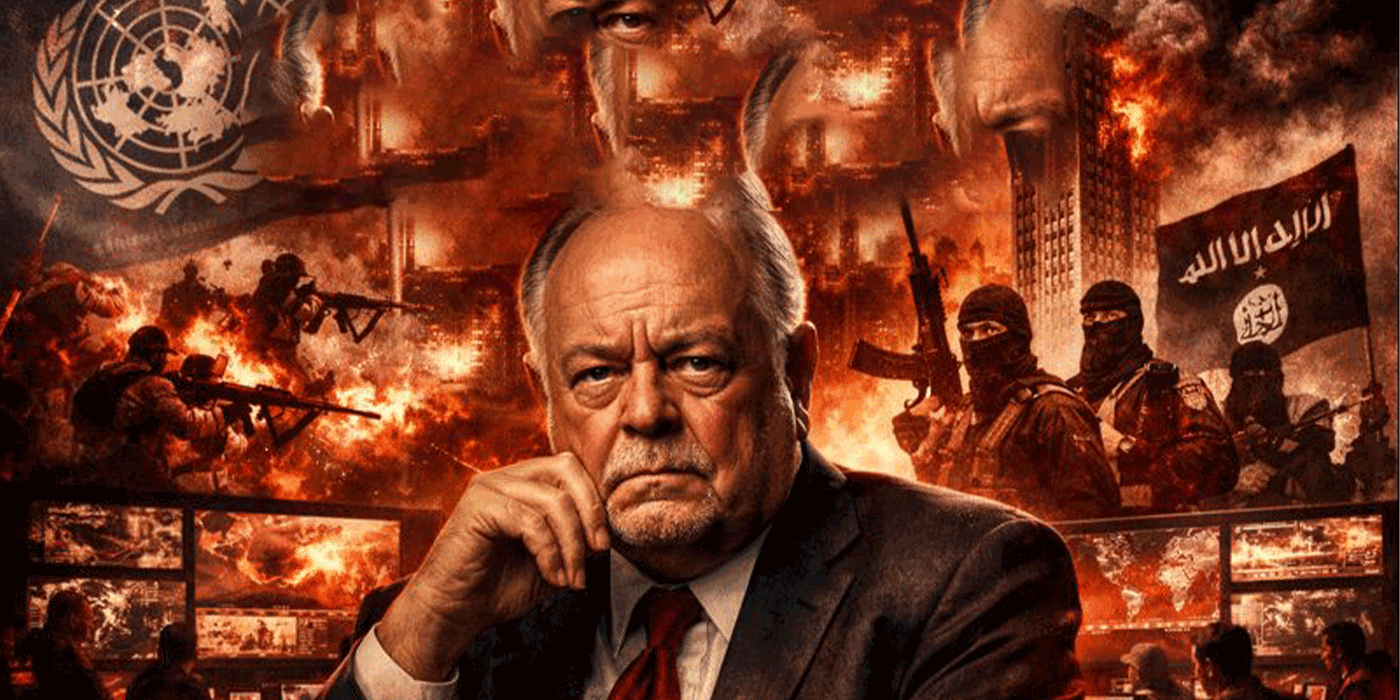
Al-Qaeda at the United Nations - Chas Freeman
The Insider’s Judgment: Biography and Uncomfortable Truth
Chas Freeman belongs to a rare generation of American diplomats who understood foreign policy not as ideology, but as a craft. He served for decades in the U.S. Foreign Service — not as a public figure, but as a strategist, negotiator, and sober analyst of global power shifts.
Freeman served as U.S. Ambassador to Saudi Arabia, later became president of the Middle East Policy Council, and advised senior decision-makers during the Cold War and the turbulent decades that followed. He was directly involved in sensitive diplomatic engagements with China, the Middle East, and countries of the Global South.
💬 “Diplomacy does not fail because enemies are strong — it fails because illusions about power prevail.”What distinguishes Freeman from most contemporary commentators is his institutional experience. He understands how governments, intelligence services, and multilateral organizations think — from the inside. Today, he analyzes them with the distance of an insider who no longer has a career to protect.
His warnings are not directed at individual states, but at structural failures of Western foreign policy: moral double standards, strategic short-sightedness, and the growing instrumentalization of non-state actors for geopolitical objectives.
While Donald Trump delivers what Freeman describes as a “completely unhinged” campaign speech before the UN General Assembly, a former Al-Qaeda leader is celebrated in New York as a democrat — and almost no one seems to notice the irony.
Trump’s UN Speech: Campaign Rhetoric Instead of World Politics
“This man is completely unhinged” — diplomats texted each other during Trump’s address to the General Assembly.
Donald Trump’s appearance before the United Nations on September 26, 2025, was not an act of diplomacy, but a domestic political performance. Ambassador Chas Freeman, a former senior defense official and China diplomat, delivered an unsparing assessment of the speech.
💬 “He delivered a domestic campaign speech. He lives inside a bubble.”As Trump spoke, diplomats in the hall exchanged messages describing their disbelief. Freeman recounts texts such as: “This man is completely insane. He’s unhinged. How can Americans not see this?” The gap between Trump’s self-perception and the international reaction could hardly have been more pronounced.
Trump’s core messages were:
- Climate change was described as a “fraud,” a “hoax perpetrated by con artists”
- The United States would continue expanding fossil fuel production
- His advisers assured him that he was “the greatest speaker since Demosthenes”
The contrast with Xi Jinping was stark. While Trump denied the reality of climate change, China announced a plan to reduce global greenhouse gas emissions. Freeman noted that the proposal was insufficient to avert global warming, but emphasized that it was the first time any major power had articulated such a commitment.
Trump’s appearance, however, was not the most disturbing moment at the General Assembly. An even more unsettling speech followed from Benjamin Netanyahu. Delegates reportedly left the chamber as the Israeli prime minister boasted about bombing and killing across the region, openly claiming responsibility for regime change operations and targeted assassinations.
Freeman summarized the tone bluntly, recalling statements such as:
💬 “I killed the prime minister of Yemen,” among others.Freeman poses a fundamental question. Does Netanyahu’s rhetoric not confirm what he describes as a growing global consensus — that Israel is increasingly perceived as a state acting without moral restraint? This moral collapse, he argues, inevitably raises a deeper issue: whether the international community can indefinitely tolerate such behavior.
The Middle East Envoy Without a Vision
“The endgame is dominance” — Tom Barrack’s candid but catastrophic assessment.
Tom Barrack, President Trump’s envoy to the Middle East, revealed a worldview in an interview that Chas Freeman describes as historically illiterate and politically bankrupt. Asked about the “endgame” in Palestine, Barrack replied:
💬 “The endgame is dominance. Someone has to submit. There is no Arabic word for ‘submission’ in this region.”Freeman dismantles this claim methodically, beginning with history. He calls it absurd to suggest that the Middle East has never known peace, pointing instead to the Ottoman Empire, which sustained long periods of stability in the region. It was, he notes, a society in which diverse religious and ethnic communities coexisted for centuries.
What undermined the Ottoman peace:
- European colonialism
- The collapse of the Ottoman Empire and the rise of Turkish nationalism
- The mass killing of large portions of the Armenian population
- The arrival of ethnonationalist Jewish movements from Eastern Europe under the banner of Zionism
Freeman considers it deeply troubling that the United States’ representative in the region appears to lack any vision for peace. Yet the deeper problem, he suggests, lies in Barrack’s unfamiliarity with Arabic language and culture.
Responding to the claim that Arabic lacks a word for “submission,” Freeman offers a linguistic and theological correction. The word “Muslim,” he explains, literally means one who submits to God, and “Islam” itself denotes submission. He recalls a conversation with the head of the World Muslim League, who, when asked who the best Muslim he had ever met was, replied:
💬 “That it was a Jew — a deeply pious man who ordered his life according to the shared ethical principles of the Jewish, Christian, and Islamic traditions.”Freeman also cites an Arabic proverb: “Kiss the hand you cannot bite.” Its meaning is straightforward — when accommodation is necessary to protect one’s interests, it is practiced. From this, Freeman concludes that the region possesses a long and well-understood tradition of submission to power, directly contradicting Barrack’s claim.
Al-Julani at the United Nations: From Terrorist to Democrat
General Petraeus praises an Al-Qaeda leader — and no one asks about the beheadings.
One of the most grotesque moments at the United Nations was the treatment of Ahmad al-Sharaa, also known as al-Julani, now presented as Syria’s new leader. Chas Freeman poses the question bluntly: he cannot recall any precedent in UN history comparable to al-Julani’s case. In Freeman’s words, al-Julani is quite literally one of the leaders of Al-Qaeda.
David Petraeus, former CIA director and commander in Iraq and Afghanistan, delivered a public tribute to al-Julani that Freeman describes as extraordinary in the worst sense of the word.
💬 “Your vision is powerful. We hope for your success, inshallah, because your success is our success.”Freeman recalls the background that made this situation possible. In 2011, the United States spent five billion dollars attempting to create what were described as “moderate jihadists,” a term Freeman calls deeply strange. The outcome was predictable. Many of those trained by U.S. intelligence and military forces in places such as Saudi Arabia and Jordan crossed the border and promptly joined Al-Qaeda.
Al-Julani’s support network consisted of:
- Israel, in opposition to the Assad government
- Turkey, pursuing its own regional interests
- The United States, driven by a regime-change agenda
There is no doubt, Freeman emphasizes, that al-Julani was responsible for beheadings. He embodied some of the most extreme practices of Salafist Islam. To now present him as a democrat is, in Freeman’s assessment, remarkable.
Freeman concedes that individuals can repent for past crimes. Yet he adds that conditions on the ground do not support claims that a tolerant, emerging democracy is taking shape. In Syria, Alawites, Druze, and Christians are being systematically killed by al-Julani’s followers, while Israel cooperates with Druze and Kurdish groups in efforts that Freeman describes as the fragmentation of the Syrian state.
Qatar and Saudi Arabia played a central role in enabling this outcome. Freeman points to Bandar bin Sultan, the former Saudi ambassador to the United States, whom he describes as a fighter pilot with an aggressively interventionist approach to regime change in the region. The United States, Freeman concludes, was complicit throughout this process, making it unsurprising that Petraeus now seeks to rehabilitate and sanctify a former jihadist.
Palestine: The Illusion of the “Deal”
Tony Blair as governor of Gaza — colonial fantasies in the 21st century.
Donald Trump optimistically announced that he was “very close to a deal in Gaza.” This deal, he claimed, would “bring the hostages home,” “end the war,” and “deliver peace.” Chas Freeman sees no diplomacy in this vision, describing it instead as the mindset of a real estate developer rather than that of a diplomat.
The reality behind this so-called deal is sobering. Tony Blair was nominated to serve as governor of Gaza for five years. Freeman comments dryly that no Palestinian participation would be required, calling it a purely colonial undertaking.
What the “Gaza resort plan” entails:
- Ethnic cleansing of the Palestinian population
- Continuation of mass killing
- No Palestinian self-determination
- A focus on hostages rather than Palestinian rights
Freeman draws a historical parallel to underscore the long-term consequences.
💬 “Jews were dispersed for two thousand years and never abandoned their desire to return. What makes anyone believe Palestinians will be different?”Israel, Freeman argues, is creating a threat that could persist until it ultimately destroys the state itself. He asks whether this truly resembles any agreement that could be acceptable to those most affected.
This process of self-destruction is accelerated by the rhetoric of Benjamin Netanyahu. Speaking at the United Nations, Netanyahu declared:
💬 “Israel will not allow you to impose a terrorist state on us. We will not commit national suicide.”Trump’s promise to prevent Israel from annexing the West Bank, Freeman cautions, should be treated with considerable skepticism. He recalls George W. Bush, who once claimed he would stop Israel from entering Jenin, only to be ignored as Israel proceeded regardless.
The Abraham Accords, originally intended to prevent annexation, have effectively collapsed. Even the United Arab Emirates have signaled that annexation would not lead to a rupture in diplomatic relations with Israel. Freeman asks what foundation the Abraham Accords now rest upon.
Particularly troubling, Freeman argues, is the international recognition of a Palestinian state by roughly eighty percent of the world’s countries. This recognition, he warns, benefits not the Palestinian people but the Palestinian Authority and its surrounding elite. The Authority is now widely regarded by Palestinians as corrupt and illegitimate, having not emerged from an electoral process.
The Palestinian dilemma:
- The last election was won by Hamas, not Fatah
- The Palestinian Authority functions as a collaborationist regime
- International recognition legitimizes continued collaboration
- Genuine self-determination remains out of reach
Before those who hope for Palestinian self-determination celebrate these developments, Freeman concludes, it is worth recognizing that the world has effectively empowered an illegitimate collaborator with the occupation to continue collaborating.
Iran: ICBM Development as a Logical Consequence
“Maximum pressure” produces maximum threat — the North Korea lesson repeated.
The Iranian nuclear question exposes the full incoherence of Western policy. Chas Freeman is explicit: it was the United States that withdrew from the JCPOA, not Iran. Only after that decision did Iran begin, very gradually, to deviate from the agreement.
Europe’s position is particularly contradictory. European governments demanded Iranian cooperation with the IAEA and, in return, promised to withdraw the snapback mechanism. Iran accepted. Russia then proposed a compromise: a six-month delay of the snapback to make negotiations more viable. Iran accepted this as well.
Then came the reversal. European governments rejected the proposal, insisting that the United States had to be involved. When Iran subsequently suggested returning to JCPOA negotiations with all parties present, the Europeans again rejected the idea.
Freeman draws what he considers the only logical conclusion. Europe, he argues, does not appear interested in an agreement with Iran. Instead, it is attempting to appease President Trump.
The consequence is dramatic:
The policy of maximum pressure — the same policy that drove North Korea to develop an intercontinental ballistic missile — is now being applied to Iran. Freeman reports that Iran appears to have tested an ICBM roughly a week ago.
💬 “If religious restraints were abandoned, this ICBM could be fitted with nuclear warheads.”The assumption that the United States can act with impunity while Iran remains incapable of striking back will not hold for long. Freeman notes that this illustrates the limits of policies designed to force submission from other countries. Some states, he argues, possess the pride and determination never to submit, and Iran belongs to that category.
Russia had offered a constructive proposal: placing Iran’s uranium enriched to sixty percent under Russian custody and converting it into fuel, thereby removing it from a level easily convertible into weapons. Freeman notes that Iran apparently accepted this proposal, yet nothing came of it.
A fundamental question therefore remains unanswered. There is still no evidence that Iran has made a decision to build a nuclear weapon. President Pezeshkian has denied such intent. Freeman asks why the Iranian president should be considered less credible on this issue than Prime Minister Netanyahu.
The Israeli context is central:
- Israel secretly developed nuclear capabilities
- Between ninety and one hundred warheads were produced at Dimona
- Iran has released detailed information about Dimona
- Israel is planning further attacks on Iran
Freeman defines peace in pragmatic terms. Peace, he argues, is a stable order that is sufficiently acceptable to all actors with the power to overturn it, such that none choose to do so. Current demands imposed on Iran, Syria, Lebanon, and Palestine, he concludes, are neither just nor fair. It is therefore unsurprising that they generate resistance rather than acceptance.
Tucker Carlson’s Anger: “I Control the United States”
When a country of nine million people humiliates one of 350 million — and boasts about it.
Tucker Carlson’s outburst over what he describes as Israeli control over the United States reflects a growing frustration now visible across the political spectrum. His remarks were unusually direct.
💬 “I don’t own this country, but I’m a shareholder in it. I’m an American, and you can’t use my country like a disposable product. That’s not acceptable.”The core accusation follows immediately. According to Carlson, Benjamin Netanyahu openly tells audiences in the Middle East that he controls the United States and controls Donald Trump. Carlson insists this is not speculation, but something he has heard confirmed by multiple people who were told this directly.
Chas Freeman corroborates the broader pattern. He recounts that an Israeli interlocutor once offered to “arrange” any position Freeman wanted within the Bush administration. Freeman’s reaction, he says, was visceral — he nearly leapt across the table in anger.
Freeman identifies a notable convergence between left- and right-wing critics:
- The left rejects Israel over severe human rights violations, breaches of international law, and what is described as profoundly amoral policies.
- The right rejects Israel over national humiliation — the perception that a smaller country exercises control over the U.S. government through campaign financing.
Freeman warns that Israel is losing support in the United States at a pace it cannot afford. The figures, he notes, are stark. Only six to eight percent of Democrats still support the relationship, and even among Republicans support no longer commands a clear majority.
The historical parallel is disturbing. Freeman recalls the Crusader States:
💬 “In the Middle Ages, two Christian kingdoms were established in Palestine. Each lasted less than one hundred years because they lost the support of the external powers that sustained them.”The United States, Freeman argues, has not only shielded Israel diplomatically at the United Nations and armed it extensively, but is now actively implicated in its actions. This trajectory, he warns, could prove fatal for Israel itself, and he questions why such a course would be celebrated within the country.
Freeman also highlights what he sees as a striking double standard:
While intense political and media attention has focused on alleged Russian interference in U.S. elections, little attention has been paid to what he describes as the most open and obvious manipulation of American politics — influence exerted by Israel.
The phrase “the U.S. Congress is Israeli-occupied territory” comes to Freeman’s mind. He observes that outrage over this perception is growing on both the left and the right, albeit for different reasons.
Netanyahu, Freeman concludes, made a strategic error by turning relations with Israel into a partisan issue. Republicans increasingly defend the relationship, while Democrats increasingly reject it. The result is the erosion of bipartisan support — something Israel critically depends on.
Lebanon: An Armed Government Against Its Own People
Tom Barrack’s plan: funding an army to fight the majority.
Tom Barrack’s vision for Lebanon reveals a profound ignorance of Lebanese society. His position is explicit. The primary objective for Lebanon, he argues, is to arm the government so that it can fight its own population. The purpose is not to enable it to fight external adversaries, but to suppress internal opposition.
Chas Freeman dismantles this strategy methodically. Lebanon, he explains, is an extremely complex society marked by deep religious and ethnic divisions. The French creation of Lebanon as a Christian enclave is no longer viable. Today, Lebanon is a majority Shiite society, with Christians constituting a relatively small minority and Sunnis also a minority.
The Lebanese dilemma:
- A confessional political system dating back to 1920 no longer reflects demographic reality
- Hezbollah represents the vast majority of the Shiite population
- The Lebanese army has defended the country neither against Israel nor against Syria
Freeman is unequivocal. Hezbollah represents the great majority of Lebanon’s Shiite population, even if not all of it, and it possesses a legitimacy that cannot simply be dismissed.
The American demand — to disarm Hezbollah and then arm the Lebanese army — is absurd on multiple levels.
💬 “The Lebanese army has never defended Lebanon against Israel. It has never defended it against Syria.”This strategy, Freeman argues, places the United States on the side of a minority against the majority of the Lebanese population. As a result, it is unlikely to be sustainable, even if it could be implemented.
The comparison with Syria is instructive. People in Lebanon are watching what is happening there. A former Al-Qaeda leader is being rebranded as a democrat, while minorities inside Syria are being killed. Freeman does not believe that Lebanese society will fall into the same trap.
Ukraine: Trump Gives Up, Europe Pays the Bill
“Putin is not marching on Boston” — but Europe is expected to give everything.
The Trump administration’s Ukraine policy follows a clear pattern. The president retreats without admitting defeat and shifts responsibility onto Europe. J.D. Vance announced the new line publicly:
💬 “The president is currently growing impatient with the Russians because he feels they are not putting enough on the table.”Chas Freeman translates this rhetoric into reality. Donald Trump has concluded that he cannot end the war on the terms he expected. The war will continue, but responsibility has been handed to Europe. Trump has now publicly declared that this is a European war and that the United States is no longer involved.
The absurdity peaks when Trump claims that Ukraine might still recover all of its lost territory. Freeman responds dryly that this is absurd.
Trump’s strategy of responsibility transfer:
- Declaring Ukraine a “European war”
- Preparing Europe to be blamed for failure
- Completely ignoring Russia’s war aims
Freeman criticizes the superficiality of this approach. Simply talking about ending the killing achieves little, he argues, because wars are fought for specific objectives.
Russia’s objectives have always been clear. They include protecting Russian-speaking populations, ensuring a neutral Ukraine without anti-Russian military forces, and initiating a broader discussion about European security. Freeman stresses that these goals were never ambiguous. Ignoring them is precisely why negotiations with Russia have failed.
A particularly dangerous demand came from Scott Bessent, who urged Europe to “put everything on the table.” His reasoning was blunt:
💬 “All I hear from you is that Putin wants to march on Warsaw. One thing I know for sure is that Putin is not marching on Boston.”Freeman exposes the hypocrisy. It is easy, he says, to shift all costs onto Europe, which is exactly what the United States has done. The destruction of Nord Stream 2 has already hollowed out the German economy. Europe’s economies are now stagnating.
Freeman issues a central warning. Europe cannot be rebuilt through a combination of austerity and rearmament. Such a strategy will not produce a prosperous, democratic, and stable Europe.
He identifies a fundamental contradiction in Europe’s position. On the one hand, European leaders claim Russia is a grave threat capable of marching to Paris. On the other, they argue that Russia is weak and unable to advance in Ukraine. Freeman notes that it cannot be both.
Freeman also expresses skepticism regarding the recent wave of drone incidents in Denmark and other European countries. There are ample reasons, he argues, to question these events. The term “false flag” has been raised, and Freeman considers it a plausible explanation.
He sees no rational incentive for Russia to conduct such attacks. From his perspective, they appear staged to reinforce European commitment to the war.
Europe’s strategic schizophrenia:
- Multiple proposals to expand and intensify the war
- Not a single concrete proposal for peace
- No discussion of a European security architecture
The core problem, Freeman concludes, is that Europe has failed to acknowledge the long-term necessity of discussing a security framework in which Europe feels secure vis-à-vis Russia and Russia feels secure vis-à-vis Europe.
Vladimir Putin once captured Europe’s self-destructive posture with biting clarity: if Europe were asked to hang itself, it would ask whether it should use European rope.
Pete Hegseth and the Generals: Echoes of 1934
When a defense secretary summons all flag officers — is this about Venezuela, or about loyalty?
The announcement of an “urgent meeting” between Defense Secretary Pete Hegseth and “hundreds of generals and admirals” triggered widespread speculation. Chas Freeman sees no foreign-policy rationale in the move, but rather a domestic political signal.
The historical parallel, he suggests, is unsettling.
💬 “In 1934, German generals were assembled to swear a personal oath of loyalty to Adolf Hitler rather than to the Weimar Republic.”Freeman believes the central issue is loyalty, a defining theme of the Trump administration. Appointments, he argues, are not driven by competence, but by conformity. Those perceived as insufficiently aligned with the president’s views are removed.
What the meeting may signify:
- A warning to all flag officers, from brigadier generals to four-star commanders
- A lecture on loyalty to Trump
- No substantive connection to foreign-policy issues such as Venezuela, Iran, or China
The insecurity of Trump and Hegseth, Freeman argues, is evident. They demand a level of obedience and the suppression of dissent that is without precedent.
A particularly disturbing example is Tulsi Gabbard’s decision to cancel the intelligence community’s long-term assessments. These reports, Freeman notes, were highly valuable and incorporated foreign perspectives, including those of China, Russia, and others.
Why were they canceled? Because forward-looking assessments include issues such as climate change — topics that have become politically unacceptable for the Trump administration even to consider.
Freeman draws a stark conclusion. The government is being told to engage not with observable reality, but with the reality that exists inside Donald Trump’s mind. Freeman warns that this is extremely dangerous.
Conclusion: Piercing the Media Bubble
Chas Freeman closes with an appeal that encapsulates the entire interview.
💬 “We live inside a media bubble that must be pierced, because it has less and less to do with reality.”The core findings of the interview are strikingly consistent.
Trump operates inside a bubble, delivers campaign speeches instead of practicing diplomacy, and is widely perceived abroad as unhinged.
Israel is losing support across the political spectrum, openly influences American policy, and repeats the historical mistakes of the Crusader states.
Syria, a former Al-Qaeda leader is celebrated as a democrat while minorities are being killed — with General Petraeus applauding.
Iran, the policy of maximum pressure produces ICBM development, just as it did in North Korea, yet no lessons are learned.
Ukraine, Trump disengages and shifts responsibility to Europe while the continent’s economy is steadily hollowed out.
Inside the United States, loyalty is valued over competence, reality is replaced by Trump’s worldview, and historical parallels to 1934 become unavoidable.
Freeman’s definition of peace remains central.
💬 “Peace is a situation that is sufficiently acceptable to all parties with the power to overturn it, such that none choose to do so.”Current American policy produces the opposite outcome. It creates conditions so unjust that they generate resistance rather than acceptance.
The question is no longer whether American foreign policy is failing. The question is how catastrophic the consequences will be if no one is willing to pierce the media bubble and confront reality.
Thank you, Chas Freeman.
Sources & Geopolitical References
Substack – US-Edition
This article is also available as a English-language edition on Substack:
Al-Qaeda at the United Nations – When Terrorists Are Rebranded as Democrats - Chas Freeman
Original conversation (video)
YouTube-Interview:
Al Qaeda gets a seat at the UN - Chas Freeman
Support Independent Journalism
If you find my work valuable, you can support it with a voluntary contribution here:
Voluntary support via PayPal
Voluntary support via Buy Me a Coffee
Many thanks for your support!

More Articles
How America’s Economic War on Russia - Richard Wolff
An Indictment of 80 Years of Vassal Politics - Larry Johnson
America’s New Imperialism - John Mearsheimer

investigative commentary.