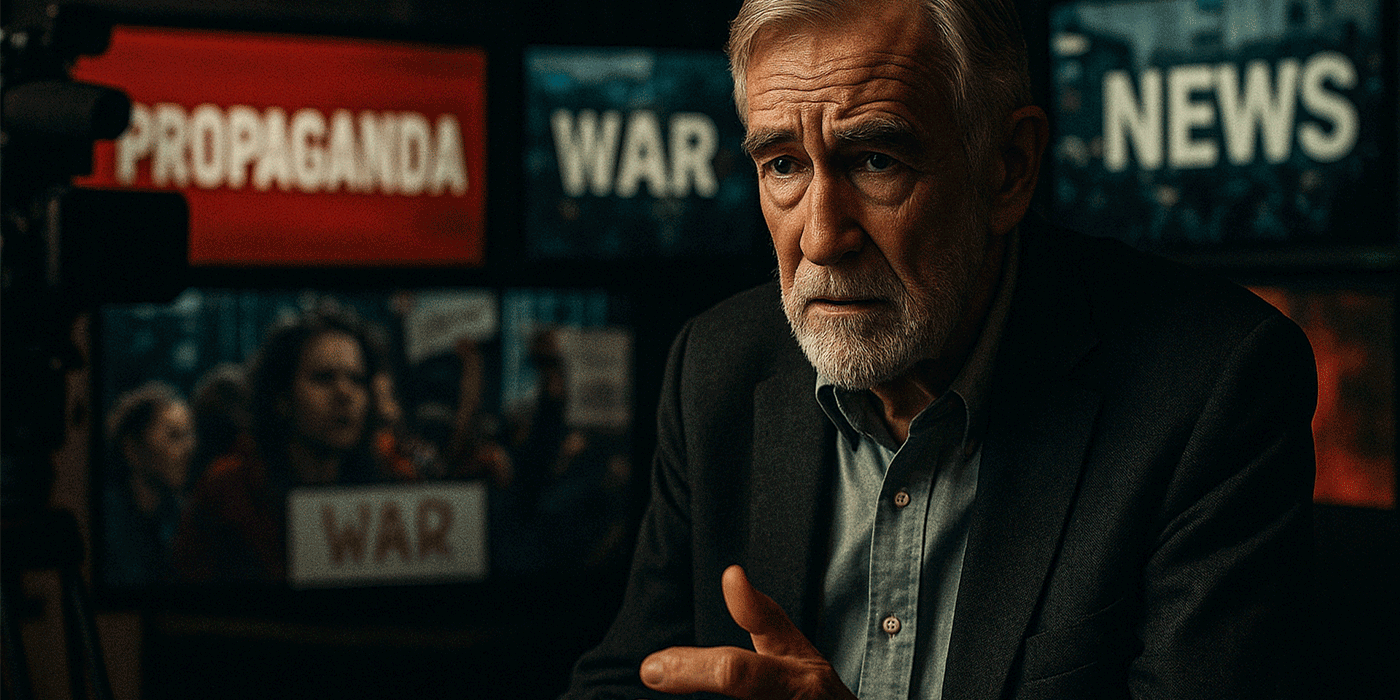
Europe Is Playing with Fire – Ray McGovern
The Insider and His Verdict: Biography and an Uncomfortable Truth
From the innermost circle of U.S. intelligence to an uncompromising critic of power.
Ray McGovern’s analysis is an examination of the systemic abandonment of Western diplomatic principles.
Ray McGovern grew up in the Bronx, New York City, studied Russian and Soviet studies at Fordham University, and served briefly as an infantry and intelligence officer before joining the CIA’s analytical division in 1963. He completed a 27-year career—under seven U.S. presidents—and at times served as head of Soviet foreign policy analysis. In the 1980s, he was responsible for preparing National Intelligence Estimates and regularly briefed the President through the “President’s Daily Brief.”
After retiring in 1990, McGovern transformed from intelligence insider into whistleblower and activist. In 2003, he co-founded Veteran Intelligence Professionals for Sanity (VIPS) to expose the abuse and political manipulation of intelligence. In a powerful act of protest, he returned his Intelligence Commendation Medal in 2006 to express his profound unease with the CIA’s role in torture and intelligence operations conducted in the name of war.
💬 “If an empire is to fall, it will not be brought down by bombs—but by the truth.”McGovern articulates a clear and uncompromising principle: intelligence services must never become instruments of political manipulation—truth and transparency must stand above power.
Today, he operates outside official circles as an independent commentator, author, and warning voice. His criticism targets war propaganda, manufactured narratives, and the deliberate distortion of intelligence—especially in the context of wars, regime-change operations, and media manipulation.
On the European continent, he observes a kind of collective madness—a painful departure from reason, diplomacy, and the pursuit of peace—as Europe desperately struggles to assert relevance in a multipolar world order. Germany in particular appears to have assumed the role once held by the United States: Russia’s most antagonistic opponent in Europe.
Through his travels and conversations, McGovern identifies a deeply rooted Russophobia embedded in Western thinking. What he uncovered about the alleged war readiness of the West is not a theoretical critique, but the diagnosis of a strategically manufactured hysteria.
The Invention of the “Russiagate” Hysteria
How a political narrative became a global escalation machine.
Ray McGovern, who served for 27 years as a senior analyst advising U.S. intelligence services, describes a dangerous, deliberately manufactured form of madness in Europe. For him, the erosion of reason, diplomacy, and the pursuit of peace is not accidental, but the direct result of a global disinformation campaign orchestrated by an American power elite within the so-called Deep State to advance geopolitical objectives.
💬 “The United States has become a nation of people—not of laws.”Especially in Germany, McGovern argues, an aggressive Russophobia has become pervasive—a posture that forces the country into a role it should never have assumed, historically or strategically. Germany has effectively replaced the United States as Russia’s primary adversary in Europe, thereby enabling the return of war to the European political consciousness.
Western rhetoric of confrontation, he contends, is not grounded in rational threat assessment but in the fabricated narrative of Russian hacking and alleged interference in the 2016 U.S. presidential election.
The Construction of the Enemy Image – The Existential Danger of the Lie
Why fabricated threats are more dangerous than real adversaries.
For McGovern, the foundation of this strategic hysteria is unmistakable: the fabricated accusation of a Russian hacking operation. The “Russiagate” lie, he argues, is not an ordinary deception but a crime against analytical integrity and international security.
McGovern pursues this case with the precision of a former analyst—not out of vengeance, but out of obligation to the facts. He understands the existential danger posed when a major power, possessing the world’s largest nuclear arsenal, is confronted on the basis of a manufactured threat.
The true danger of this lie lies not only in its falsehood, but in its strategic effect: it replaces sober analysis with moralized outrage and transforms political decision-making into an echo chamber of escalation. An enemy image built on fiction leaves no room for correction—and therein lies its destructive power.
The Strategic Obligation to Truth
When lies become state doctrine, the abyss draws closer.
McGovern issues an unequivocal warning: In a world where leading powers control nuclear codes and the Doomsday Clock stands closer to midnight than ever before, the falsification of truths that lead to unnecessary confrontation is not a political misstep—it is an act of strategic arson.
A foreign policy enemy image built on lies poisons diplomatic channels, creates a self-fulfilling prophecy of hostility, and increases the risk of miscalculation in times of crisis. Rational dialogue with Moscow is thus systematically dismantled—by the hysteria of the Deep State.
In such an environment, truth is no longer regarded as the foundation of political stability but as a disruptive force. Those who insist on facts are branded disloyal; those who argue for de-escalation are dismissed as naïve. Strategic responsibility is thereby shifted away from preventing war toward its silent normalization.
The Complicity of Intelligence Chiefs
When analysis was replaced by loyalty.
The official claim that Russia hacked the Democratic National Committee (DNC) was politically orchestrated at the highest levels. Former intelligence chiefs such as John Brennan (CIA), James Comey (FBI), and James Clapper (DNI) promoted this narrative—betraying the core principle of independent, apolitical analysis.
💬 “McGovern shows: The whole thing was fabricated. There was no Russian hack.”His conclusion rests on verifiable technical evidence and decades of expertise in U.S.–Russia relations—evidence that political actors deliberately ignored to cement the desired narrative. By adopting this lie, the highest intelligence officials abused the authority of the state to manufacture a political fiction.
The consequence of this moral capitulation is stark: a public that should be able to trust its intelligence services to prevent war is rendered strategically blind. The enemy image thus becomes a domestic political weapon—used to manage public opinion and legitimize expanding military budgets.
The Enemy-Image Mechanism and the Alienation of Europe
How Washington’s narratives fuel Europe’s strategic self-destruction.
The consequences of the Russiagate lie extend far beyond the United States. It provides the ideological justification for the deliberate strategic alienation of Europe from Russia.
The artificially constructed enemy image forces Washington’s allies—especially Germany—into an aggressive, irrational Russophobia.
- Undermining sovereignty: European sovereignty is eroded, binding the continent militarily and economically to American interests.
- Normalizing war: The enemy image functions as a tool to normalize the return of war within the European mindset.
- Discrediting reason: Rational diplomacy is denounced as “weakness” or “appeasement.”
In the end, Europe sacrifices its strategic relevance in a multipolar world to the simple—but dangerous—dogma of enmity.
The Strategic Logic of the Kremlin – Rejecting Unpredictability
Why Moscow seeks stability—and fears chaos.
The claim that Vladimir Putin favored Donald Trump in order to manipulate the U.S. election is, from a strategic perspective, irrational, illogical, and dangerous. It exposes the analytical short-sightedness of the intelligence chiefs who constructed this narrative. Ray McGovern dismantles it with the cold logic of geopolitical reality.
From the standpoint of Russian security doctrine, political predictability is not a diplomatic nuance but an existential necessity. In a system of mutual nuclear deterrence, stability is determined not by sympathy, but by the reliability of signals, commitments, and red lines.
An unpredictable actor at the helm of the United States therefore does not increase strategic advantage, but the risk of losing control. For the Kremlin, unpredictability represents not a geopolitical opportunity, but a threat to the last remaining mechanisms designed to prevent a catastrophic false alarm.
The Dogma of Stability in the Nuclear Age
Predictability as the last line of defense against nuclear accident.
What a Russian president actually expects from an American president is, above all, predictability and adherence to clearly defined strategic security zones.
The supreme dogma of the nuclear era.
- Predictability as a shield: Given the nuclear capabilities of both states and the extremely short reaction time between warning and retaliation, the predictability of the other side is the most critical safeguard against a nuclear miscalculation.
- Uncertainty as a risk multiplier: Any uncertainty at the highest level of leadership multiplies the risk of an unintended yet catastrophic conflict. The Kremlin operates strategically—not emotionally.
Yet the official intelligence narrative, driven by political interests, ignored this logic entirely. Honest analysts within the CIA knew that Putin had no preference for Trump. Drawing on decades of experience with Russia, they argued that the Kremlin would have preferred Hillary Clinton—guided by the principle that “the devil you know is better than the devil you don’t.”
Trump as a Strategic Risk
Unpredictability as a geopolitical accelerant.
Hillary Clinton was predictable from Moscow’s perspective. Her stance was hostile, but embedded within familiar structures of American foreign policy.
Donald Trump, by contrast, embodied the exact opposite: unpredictability.
- Threat to strategic constants: His rhetoric about abandoning international agreements, his erratic treatment of allies, and his disregard for diplomatic protocols made him a strategic risk of incalculable magnitude.
- Absurdity of the narrative: The notion that Putin would promote a leader whose defining characteristic was the destruction of all strategic constants is, from Moscow’s viewpoint, simply absurd.
- The Kremlin seeks stability: Moscow prioritizes stability—particularly in nuclear arms control and the containment of military interventions. Trump, however, threatened to dismantle precisely these last remaining pillars of global security.
The narrative of Putin’s supposed preference for Trump therefore had to be fabricated to provide an ideological foundation for the accusation of election manipulation. In doing so, rational statecraft was replaced by ideologically charged hostility that ultimately served only the political elites in Washington.
The Poisoning of the Analytical Source
When intelligence agencies begin to believe their own lies.
The intelligence chiefs chose a narrative that was politically useful but analytically toxic. They constructed a fiction in which Russia was portrayed not as a rational actor, but as a malevolent manipulator whose objective was the destruction of American democracy.
💬 “Telling the truth is not treason. In fact, our country needs more of this kind of ‘treason.’”This poisoning of the analytical source meant that all future communication with Moscow was no longer filtered through the lens of rational geopolitics, but through the ideological prism of an alleged “genetic hostility.” The result was the cementing of division, escalating tensions, and the justification of military escalation—an outcome that, in the nuclear age, can only be described as an existential danger.
The long-term damage lies in the loss of analysis as a corrective force. When intelligence services no longer exist to challenge political falsehoods but to reinforce them, strategic blindness becomes the new normal—and it is precisely this blindness that makes escalation not only possible, but likely.
The Technical Proof of the Lie – The Irrelevance of the Internet and the Local Copy
Forensics versus propaganda.
Analytical integrity forbids accepting political claims that contradict the immutable laws of physics and digital forensics. Technical analysis exposes the accusation of a “Russiagate hack” not merely as false, but as a deliberate, strategic falsification of the truth.
Forensic investigations, documented in a sworn affidavit dated December 5, 2017, dismantled the official narrative with the incorruptible logic of the machine.
This causes the foundation of the entire narrative to collapse—not politically, but technically. What remains is no longer a matter of interpretation, but a matter of willful disregard for verifiable facts—a condition in which propaganda openly assumes the role of evidence.
The Physical Impossibility of the Hack
Why the data contradicts the story.
The sober technical reality is this: there is not a single piece of evidence showing that emails from the Democratic National Committee (DNC) were exfiltrated over the internet. This is the decisive, technically compelling fact that brings the entire narrative crashing down.
Had there been an external hack—whether from Russia or elsewhere—clear digital traces of data exfiltration abroad would have had to appear in the server logs and network traffic. No such traces exist.
The head of the forensic team operating outside the FBI, a former bureau employee and independent expert, confirmed under oath:
💬 “There was no hack—neither from Russia nor from anyone else.”The physical logic is unavoidable: the data was copied locally.
This conclusion pulls the foundation out from under the entire Russiagate narrative because it rests not on political judgment, but on measurable reality. When basic physical and technical parameters are ignored to sustain a preferred narrative, analysis turns into deliberate deception—with predictably dangerous strategic consequences.
The Mathematics of Transmission – The Signature of the Copy
Timestamps, bandwidth, and the logic of the machine.
Ray McGovern and the group Veteran Intelligence Professionals for Sanity (VIPS) conducted a detailed analysis of the metadata associated with the published DNC emails.
The result was positive proof of a local copy.
- The 90-second rule: The total data volume of the emails was copied and transferred in less than 90 seconds.
- The local signature: The measured transfer speed—in megabytes per second—was physically achievable only via a direct local connection, such as copying to a USB stick or an internal hard drive.
- The timestamps: An internet connection—even at the best bandwidth available at the time—would have required many times longer for this data volume. The timestamps and transfer rate revealed the unmistakable signature of an internal operation.
This makes the claim of a Russian cyberattack technically untenable and exposes it as a deliberate falsification of forensic facts.
The Strategic Consequence of the False Statement
How a lie reshaped foreign policy.
McGovern underscores the strategic magnitude of this lie.
- Political orchestration by the FBI: The fact that the FBI—contrary to its standard procedures—did not conduct its own forensic examination but instead relied on reports from a private security firm demonstrates the political nature of the accusation.
- Knowledge at the highest level: The FBI did not need to inspect the DNC servers because the government already knew the truth: there was no hack.
The entire narrative that has shaped U.S. and European foreign policy since 2016 therefore rests on a technically refuted foundation. This manipulation of facts is the price the West pays for its strategically cultivated Russophobia—a posture that now serves as the ideological basis for escalation and enemy-image construction in Europe.
The fact that intelligence agencies deceived the public with a technically impossible fiction demonstrates their willingness to sacrifice fundamental principles of analysis for political objectives.
The Strategy of Political Manipulation
Manufactured hysteria as an instrument of power.
The falsification of truth, McGovern argues, was not an accident or a mistake made in the heat of political conflict, but the result of calculated strategy. He shows how top political and intelligence circles deliberately suppressed the truth and ignited a controlled hysteria that undermined national interests—all in order to steer electoral dynamics and conceal their own political failures.
This form of manipulation follows a recurring pattern: first, a threat scenario is constructed; then it is amplified through the media; and finally, it is institutionalized politically. Once the narrative is anchored, any dissenting analysis is branded a threat to national security—not because it is wrong, but because it disrupts the power calculus.
In this process, hysteria replaces rational judgment. It generates moral pressure, narrows decision-making space, and legitimizes measures that would otherwise encounter resistance. Fear thus functions not as a byproduct, but as a deliberately deployed instrument of political control.
The Strategic Refusal of Disclosure – Censorship as an Act of Betrayal
When truth is deliberately suppressed.
The first—and most shocking—form of manipulation was the active censorship of forensic evidence that could have irrevocably destroyed the entire narrative of an alleged Russian hack.
Suppression by the Intelligence Committee
The sworn affidavit that technically proved no hack had occurred and that the data had been copied locally was suppressed for more than two and a half years by Adam Schiff, then Chairman of the House Intelligence Committee.
Institutional Betrayal
Although the testimony—backed by the incorruptible logic of forensic analysis and demonstrating that Russia had not infiltrated the DNC systems—was submitted as early as December 5, 2017, Schiff blocked its publication. This was not a routine political maneuver, but an institutional betrayal of the truth.
💬 “Our Bill of Rights has been shredded.”Only after sustained pressure and public protest was the testimony finally released on May 7, 2020, together with 56 additional documents. By that point, however, the strategic and psychological damage had long since become irreversible.
The Complicity of the Fourth Estate
Media failure as a systemic factor.
The mainstream media—whom McGovern openly accuses of complicity—largely ignored the release of the exculpatory evidence.
This was not negligence, but deliberate censorship by omission.
- Ignoring the core facts: They failed to report the central reality that the entire story of a Russian cyberattack was technically untenable.
- Strategic collapse: McGovern describes a strategic collapse of the Fourth Estate, whose role is no longer to inform, but to manage public perception.
The press’s refusal to report the facts, he argues, is the ultimate proof that opinion leaders determine which version of reality the American public is expected to accept.
In doing so, the media invert their original mandate. Instead of checking power, they stabilize narratives; instead of exposing contradictions, they smooth them over. In this convergence of politics, intelligence services, and the press, a closed information system emerges—one in which truth is not refuted, but rendered invisible.
The Strategic Folly of the “Kremlin Preference” – The Loss of Rational Statecraft
Why the official narrative defies all logic.
The second pillar of manipulation was the absurd claim that Vladimir Putin actively supported Donald Trump during the election campaign. McGovern characterizes this assertion as strategically indefensible and dangerous.
What a Russian president expects from an American counterpart is, first and foremost, predictability and adherence to established strategic security zones. Given the nuclear capabilities of both countries, the predictability of the other side is the highest safeguard against an accidental nuclear false alarm.
Yet the official intelligence narrative—driven by political interests—ignored this logic entirely:
- Rational analyst perspective: Honest analysts understood that Putin had no preference for Trump. They argued logically that the Kremlin would have preferred Hillary Clinton—following the principle that “the devil you know is better than the devil you don’t.”
- Trump as a risk: Trump, by contrast, represented the embodiment of risk from Moscow’s perspective—unpredictable, impulsive, willing to tear up international agreements, and dismissive of diplomatic protocol. From a Russian standpoint, he was therefore the worst possible counterpart.
The narrative of Putin’s alleged preference therefore had to be fabricated—to provide an emotional foundation for the accusation of election interference and to replace rational statecraft with ideologically charged hostility.
The Deliberate Poisoning of the Election by the Obama Administration
Politics replaces analysis.
According to McGovern, Barack Obama was the central architect and conductor of this operation, as he personally authorized the release of the lie. He encouraged his highest-ranking security officials to disseminate the fabricated accusation of a Russian hack—despite the absence of evidence.
The decisive, strategically prepared step was the release of a sensational government statement on October 7, 2016—just one month before the presidential election.
- Politics before analysis: At that point, there was no forensic evidence whatsoever. The political decision therefore preceded—and replaced—analysis.
- Instrumentalizing loyalty: Obama deliberately selected loyal officials—James Clapper and Jeh Johnson—and instructed them to issue a memorandum accusing Russia of hacking, with the aim of damaging Trump ahead of the election.
Johnson later confirmed before Congress that the president personally wanted this statement released as an official declaration of the U.S. government. It was therefore not a neutral intelligence assessment, but a politically motivated preemptive act by the sitting president—lacking the analytically grounded evidence required—designed to support the Democratic agenda and deliberately poison the electoral process.
The Real Purpose – Covering Up Inner-Party Fraud and Moral Capitulation
Distraction instead of accountability.
The decisive revelation about the true motive behind the entire Russiagate campaign came from Jennifer Palmieri, Communications Director for Hillary Clinton’s campaign. Her statement made one thing clear: the accusation of a Russian hack did not arise from concern for national security, but from cold political calculation.
Palmieri explained that the Democratic Party had already decided at its party convention to blame Russia for the publication of the emails by WikiLeaks.
This makes clear that Russiagate was conceived from the outset as a protective shield—not to defend democracy, but to shield the party leadership from its own disclosures. The external enemy served as a projection surface, allowing internal responsibility to be systematically displaced and political narrative control to be preserved.
The moral capitulation lies precisely in this mechanism: instead of establishing transparency and admitting wrongdoing, escalation outward was chosen. Truth was geopolitically instrumentalized to cover up inner-party misconduct—with consequences that extend far beyond a single election campaign.
The Shadow-Play Strategy – Distraction as the Highest Priority
Fear as an instrument of political control.
This strategy was purely defensive and diversionary—a clear sign of the party leadership’s moral capitulation.
- Deflecting from fraud: The objective was to divert public attention with maximum aggression away from the explosive contents of the DNC emails.
- The irrefutable proof: These emails provided conclusive evidence that the party leadership had systematically manipulated the nomination process against Bernie Sanders—an act of inner-party fraud that called the legitimacy of the entire Democratic primary process into question.
The party leadership thus faced a dilemma: either admit the fraud and risk a collapse of public trust, or construct a powerful external enemy onto whom blame could be projected. They chose the latter—because it was politically easier to fabricate a strategic lie than to accept responsibility for their own moral bankruptcy.
The Creation of a Scapegoat – Immunization Against Criticism
Enemy images as immunity against accountability.
Palmieri cynically suggested that the accusation was a desperate yet calculated diversion. The story of a Russian hacking operation was, from the outset, a political shadow play designed to conceal inner-party betrayal.
The narrative of a “hostile Moscow” enabled the party leadership to cast itself as the victim of an overwhelming foreign attack. In doing so, it immunized itself against any internal criticism of its unethical conduct.
The moral balance is devastating: the political elite proved willing to endanger national security and provoke an international crisis with a nuclear power rather than accept responsibility for its own misconduct.
Once established, an enemy image functions like a political shield. It redirects attention outward, replaces self-criticism with indignation, and turns legitimate questions into alleged disloyalty. Criticism is thus not rebutted, but delegitimized—a mechanism that systematically dismantles democratic oversight.
Moral Capitulation and Its Consequences
When power triumphs over truth.
McGovern sees in this tactic clear proof of the elite’s moral bankruptcy. The strategic use of lies as a political instrument to evade responsibility for one’s own misconduct undermines the very foundations of any democracy.
The danger lies not only in deceiving the public, but in the systematic distortion of perception:
- Manufactured realities: Political actors grow accustomed to constructing false realities to secure short-term power interests.
- Power over truth: A dangerous principle becomes entrenched—power stands above truth.
As long as the elite believes it can invent an external enemy at will to conceal internal failures, honest diplomacy and rational statecraft are sacrificed. The existential danger of this lie lies in the fact that it exposes the moral void at the heart of the political class.
The Destruction of Integrity and Accountability
The price of political loyalty.
McGovern does not describe U.S. intelligence agencies as victims of an isolated failure, but as institutions marked by chronic, systemic corruption—a firmly established method of political control. He deliberately speaks of a “prostitution of the analytical process,” because the integrity of intelligence work has been sacrificed to the calculus of political power.
This development destroys the system’s internal corrective function. When careers are no longer tied to analytical accuracy but to political usefulness, accountability loses its institutional anchor. Loyalty replaces competence, conformity displaces dissent.
In such an environment, integrity is no longer rewarded but penalized. Those who deliver inconvenient analyses threaten not only narratives, but power positions. The result is an apparatus that protects itself while abandoning its core mission: shielding political decision-makers from dangerous false assumptions.
The Blueprint of the Lie – From the Iraq War to Russiagate
Old methods, new enemies.
For McGovern, Russiagate is not an anomaly but the continuation of a well-established practice that already enabled the gravest political crimes of the 21st century. He draws a direct line from the lies about Weapons of Mass Destruction in Iraq to the fabrication of Russian election interference.
The Iraq War was not a historical aberration, but a blueprint for a process in which political objectives dominate analysis. Even then, doubts were systematically suppressed, dissenting assessments marginalized, and a public certainty manufactured that later proved to be entirely constructed.
Russiagate follows the same script: an external enemy image replaces internal accountability, moral outrage overwhelms factual scrutiny, and intelligence is selectively curated to legitimize a decision already made. It is this continuity of method that McGovern identifies as particularly dangerous.
The Direct Line of Betrayal – Brennan, Tenet, and Cheney
Continuity of manipulation.
McGovern draws a sharp, unbroken line of corruption—from the justification of the Iraq War to the staging of alleged Russian interference.
- John Brennan, former CIA Director and a central figure in the Russiagate narrative, was the architect of a policy that deliberately used intelligence as a political instrument.
- His predecessor, George Tenet, bowed to Vice President Dick Cheney and delivered the lies about alleged Weapons of Mass Destruction in Iraq, as well as the fabricated link between Saddam Hussein and al-Qaeda.
- Tenet’s infamous phrase—“slam dunk”—became the symbol of analytical capitulation.
This personnel continuity makes clear that these were not isolated misjudgments, but a persistent pattern of power. The same actors who sacrificed analytical integrity in the Iraq War carried this practice forward by constructing narratives that were politically expedient—thereby once again undermining the foundations of responsible statecraft.
The Staging of Nothingness – How Lies Create Wars
Propaganda as the prelude to violence.
These entirely fabricated claims formed the basis for Colin Powell’s notorious speech before the UN Security Council in February 2003—a presentation that was later exposed as a lie. McGovern cynically described this “analysis” as the “Whore of Babylon,” a symbol of the moral degradation of the entire intelligence apparatus.
Years later, the Chairman of the Senate Intelligence Committee confirmed after extensive investigations:
💬 “The intelligence used to justify the Iraq War was unverified, contradictory, or simply nonexistent.”- The lesson of emptiness: McGovern draws a bitter conclusion—when intelligence does not exist, it looks exactly like this, because it is being invented.
- Political directive: Political actors deliberately produced falsified reports to serve the military and geopolitical interests of the hawks. The result of these fabricated facts was catastrophe—more than one million Iraqis dead, on the basis of forged evidence.
This pattern of systematic abuse of truth reveals that the manipulation was not an aberration, but a strategic manual for enforcing aggressive geopolitical agendas.
The Moral Danger of Impunity
When lies carry no consequences.
The core of the problem—which McGovern shares with Theodore Postol’s critique of moral double standards—lies in the complete absence of accountability.
Rewards for Betrayal
Those who constructed the lies that enabled the Iraq War—the national intelligence chiefs who compiled false assessments about Weapons of Mass Destruction—were neither punished nor dismissed. On the contrary, they were rewarded and promoted. Some even received the highest civilian honors.
Elite Immunity
This system of rewarding betrayal of the truth created the dangerous assumption that the elite stands above the law. McGovern warns that this analytical immunity enabled actors like James Comey and John Brennan to once again prostitute the intelligence process in the Russiagate affair—without any fear of consequences.
In this context, impunity does not function as neutrality, but as an invitation to repetition. When powerholders learn that deception brings no sanctions but advances careers, lying becomes a rational instrument of political enforcement—with structurally destructive consequences for democracy and international security.
The Corruption of Truth – Rewards for Betrayal
The perverse incentive structure of power.
The consequence is inevitable repetition:
As long as those who enable wars through their lies are not held accountable, each new generation of actors will likewise feel immune—and will continue to produce lies in order to achieve political objectives.
At the heart of the systemic problem, McGovern argues, lies the perverse incentive structure of the U.S. security apparatus: the system rewards not analytical integrity, but political loyalty—even when that loyalty manifests itself as falsehood. The result is a toxic environment in which analytical failures and deliberate deceptions that lead to catastrophe are not punished, but honored.
In such a system, truth becomes a liability and conformity a survival strategy. When careers are tied to loyalty rather than insight, further deception is produced not by error, but by calculation. The corruption of truth is therefore not a byproduct, but the stable core of a power apparatus that perpetuates itself.
The Reward of Catastrophe – The Iraq Precedent
How lies become careers.
Those responsible for the lies that enabled the Iraq War—the national intelligence chiefs who delivered completely false assessments about Weapons of Mass Destruction—were neither punished, imprisoned, nor demoted. On the contrary:
- Reward for deception: They were promoted, received high honors, and were absorbed into lucrative consulting positions after retirement.
- Premise of immunity: This system of rewarding betrayal of the truth created the dangerous premise that the elite stands above the law and beyond any consequence.
A fatal precedent was thus established: participation in the lie became the fastest path to career advancement and financial security. The political class accepted the complete immunity of the intelligence elite—in exchange for the guarantee of politically convenient “truths.”
The Handpicked Tactic – Russiagate as a Repetition
Loyalists instead of analysts.
This corrupt incentive system reached its culmination with Russiagate. Instead of listening to seasoned, honest CIA analysts—who knew that Russia had no interest in supporting Trump—those very specialists were systematically sidelined and ignored.
- The “handpicked” group: In their place, leadership under John Brennan assembled a small group of five handpicked, inexperienced analysts drawn from other agencies—the so-called “handpicked.” They were given a clear directive: deliver the politically desired outcome.
- Rewards for loyalty: They were compensated with bonuses, awards, and public recognition for presenting the story of the “Russian hack,” while analysts with integrity were relegated to irrelevance.
McGovern draws a historical parallel here: the same tactic had already been employed under CIA Director Bill Casey in the 1980s, when he assembled his own “team of five” to “prove” a fabricated Russian-Bulgarian involvement in the attempted assassination of Pope John Paul II—after his own analysts refused to support the claim.
The method is time-tested: all that is required is to find the right ambitious loyalists willing to sacrifice truth for career and power.
The Dangerous Moral Imbalance
A system without brakes.
The systematic rewarding of liars leads to a moral collapse within the Deep State. When actors like Comey and Brennan observe that their predecessors were promoted for the lies about Iraq—and that they themselves remain unpunished despite abusing the intelligence process for Russiagate—repetition becomes inevitable.
This immunity sends a clear signal to the next generation of intelligence officers:
- Analytical truth is irrelevant—political loyalty is everything.
As long as those who enable wars through their lies and undermine democracies are not held accountable, the cycle will continue. The integrity of intelligence work is thus definitively sacrificed to the preservation of power.
In doing so, the system loses any internal restraint. Without sanctions, without moral consequences, and without institutional resistance, power becomes decoupled from correction. What remains is an apparatus that no longer prevents escalation, but facilitates it—because no one pays a price for crossing red lines.
The Existential Danger of Impunity — and the Appeal to the Public
Why repetition becomes inevitable.
The true danger, McGovern argues, lies not in the lie itself, but in the enduring, systemic impunity of those who propagate it. The absence of accountability for the lies that enabled the Iraq War created a toxic leadership culture in which intelligence chiefs came to believe they stand above the law and can evade all responsibility for prostituting the analytical process.
This culture of impunity acts as a historical amplifier. It signals inwardly that power overrides law, and outwardly that escalation carries no personal cost. In such an environment, repetition ceases to be a risk and becomes the logical consequence of political practice.
McGovern’s appeal is therefore directed not only at institutions, but at the public itself. As long as citizens are willing to accept narratives uncritically and outsource responsibility to presumed authorities, the system remains intact. Only where truth is demanded, examined, and actively disseminated does the sole effective counterforce to the return of war begin to emerge.
The Inevitability of Repetition — The Second Iraq Disaster
Impunity as an invitation to repeat.
McGovern issues an unequivocal warning: if those responsible for lies and for sabotaging the analytical process are not held accountable, a second Iraq catastrophe is inevitable.
- Consequence of impunity: As long as the political elite knows it can justify wars through lies or conceal its own failures without fearing consequences, it will continue to do exactly that.
- The signal is devastating: The absence of accountability becomes the strategic breeding ground for future catastrophes.
This warning is therefore not hypothetical, but grounded in history. The Iraq War demonstrates that systemic deception, when left unpunished, becomes the template for the next escalation. Without a break from this logic, repetition is not merely possible—it is likely.
The Collapsed Apparatus — Hope in Integrity
The last remnant of honesty.
McGovern reflects on the deep destruction of the intelligence apparatus. At one point, he even contemplated the complete dissolution of the CIA—transferring its analytical divisions to an independent institution and placing covert operations that overthrow governments under Pentagon control. Yet he recognizes that even the analytical branches themselves have long been permeated by corruption.
💬 “We are once again being led into conflict by fabricated intelligence.”Nevertheless, he holds on to a final residue of hope:
- The core of integrity: He points to the small number of honest analysts who tried to uphold the truth—such as those who insisted that Iran had halted its nuclear weapons program by the end of 2003. This demonstrates that a core of integrity still exists within the system, one that retains the potential for self-correction.
- The power of synchronized media: The bitter reality, however, is that none of these honest analysts dared to resign or go to the press. And for good reason: Where would they have turned? Which segment of the mainstream media would have told their story honestly?
The Call for Political Self-Defense of the Public
Read the truth. Share it. Resist.
McGovern’s conclusion is an urgent appeal for political self-defense: The truth about Russiagate lies in plain sight—in the documents themselves.
He calls on the public to read them and to pass them on:
- Truth as a weapon: “Anyone can review the evidence—on the website of the Office of the Director of National Intelligence.” This, he argues, is not merely a duty of truth-seeking, but an act of political hygiene.
- The question of willingness: “The truth lies openly before us. The question is: Do people want to see it?”
The final outcome of this immunity is clear: The next generation of actors will feel just as unrestrained and untouchable—and will repeat the same lies in pursuit of political objectives, without fear of consequences.
Accountability is therefore the most important line of defense against the return of war.
This appeal understands the public not as a passive mass, but as the last effective control mechanism. The moment institutions lose their capacity for self-correction, reading, scrutinizing, and disseminating primary sources becomes an act of political self-defense—not ideological, but existential.
Without this public resistance, immunity hardens into normality. Truth does not disappear through refutation, but through neglect. Accountability thus remains the final barrier against repetition—and against a political logic in which war once again appears as an acceptable instrument.
Thank you, Ray McGovern.
Sources & Geopolitical References
Substack – US-Version
This article is also available as a US version on Substack:
Europe Is Playing with Fire - Ray McGovern
Original conversation (Video)
YouTube-Interview:
Europe's Irrationality and the Return of War - Ray McGovern
Support Independent Journalism
If you find my work valuable, you can support it with a voluntary contribution here:
Voluntary support via PayPal
Voluntary support via Buy Me a Coffee
Many thanks for your support!

More Articles
How America’s Economic War on Russia - Richard Wolff

An Indictment of 80 Years of Vassal Politics - Larry Johnson
America’s New Imperialism - John Mearsheimer

investigative commentary.