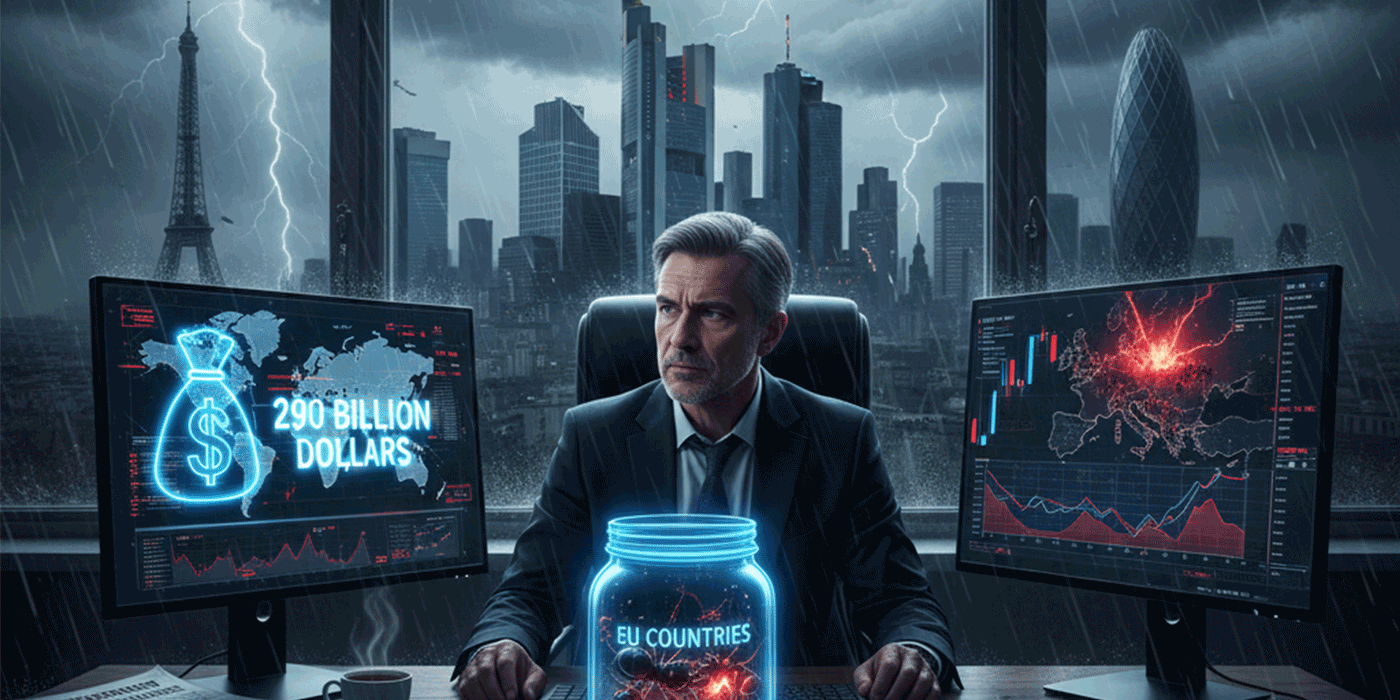
Europe’s Militarism and the Irrelevance - Alex Krainer
A forensic analysis by Alex Krainer
A forensic analysis by Alex Krainer of a system willing to sacrifice its own societies.
Alex Krainer belongs to that rare breed of analysts who know war, ideology, and financial power first-hand. Growing up in the disintegrating Yugoslavia, he experienced the transition from the socialist system into a brutal civil war—an experience that sharpens his current view on power politics.
In the 1990s, he transitioned from the army to the global financial markets, becoming a trader, hedge fund manager, and later the founder of Krainer Analytics. His work on commodities, inflation, and geopolitical power shifts has earned him international recognition.
💬 “When ideology collapses, the reality of resources takes over.”Krainer connects economic analysis with geopolitical clarity—a perspective that often frontally challenges the narratives of the West. His books and interviews are warnings born of experience: anyone who views markets, power, and global conflicts separately truly understands none of the three levels.
Recent geopolitical developments cast a somber shadow over the future of Europe. What many consider a painful but necessary reaction to the conflict in Ukraine is, upon closer inspection, proving to be a self-destructive path that could lead the continent into an unprecedented economic crisis and geopolitical irrelevance.
The market analyst and former hedge fund manager Alex Krainer illuminates the deep-seated causes of Europe’s predicament and warns of an impending collapse that could be triggered by the end of the Ukraine war.
The Binary Trap — When Complexity Becomes Treason
Supporting weapons deliveries marks you as pro-Western. Questioning them makes you a Putinist — and suspect.
The debate over the Ukraine war exposes a fundamental failure in European politics: the reduction of complex strategic questions to binary moral positions. Whether weapons deliveries, diplomacy, or sanctions, core strategic issues are systematically excluded from discussion.
- Will this escalate?
- Can escalation be controlled?
- Does this lead to direct war — possibly even nuclear war?
- Will it increase casualties for Ukraine?
- Could it improve or destroy negotiation prospects?
These questions are not asked. Instead, politics operates through ideological loyalty tests. Supporting weapons deliveries signals alignment with “our side.” Opposing them marks you as disloyal. The same logic applies to diplomacy: advocating negotiations suggests sympathy for Russia; rejecting them signals virtue.
Sanctions follow the same pattern:
Accept all sanctions and you are righteous. Question them and you are accused of siding with the enemy.
This is the intellectual depth of today’s debate — not only on Ukraine, but increasingly on the Middle East, China, and European integration itself.
The questions that should dominate policy discussions:
- What can realistically be achieved?
- Can Europe diversify?
- Can Russia diversify?
- What are our actual security interests?
Are replaced by moral posturing. Citizens are expected to accept any policy so long as it carries the correct ethical label. Serious debate about costs, risks, and alternatives is simply absent.
The Oligarchic Empire — Predators and Prey
It is not a conflict between nations, but an oligarchic empire against everyone else.
This is a conflict between the European oligarchic, imperial system — one that is structurally oriented toward creating colonies — and virtually everyone else, including the native populations of Western European countries.
Almost everything the European side does is counterproductive. But none of this is surprising or unpredictable once the nature of this conflict is properly understood. This is not a conflict between nations in the traditional sense. It is a conflict between two systems of governance — between the European oligarchic, imperial system and practically everyone else, including Western Europe’s own populations.
The lending oligarchies drive a neo-colonial system of governance that is always oriented toward creating colonies and extracting colonial rents. For these oligarchies, all of humanity is prey. They are the predators; everyone else is the prey. This is not only about Russia, not only about China, Iran, or other parts of the Middle East.
All of humanity is prey to them. That includes their own populations in Germany, France, the United Kingdom, the United States, and Canada.
💬 “Oligarchic power does not measure success by the prosperity of societies, but by the ability to externalize losses.”In order to preserve their power, dominance, and global hegemony, they willingly sacrifice the domestic economies and societies of these countries. Having failed to secure victory in Ukraine — now their primary global battlefield — they continuously double down. They exhaust the societies in which they are embedded, their host societies, completely. The economies of Germany, France, the United Kingdom, the United States, and Italy are collapsing. And the people who brought these elites to power are of no concern to them whatsoever.
The outcome of this logic is clear:
- Their own societies are reduced to geopolitical expendables.
- Domestic economies are treated as resources for imperial power projection.
- Social stability is not a goal, but a disposable cost factor.
They speak only about Ukraine. They speak only about confronting Russia. This is not difficult to predict. It is the obvious course of action, because they have no other business model. They are no longer interested in governing sovereign nations as independent, neutral economies and societies, nor in developing policies to improve living standards, prosperity, employment, or industrial production.
In Russia, these dynamics can be observed. In China, they can be observed. In other parts of the world as well. But across the entire West, there is a steady slide into something that increasingly resembles open fascism.
Open Fascism — When Banks Devour Nations
When economic power replaces political governance and ideology becomes the justification for rule.
Across the entire West, we are steadily sliding into something that increasingly resembles open fascism — everything is subordinated to the interests of banking oligarchies and their corporate clients.
Everything is subordinated to the interests of banking oligarchies and their corporate clients. The results are now undeniable, even though the symptoms have been visible for decades to anyone willing to pay attention. We have reached a point where those who believe that we are the good side, and that the Russians, the Chinese, and the Iranians are the bad side, find themselves at a moment of moral inversion.
💬 “When economic power fully dominates political decision-making, ideology becomes a cover for rule.”There is a warning: Woe to those who call evil good and good evil, for they bring many of these destructive consequences upon themselves. And there is another warning from Goethe: No one is more blind than those who deliberately refuse to see the truth. Those close to power in Europe and the United States are, to a large extent, deliberately choosing not to see reality. They want to continue down this path of self-destruction, and they will do so until the system either collapses or they are removed from power through popular uprisings.
The practical consequences of this development are already visible:
- Economic reality is systematically subordinated to ideological objectives.
- Deindustrialization, capital flight, and declining purchasing power are politically ignored.
- Foreign policy escalation replaces economic and social governance.
This refusal to acknowledge reality runs through every level of the political class. One can report on the economic consequences. One can document deindustrialization. One can show rising energy prices, shrinking real incomes, and capital flight abroad. None of this changes policy.
The response is always the same:
More weapons, more sanctions, more confrontation with Russia. Economic reality is fully subordinated to the ideological agenda. And that agenda is shaped by forces whose interests do not align with those of Europe’s populations.
Germany’s Implosion — The Heart of Europe Collapses
How deindustrialization, debt, and political hardening create a self-reinforcing downward spiral.
The fiscal situation will continue to deteriorate as the country becomes increasingly deindustrialized and more people lose their jobs — it is almost like a self-reinforcing cycle.
Germany, once the economic driving force of the European Union, is undergoing profound political and economic upheaval. The country that believed it had overcome its historical relationship with military force is now once again fighting a proxy war against Russia. According to Merz, Europe is at war with Russia. Economically, an implosion is taking shape. The largest opposition party — in some polls even the strongest in the country — is being criminalized. There is open discussion about banning it.
💬 “When economic substance erodes, systems tighten political control to mask their own loss of power.”The economic situation will continue to worsen as long as Germany adheres to its current policies and refuses to change course. The government’s fiscal position keeps deteriorating as the country becomes increasingly deindustrialized and more people lose their jobs. This produces a secondary effect: when large industrial companies shut down production, many small and medium-sized businesses that depend on those companies and their employees — restaurants, cafés, all kinds of small shops — also lose their livelihoods. They depended on the purchasing power of those workers.
It is almost like a self-reinforcing cycle that ultimately and dramatically reduces state revenues. The fiscal position worsens further, forcing the government to take on even more debt just to remain operational. But while the economy collapses, interest rates rise, making it increasingly expensive to finance the state.
The consequences of this process are clearly visible:
- Deindustrialization reduces employment and tax revenues.
- Secondary effects destroy local economic structures.
- Rising interest rates intensify the debt burden as the economic base shrinks.
With responsible leadership acting in the country’s interest, one would say: we must change course. We must come to terms with Russia.
We must bring the Nord Stream pipelines back online to restore industrial competitiveness. We must restart nuclear power plants to ensure more abundant energy production, making industrial output competitive again. We must reverse the European Central Bank’s policy aimed at eliminating small and regional banks in order to consolidate the entire banking system under a handful of large institutions. But all one hears is “Russia, Russia, Russia.” None of these problems are addressed.
The Nord Stream Sabotage and Poland’s Betrayal
How state obstruction, political diversion, and shifting loyalties create a spiral of escalation.
Poland will not extradite the person suspected of blowing up the Nord Stream pipeline — of course, no one believes he actually did it, but an investigation would move us closer to the facts.
They ignore the issue even when their own national interests are directly threatened. Poland will not extradite the person suspected of sabotaging the Nord Stream pipeline. No one believes this individual actually carried it out, but an investigation and a trial might have clarified what really happened. Polish courts simply said no. Merz goes on television and once again talks about “Russia, Russia, Russia.”
💬 “When even the most serious attacks on critical infrastructure are not allowed to be investigated, loyalty has become more important than truth.”The result is that people are shifting their loyalty away from traditional parties — the SPD and the CDU — toward the Alternative for Germany, the AfD. The situation reaches a point where class conflict becomes the most fiercely contested struggle in the country. Established parties and their supporters use every means available to remain in power and prevent the AfD from governing, because the AfD is the only party offering a meaningful change in policy.
The consequences of this development are predictable:
- Political loyalty shifts away from established parties.
- Institutions respond with insulation rather than investigation.
- Social tensions condense into an open system conflict.
Then there are bizarre reports of seven or thirteen AfD candidates collapsing dead within a two-week period shortly before regional elections in North Rhine-Westphalia. Of course, these incidents are not explained. They are not discussed. People are expected to pretend nothing happened and move on. But even in a society known for disciplined, conformist citizens who are highly reluctant to disrupt social order or break the law, there is a limit to what people will tolerate.
This is precisely why some social scientists predict that European countries will slide into civil war and revolution. At present, it is impossible to predict whether this crisis will be resolved through democratic institutions and peaceful political change, or whether it will erupt into social unrest and spiral completely out of control.
What can be said is that those in power will intensify their current policies, keeping them largely unchanged while the economic situation continues to deteriorate.
Russia Obsession — While Europe Burns
How foreign-policy fixation conceals internal erosion and produces strategic blindness.
At every meeting of the European Union, every agenda item is the same: Russia first, Russia second, Russia third — that is all they deal with.
A common criticism of many European leaders — whether Starmer, Merz, or Macron — is that their focus lies exclusively on foreign policy. In fact, not even on foreign policy in general, but on Russia. That’s it. They pay little attention to domestic issues, which is deeply problematic given that much of Europe is currently experiencing economic stagnation or decline. Europe faces serious difficulties securing cheap and reliable energy, which further accelerates deindustrialization. It has no technological autonomy.
💬 “A policy that looks only outward inevitably loses control over its internal foundations.”After years of dependence on Western tech companies, Europe has forgotten that these companies were, in reality, American. Who would have thought that America would prioritize itself first? They have different interests. The United States is increasingly accepting a multipolar reality, which means Europe can no longer be prioritized as it once was. Europe finds itself in a vulnerable position, especially as the U.S. becomes more extractive — seeking greater tribute payments as a means of recovery.
One can add all these other factors: declining birth rates, social instability, democratic erosion. Yet despite all these accumulating problems, Slovak Prime Minister Robert Fico pointed out that at every European Union meeting, every agenda item is Russia first, Russia second, Russia third. That is all they deal with. Sweden’s defense minister claimed that Sweden’s experience of living next to Russia showed that they always had to fight for their freedom, and therefore must expand their military.
The practical consequences of this fixation are obvious:
- Domestic erosion is strategically ignored.
- Energy, industrial, and technological issues remain unresolved.
- Military escalation replaces long-term stability policy.
That is not their historical experience. They lived next to Russia, they chose neutrality, and they had no conflicts with it. The same can be heard from the Finns, although they too now have to maintain a NATO narrative. Their experience was that peace was possible — and that was the foundation of their rise. But now Sweden’s defense minister insists that all of Europe must shift into war mode because a strong deterrence against Russia is supposedly required.
Deterrence as Aggression — Seizing Russian Ships, Bombing Cities
How a distorted security logic sells escalation as stability.
Deterrence normally means preventing an adversary from undertaking aggressive actions. But it now appears that the goal is to prevent Russia from reacting at all. In the same breath, Sweden’s defense minister calls for seizing Russian sovereign assets and taking control of Russian ships in the Baltic Sea — the so-called shadow fleet — while simultaneously advocating Western-supplied, and likely Western-operated, long-range missiles striking targets inside Russia. All in the name of deterrence.
💬 “When deterrence turns into active provocation, escalation is no longer an accident but part of the strategy.”This sounds genuinely insane, completely unhinged. Something will break, something will explode. Either this ends in a direct war with Russia. For some reason, Europeans seem to expect tank columns facing tank columns. They do not appear to anticipate warheads raining down on European cities. But even aside from war, this cannot continue indefinitely. Something will break economically.
The consequences of this inverted logic of deterrence are obvious:
- Provocations are relabeled as defensive measures.
- Military escalation replaces political risk management.
- Economic and social collapse is knowingly accepted.
The logic of deterrence is turned completely upside down. Russia is to be deterred through military force from responding to provocations, while those provocations are simultaneously escalated. Russian assets are to be seized, Russian ships hijacked, Russian territory attacked with Western weapons — and then military presence is supposed to ensure that Russia does not react. This logic works only if one assumes that Russia is willing to absorb unlimited humiliation and attacks. That assumption is dangerously false.
The Bond Crisis — The Budget Hole That Keeps Growing
How fiscal illusions, political obfuscation, and strategic distraction undermine Europe’s financial foundations.
When Keir Starmer was in opposition, he spoke of a budget hole of £76 billion — once in power, that hole suddenly shrank to £22 billion, without any explanation.
The greatest concern lies in Europe’s bond markets — British and European bonds, German, French, Italian, and British. Germany is the largest economy in the European Union, France the second largest. Their fiscal positions, like Britain’s, are in catastrophic condition. All of them — France has crossed the threshold of 100 percent debt-to-GDP. The figures that are publicly known are likely incorrect. The situation is far, far worse.
💬 “When governments begin redefining their fiscal problems instead of solving them, trust becomes nothing more than a statistical variable.”When Keir Starmer came to power, much was made of his discovery of a £22 billion hole in public finances — even though, while in opposition, he had initially spoken of a £36 billion hole. A few months later, he spoke of a £67 billion hole. Shortly afterward, he corrected himself and said: “It’s not 67, it’s 76 billion.” While in opposition, and using these figures to attack Rishi Sunak’s cabinet, the number was known — it was a £76 billion budget hole. Once in power, however, that hole suddenly shrank to £22 billion, without any explanation.
The structural consequences of this practice are obvious:
- Budget figures lose credibility.
- Bond markets are destabilized by political window dressing.
- Long-term risks are subordinated to short-term narratives.
Authorities in France, Germany, and elsewhere are deceiving the public. The situation is entirely unsustainable and continues to deteriorate — it is only getting worse. Those who should be attempting to mitigate the crisis are entirely absent. Everything comes back to Russia first, Ukraine second, defense spending third, Russia again fourth, and so on. There is no discussion about improving competitiveness.
Mario Draghi published a report on European competitiveness more than a year ago, and since then, very little has happened.
All Western technology companies are, in reality, American technology companies. The United States has a firm grip on high technology across the Western world. Europe not only lacks real competitors, it has made life so difficult that those companies which do emerge in Europe eventually migrate to the United States.
American Extraction — Buy Our Energy, Invest with Us, Pay Tribute
How economic loyalty is enforced and Europe’s room for maneuver is systematically narrowed.
Focus on the important regions — America, Asia — turn away from Europe, but make sure that Europeans maintain their economic loyalty to America.
One can already see this happening to a certain extent. The Nexperia case is instructive: the Dutch government took control of a Chinese chip manufacturer. According to reports, this happened at the urging of the United States — Americans pressured Europeans to seize the Chinese company. China is now retaliating, and a fracture is emerging. If Europe continues down this path, it will effectively be able to source its chips only from the United States.
💬 “Extractive power does not operate through partnership, but through dependency.”If all Chinese exports to the United States are curtailed, they must be redirected somewhere — for example to Europe — which could lead to oversupply. That could drive prices down. This is understandable, and precisely why Europe should be sitting down with China to negotiate how to navigate these turbulent times. But that is not what Europe is doing. It is now seizing companies, just as it seized Russian assets. Europe is no longer a particularly attractive place to do business.
The structural consequences of this course are clearly visible:
- Europe loses independent industrial and technological options.
- Economic policy is subordinated to geopolitical loyalty
- The investment climate deteriorates due to political arbitrariness.
Europeans are not only turning against China, but also against India. From a European perspective, this makes no sense at all. European economies have very few genuine partners. Either they conduct business with countries over which they attempt to establish a quasi-neocolonial dependency, or with more powerful countries to which they submit in a fully subordinate position. They will harm their own interests, they will violate international law — they will do whatever is demanded when a country like the United States issues instructions.
Meanwhile, Kaja Kallas will travel to China and India, and Ursula von der Leyen will not hesitate to lecture them on values, on how they should conduct themselves, and on what they should do. They seem to forget that it was not so long ago that European powers colonized large parts of the world and left devastation in their wake.
Neocolonial Continuity — Why Europe Cannot Have Real Partners
Why Europe’s external relations remain trapped between dependency and subordination.
Either Europe conducts business with countries over which it seeks to establish a neocolonial dependency, or with more powerful countries to which it submits in a fully subordinate position.
For Europe, it is therefore absolutely crucial to open a new chapter by freeing the system from the narrow self-interests that currently dominate it. Once again, this leads back to the banking oligarchies that have taken the entire continent hostage. At this point, Europe could improve its relations with the United States, as the United States supports parties such as the AfD. Germany’s relationship with the United States would improve if the AfD were to form a government in Berlin.
💬 “A continent without sovereign interests cannot form equal partnerships.”Europe would still face the challenge of having to negotiate for its interests. They would not be handed over on a silver platter. But at least Europe would be able to articulate its position and secure some constructive concessions from the United States. In addition, it could improve its relations with Russia, which is absolutely essential. Russia is Europe’s neighbor with the largest reservoir of natural resources in the world. If Europe wants to develop its economy, it must establish good relations with Russia. It must negotiate a constructive, mutually beneficial relationship.
The strategic consequence of this situation is clear:
- Europe negotiates not from strength, but from dependency.
- Foreign policy follows structural constraints rather than its own interests.
- Partnership is replaced by hierarchy or control.
Europe must reinvent its own identity, decide who and what it wants to be, what it wants to represent in the world, and then shape a future-oriented policy accordingly. Europe has much to offer the world, but this must be done in a way that is respectful toward others — open and constructive in its relations with every country. Then, gradually, things can improve. This will not happen under Friedrich Merz, Emmanuel Macron, or Keir Starmer. But with some future governments, it eventually will.
The logical step would be to join BRICS or the Eurasian Customs Union and to cooperate with the Shanghai Cooperation Organisation or through a mutual security arrangement. Then conditions could improve. If Europe continues on its current path, the outcome will resemble that of the Western Roman Empire — following the same road of decline until everything collapses and there is virtually no capital left to put things back together.
The Eradication of Competence — Tell the Truth and You’re Removed
How groupthink, repression, and career risk cement political mediocrity.
Anyone who steps outside Western groupthink — “We must wage war against Russia” — is immediately eliminated, and in a highly hysterical manner.
Europe suffers from an acute leadership problem because all of its leaders — everyone close to the levers of power — are of extremely low quality, with very little competence, integrity, or charisma. This is not accidental. Those who hold real power ensure that anyone attempting to reform the system or alter policy is swiftly removed from power. This happens in many ways. Most often through character assassination. Today, “lawfare” is widely used to neutralize figures such as Karl Kalin, Georgescu in Romania, and Marine Le Pen in France.
💬 “Systems that fear reform promote conformity and punish competence.”There are also actual assassination attempts — or at least attempts. Two were directed at Trump, and one at Robert Fico in Slovakia. Then there are other methods of elimination, such as in the case of Jeremy Corbyn in the United Kingdom, who was essentially smeared as an antisemite simply for advocating a more balanced approach — not pro-Palestinian or anti-Israeli, just balanced — to resolving the crisis in the Middle East. He was pushed out of British political life.
Anyone who deviates from Western groupthink — “We must wage war against Russia, we must shut down nuclear power plants, we must stop buying natural gas from Russia, we must end the use of fossil fuels” — is immediately removed. These rigid doctrines imposed on Europe ensure that anyone attempting to think outside this framework is swiftly eliminated, and again, in a highly hysterical fashion.
The result is that even those leaders who recognize and understand the signs of the times choose to remain silent and simply repeat establishment slogans, knowing they will be removed if they speak the truth.
The consequences of this system are unmistakable:
- Competence is replaced by loyalty.
- Truth is treated as a threat.
- Leadership degenerates into the mechanical execution of slogans.
Anyone who is competent, anyone with even a trace of self-respect and integrity, is simply not part of Europe’s ruling class. The result is Ursula von der Leyen, Emmanuel Macron, Kaja Kallas, Keir Starmer — figures who are essentially empty suits. If they were told tomorrow that everyone in Europe must wear pink hats, they would issue a decree forcing everyone to wear pink hats. And they would say: “If you don’t wear a pink hat, Russia will win.”
Europe has reached a point where its leaders would defend the notion that two plus two equals five, that slavery is freedom, that ignorance is strength. That is where Europe now stands.
The Seizure of Russian Assets — Piracy as Economic Policy
How expropriation, power struggles, and legal breakdown are tearing apart Europe’s financial order.
Once assets have been stolen, who gets to spend them? Who gets to use them? This will lead to very bitter accusations — and it already has.
Europeans are no longer just talking about freezing assets or confiscating the interest generated by them, but about seizing the assets themselves. Perhaps to service their own debts, siphon off a portion, and send a large share to Ukraine. Either way, this is the domain of financial power.
What would be the consequences if Europeans actually went through with this? France has spoken out against it, and even in Brussels there is an understanding that this would be an extraordinary act of self-harm — and an exceptionally foolish one.
💬 “When property is politically redefined, law ceases to be a reliable framework.”There is the obvious effect of signaling to the rest of the world that Europe is an untrustworthy actor — that no fair treatment can be expected from European financial institutions, and that such relationships cannot be relied upon. That much is obvious. But a second problem emerges: once the assets have been stolen, who gets to spend them? Who gets to use them? This will produce extremely bitter disputes — and it already has.
This is no longer even about Russian assets. A full-blown conflict has erupted between Chancellor Friedrich Merz and Ursula von der Leyen over defense spending. They all agree that hundreds of billions of dollars should be spent on weapons and the military. But they cannot agree on how or by whom the money should be spent — because whoever controls the spending also controls the kickbacks.
Ursula von der Leyen wants the funds to flow through European Union institutions. Friedrich Merz wants them routed through German institutions. Former allies and political partners have devolved into an ugly family feud.
The consequences of this step are foreseeable:
- Legal frameworks lose their binding force.
- Power struggles over access and distribution escalate.
- Political corruption and violence are structurally encouraged.
Once stolen assets are introduced into such a situation — meaning the law has already been broken by the act of theft — the entire legal framework governing the use of tax revenues, newly issued debt, or other assets begins to collapse. This is uncharted territory, and it will unleash a feeding frenzy of wild hyenas — everyone against everyone. It will become extremely ugly. There is even the possibility that assassinations among European politicians and decision-makers will increase.
If Europeans take this step — and they are now so desperate that they will likely be unable to resist the temptation — they will sideline those who warn that this is a terrible idea. The consequences will resemble a form of brutal karmic justice. It is a terrible omen that this has become the core plan for Europe’s economic development: stealing the assets of another country.
This is a truly strange form of collective suicide that Europe is engaging in, driven by incompetence, desperation, and ultimately the fact that the entire system is in the hands of pirates. The lending oligarchies in London and Paris are quite literally heirs to pirates. The system evolved step by step from the practices of privateers and those who financed their ventures and the slave trade. Over time, they constructed a legal framework flexible enough to justify almost anything they wanted to do.
The moral self-deception follows the same pattern every time:
- Their own legal violations are rationalized as necessary self-defense.
- Aggressive policy is reframed as moral obligation.
- Responsibility is entirely shifted onto a constructed enemy.
The final insult is how they convince themselves that they stand on the right side of history — that all of these insane policies serve the goal of stopping the “Hitler of today.” It is deeply frustrating. It is an astonishingly stupid way for Europe to destroy itself. But it follows the classic bully narrative — when the bully brutalizes someone and then says, “Look what you made me do.” We are the good ones. The Russians are evil. They force us to do all these things that we otherwise would never do.
What is unprecedented is the refusal of Europe’s elites to acknowledge this reality. They cling to a world order that no longer exists. They speak as if they still possess the power of the nineteenth century. They behave as if the multipolar world were merely a temporary disturbance. They genuinely believe that if they just push hard enough against Russia, impose enough sanctions, and deliver enough weapons, the world of the 1990s will return. That world is gone forever.
Thank you, Alex Krainer.
Sources & Geopolitical References
Substack – US-Edition
This article is also available as a English-language edition on Substack:
Europe’s Militarism and the Road to Irrelevance - Alex Krainer
Original conversation (video)
YouTube-Interview:
Europe's Militarism & Economic Decline - Alex Krainer
Support Independent Journalism
If you find my work valuable, you can support it with a voluntary contribution here:
Voluntary support via PayPal
Voluntary support via Buy Me a Coffee
Many thanks for your support!

More Articles
How America’s Economic War on Russia - Richard Wolff
An Indictment of 80 Years of Vassal Politics - Larry Johnson
America’s New Imperialism - John Mearsheimer

investigative commentary.