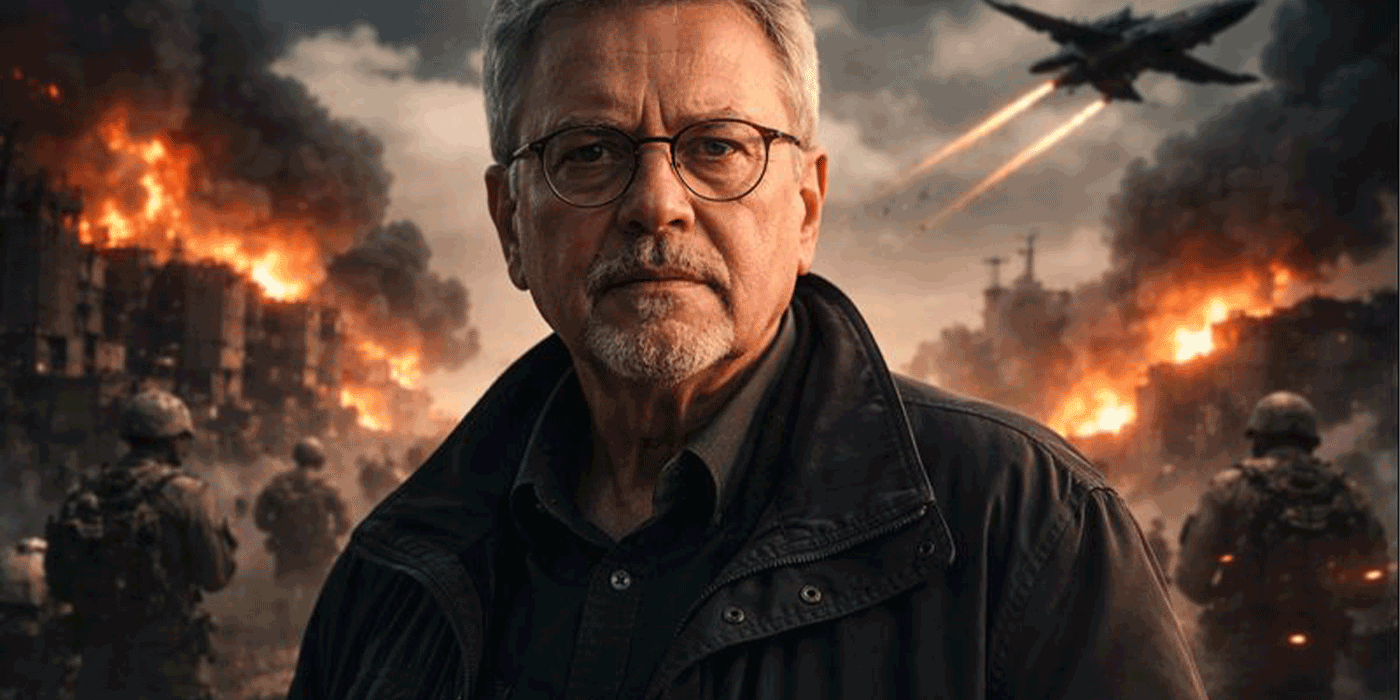
Germans are sleepwalking into the abyss - Patrik Baab
The Insider’s Judgment: Biography and Uncomfortable Truth
Patrik Baab is a German journalist, political scientist, and bestselling author with more than forty years of experience in international reporting. He has worked extensively in conflict zones including the Balkans, Afghanistan, Russia, and Ukraine, with a strong focus on first-hand observation and field research.
Baab gained international attention for his book “On Both Sides of the Front”, in which he documents his reporting from Ukraine and critically examines Western media narratives surrounding the war. His work emphasizes analytical depth over ideological alignment and challenges simplified, moralistic framings of complex geopolitical conflicts.
He previously worked for Germany’s public broadcasting system and taught journalism and media ethics at academic institutions. As his analyses increasingly diverged from dominant political narratives, Baab became a prominent independent voice outside the media mainstream, known for questioning power structures, propaganda mechanisms, and the erosion of journalistic standards in times of war.
💬 “Understanding is not betrayal – it is the foundation of journalism.”While Trump wants to write off Ukraine as a “losing business,” European elites are systematically driving their countries into war with Russia – trapped in a dead end of financial interests, transatlantic subordination, and narcissistic delusions of grandeur.
The One-Way Street: Why There’s No Turning Back
“Elites are not defined by intellectual quality, but only by their access to power”
Patrik Baab, a German journalist with forty years of experience from conflict zones in the Balkans, Afghanistan, and Ukraine, formulates a disturbing thesis: Western European elites are consciously heading toward a comprehensive war with Russia. Not by accident. Not out of stupidity. But because they have “led their countries into a dead end and are currently unable to turn back.”
In conversation with Professor Glenn Diesen, Baab analyzes this development along economic, political, cultural, psychological, and military factors. His conclusion:
💬 “All these reasons and tendencies converge in a single direction – toward war. This is a simple conclusion, but it emerges from a complex assessment.”The term “one-way street” is central: “A one-way street means that with these elites, there is no way back. They must be replaced by the people.” The question is no longer whether Europe will slide into war, but only when – and how catastrophic the consequences will be.
Baab’s definition of elites is deliberately sober: They are “not defined by their intellectual quality or superiority, but only by their access to power.” This clarification is important because it explains why these people remain in their positions despite obvious miscalculations.
The cynical formula of European Ukraine strategy is summed up by Baab: “We deliver the weapons, and you Ukrainians deliver the corpses.” But this moral bankruptcy is only the surface. Beneath lie mechanisms that run much deeper – and which Baab systematically exposes.
The Financial Crisis as Genesis: How Germany Sold Its Sovereignty
From the 2002 tax exemption to blackmail by BlackRock
The roots of current warmongering lie in an economic policy decision that is now almost forgotten. In 2002, during Chancellor Schröder’s government, Germany passed a law exempting capital gains for banks from taxation. German credit institutions could henceforth sell their corporate shares tax-free.
The double catastrophe:
- German banks sold corporate shares en masse
- They invested the money in structured securities – “stock market bets”
- The shares were predominantly bought by US banks and financial investors
- German companies fell into the hands of the US financial industry
The first consequence: “German companies fell into the hands of the US financial industry and US investors.” The second was even more devastating: The German economy became “vulnerable to the major financial crisis.”
When the banking crisis came in 2008, the familiar pattern followed: “The state rescued the creditors with tax money and new debt. Bank debts were converted into government debt.” These government debts were refinanced through government bonds – but something fundamental happened here.
The state introduced stricter regulations for the banking system, but “the government bonds ended up in the unregulated shadow banking system.” The result: “The refinancing of the German state – and indeed all European states, but especially the German state – fell into the hands of financial investors in an unregulated market.”
Where these investors make their money:
- Exploitation of the Ukrainian economy and minerals
- Military-industrial complex
- They profit in times of peace AND war
Baab draws the logical conclusion: “These financial investors are able to blackmail any state that tries to leave the path of war. The states can be blackmailed.”
This explains why Chancellor Merz – former German representative of BlackRock – “invests in war and does not stop the march toward war.” The German government is no longer free in its decisions because its refinancing depends on those who profit from war.
The Sanctions Trap: How Europe Destroyed Its Own Economy
Nord Stream, energy crisis, and the path to economic decline
“It is quite clear that the locomotive of the European economy, the German economy, is no longer under steam.” Baab’s diagnosis is unequivocal: “Without Russian gas and oil, companies in Germany are no longer competitive.”
The destruction of Nord Stream 2 was the decisive moment. According to investigative journalist Seymour Hersh, the USA blew up the pipeline, and “this energy trap has snapped shut.” The consequences are devastating:
Europe’s economic decline:
- German economy stagnating and shrinking
- European budgets overstretched for a lost war
- Countries left sitting on a mountain of debt
- Competitiveness permanently damaged
But Chancellor Merz plans to deepen the catastrophe further. His proposal: Grant Ukraine a loan of 140 billion euros as military aid and “use the frozen Russian assets as collateral.”
Baab warns of two dramatic consequences:
💬 “First, international investors will flee from the euro and leave the eurozone because they fear they won’t get their money back in the future. This means that the euro will be permanently damaged as a reserve currency.”The second consequence concerns international law: “Russia will sue for damages in international arbitration courts and will probably be vindicated. There is no legal basis for such a measure. In addition, Moscow will confiscate European assets in Russia.”
The BlackRock factor:
Ukrainian government debt is managed by a consortium of BlackRock and J.P. Morgan. Baab’s analysis is devastating: “Such financial aid to Ukraine therefore acts like state-guaranteed financial aid for Merz’s former employer. He was the German representative of BlackRock.”
The calculation is simple: “If Russia wins the war, the European taxpayer, especially the German taxpayer, must pay for this financial aid.” Merz is pursuing “policies against his own people and in favor of the financial industry in the United States.”
The All-or-Nothing Logic: Why Europe Is Doubling Down
Ukrainian resources as bait for economic collapse
Glenn Diesen formulates the dilemma precisely: “There is this tendency, as you say, to double down. And that makes sense when you consider that the outcome of the war promises either everything or nothing.”
The promise in case of success is tempting:
- Access to Ukrainian resources (concentrated in Donbass: lithium, gas, oil)
- Ukraine as a permanent front line against Russia
- Battle-tested Ukrainian army keeps Russia in check
- USA remains in Europe
But in case of failure, the exact opposite threatens: “We lose access not only to Russian raw materials and energy, but also to Ukrainian ones. The Americans would like to turn away. NATO seems to have lost all credibility.”
Diesen points to the fundamental absurdity of the strategy: “Just talking about stealing all Russian assets – even proposing that – must be very damaging for Europe. Who would still store their assets here?”
The domino chain of deterrence:
The implications go far beyond Russia. “We could turn against the Chinese tomorrow. What about India if we impose secondary sanctions?” Europe is systematically destroying its own reputation as a safe place for international investment.
The central question remains: “So if there’s no turning back, do you see a war coming between the Europeans or even with Russia?” And the disturbing reality: “But if there’s a Europe-Russia war, wouldn’t that eventually draw America in too?”
Baab confirms what many suspect but no one will say: The Americans provoked the war “through NATO eastward expansion and by trying to bring the Ukrainian economy under the control of American companies.” But now “they see that the returns are insufficient and want to drop the matter.”
The Europeans, on the other hand, are “so deeply drawn into this war that they can find no way out. And that’s the problem I see at the moment.”
Transatlantic Subordination: 2003 as a Turning Point
How Washington brought European elites into line after the Iraq disaster
The key moment came in 2003. Germany, France, and Russia refused “to join the illegal attack on Iraq. That was a warning signal for Washington, and since then they have tried to strengthen their control over European elites.”
The instruments of control:
- Scholarships for selected candidates
- Invitations to influential circles
- Study opportunities and doctoral programs
- Integration into transatlantic organizations
- Career promotion for the “right ones”
Baab confirms what Colonel Lawrence Wilkerson (former Chief of Staff to Colin Powell) told Glenn Diesen in an earlier interview: In the White House, “large whiteboards were set up on which they began to analyze which politicians should be promoted – those who essentially said the right things and repeated the talking points from Washington.”
The result was a systematic selection: “So it’s not about performance, not about qualification, not about intelligence – it’s only about being the obedient disciple and doing what you’re told.”
The 2022 Rand Corporation paper:
In 2022, a secret Rand Corporation paper was leaked – “a paper for the CIA and the White House.” The content is revealing: Washington wanted “to use the Greens as a transmission belt to strengthen the hegemon’s interests in Europe, especially in Germany, and to lead Germany into a war with Ukraine – to create a pretext for ending the energy partnership with Russia.”
The German political elite willingly played along: “Chancellor Merz is a member of an organization called Atlantik-Brücke. And Finance Minister Lars Klingbeil is also a member of Atlantik-Brücke. They made their careers with the support of American companies and transatlantic organizations.”
Baab’s diagnosis is devastating: “This led to a situation of political self-enslavement to the interests of the hegemon.”
The Bubble of Power: Hall of Mirrors Without Contact with Reality
“These people live in a bubble. They have lost contact with reality.”
The mechanisms of control have created a psychological consequence that is more dangerous than any external coercion. Baab describes it as a “hall of mirrors”:
💬 “They talk to each other, meet in the same places, in the same organizations, at the same conferences. They have lost contact with reality. It’s like a hall of mirrors – everyone confirms the opinions, ideologies, and ideas of the others.”This self-referential bubble produces a particular form of danger: “We see a situation of moral hazard.” The ideology reads: “We deliver the weapons, and the Ukrainians deliver the corpses. And that is unethical.”
The blood guilt of the elites:
Baab raises a point that is systematically ignored in Western media: Western responsibility for the 2014 Maidan massacre. “According to the research of Professor Ivan Katchanovski from the University of Ottawa, European diplomats negotiated like at a bazaar with Ukrainian fascists about how many people would have to be murdered to force the democratically elected and legitimate President Yanukovych out of office.”
The agreement was cynically precise: “Both sides agreed on the number of 100 people killed, and that’s exactly how the Maidan massacre occurred.” Eyewitnesses report sniper groups “from Georgia, Poland, and Lithuania” who “operated like well-trained special forces.”
The question that no one is allowed to ask publicly: “How much blood do Western politicians and diplomats have on their hands?”
Why the war must continue:
“An end to the war would raise the question of criminal responsibility and bring to light that European and Western politicians are partly responsible for the Ukraine war by organizing a bloody coup and dividing the country.”
The continuation of the war therefore serves a fundamental purpose: “The continuation of the war helps to cover up this question.” European elites cannot turn back because reversal would mean accountability – and accountability would mean the end of their careers.
The Censorship and Propaganda Complex: How Germany Is Being Made War-Ready
“People are systematically lied to, and our politicians believe their own lies.”
Baab identifies a totalitarian mechanism that has seized all social institutions: “Today we are facing massive disinformation in Germany organized by the censorship and propaganda complex.”
Who is part of this complex:
- Political parties
- Intelligence services
- Digital companies
- State-organized and non-governmental organizations
- Universities
- Schools
- Churches
- Trade unions
- Associations
“They are all being brought into line. All ideological apparatuses form the censorship and propaganda industry.” The dimension is historically unprecedented: “The war in Ukraine is the biggest propaganda lie and the biggest propaganda battle since the end of World War II and the capitulation of Nazi Germany.”
The consequence is fatal: “People are systematically lied to, and our politicians believe their own lies. The result is that European leaders are unable to correct their own mistakes or adapt their decisions to the actual balance of power.”
The inability to change course:
Baab quotes Hegel: “The only thing one can learn from history is that governments and states do not learn from history. That’s exactly what we’re seeing now.”
European elites are trapped in “a kind of self-reference. They cannot learn from the world. It’s an identity-based way of thinking: ‘I am who I am, and we are the right ones, and we have the moral right to fight the Russians.’”
The psychological diagnosis becomes even darker: “I have the feeling that many German politicians are truly narcissistic – they have a narcissistic personality structure.”
Narcissistic Megalomania: Germany Wants to Become a Military Power Again
“Loss of reality and megalomania” – Freud’s diagnosis fits perfectly
Baab applies Sigmund Freud’s analysis of narcissistic personalities to the German political class: “According to Sigmund Freud, there are two characteristic features of a narcissistic personality: loss of reality and megalomania.”
The symptoms are unmistakable: “They want to make Germany the strongest military power in Europe. They want to return to an imagined global political role. And that is megalomania, nothing else.”
The danger lies in self-deception: “I fear these politicians believe in the dangerous nonsense they produce.” When politicians believe their own propaganda, they lose all ability to make realistic assessments.
The German people as passive spectators:
Baab’s darkest warning concerns not the elites but the population: “We must see that the people are asleep – the Germans are sleepwalking toward the abyss.”
The historical parallel is intentional. Germany sleepwalked into World War I in 1914, sleepwalked into the Nazi dictatorship, and now? “That’s a difficult point, yes.”
False Flag Escalations: How NATO Constructs the Casus Belli
From Polish drones without warheads to Estonian airspace violations
The path to direct war is being paved with staged incidents. Baab analyzes several current incidents with forensic precision:
The Polish “drone attack”:
- Allegedly Russian drones over Poland
- Not a single drone was equipped with a warhead
- No damage
- Polish army was warned by Belarus
- Baab’s verdict: “Completely fake”
The Danish drones:
The origin of the drones observed over Denmark remains “still unclear.” There is no concrete evidence of Russian involvement.
The Estonian “airspace violation”:
- “Resulted from the expansion of Estonian airspace”
- Was “absolutely not an attack”
- Established protocols were ignored: “You have to communicate with Moscow to clarify the situation”
Baab identifies the pattern: “NATO escalates by manipulating the public in EU countries. This is a form of cognitive warfare.”
The strategic goal:
Europeans are to be “forced to join the escalating course against Russia.” NATO wants “to force Russia into a difficult decision: either accept the closure of airspace over the Baltic Sea or respond militarily. And that means a comprehensive war in Europe.”
The dangerous miscalculation: “They hope that this war will not escalate into a nuclear war, but that is in Moscow’s hands and not in the hands of the Europeans. That is a Russian decision.”
Why NATO is opening new fronts:
“All this shows how desperate NATO is. They fear losing the war and are trying to expand the war and open new battlefields, for example over the Baltic Sea, to force Russia to divide its forces.”
The goal is transparent: “NATO wants to relieve the Ukrainian defense forces so that they are able to continue the war. And that shows that NATO wants war, not peace.”
European Schizophrenia: Russia as Both Threat and Weakling
“It’s either one or the other. It can’t be both.”
Glenn Diesen brings the fundamental contradiction of European rhetoric to the point: “On the one hand, they say the Russians are a great threat and could march to Paris. On the other hand, they say the Russians are weak and can’t make progress in Ukraine. Well, it’s either one or the other. It can’t be both.”
Baab adds another layer of analysis: European elites “suffer from apocalyptic blindness. They risk leading their own countries into a nuclear Armageddon by provoking the strongest nuclear power.”
The blind spot of European policy:
Europe produces “various proposals for expanding and intensifying the war,” but “not a single proposal for peace.” The fundamental question is not asked: “Europe has not acknowledged that in the long term it is necessary to talk about the security architecture in Europe so that they can feel safe vis-à-vis Russia and Russia can feel safe vis-à-vis them.”
Vladimir Putin formulated Europe’s self-destruction in one sentence: “If you asked Europe to hang itself, it would ask: ‘If you want to hang us, you must use European rope.’”
The five-year illusion:
The German intelligence chief argues “we would simply have to delay this war for another five years to prepare.” Diesen rightly asks: “But what’s the goal here? Is it just to continue the war aimlessly? Because if there’s no path to victory, what are we talking about?”
Baab’s answer is sobering: “I can’t look into our politicians’ heads, but I think they hope to continue and expand this war, for example to the Baltic region, by provoking the Russians. They hope that in five to ten years they will be strong enough to bring Russia to its knees.”
The real goal:
“The whole thing aims to throw Russia off balance because they need new collateral.” The vision is imperial: “First of all, Ukraine – minerals as collateral, for example black earth, rare earths, lithium – and then throw Russia off balance to bring Russia back into the capitalist circle of the EU and the so-called collective West.”
The Europeans dream of a replay of the 1990s – Russia weakened, exploited, subjugated to the West. “I think that’s the background, and currently NATO is escalating.”
The Russian Perspective: 80% Stand Behind Putin
“We cannot accept American missiles 500 kilometers from Moscow”
Baab was last in Russia in June and reports on a mood that Western media systematically ignore: “During all these visits, I saw and heard that most people identify with the Kremlin.”
The numbers are clear: “About 80% of people say: ‘Okay, this war is not a good thing, but we must support our Russian interests and we must support Putin’s policy. We cannot accept American or NATO missiles 500 kilometers from Moscow.’”
The minority of war opponents:
Baab does not hide the opposition: “I see that a minority, mainly academics, is dissatisfied with this war and that about half a million young people have fled from Russia because they did not want to be mobilized.”
But the majority remains steadfast: “The majority of people say: ‘We Russians must fight now.’”
The global context according to Emmanuel Todd:
French historian Emmanuel Todd is quoted: Neither side can back down “because the Ukraine war is at the center of a global struggle between a unipolar world led by the United States and those forces striving for a multipolar world, especially India, China, and Russia.”
The international numbers speak a clear language: “None of these countries wants a defeat of Russia, so they support Russia. At the international level, only 40 countries support the Western sanctions against Russia and have joined them.”
The other side is overwhelming: “153 states in the United Nations General Assembly maintain relations with Russia and partially support Russia. So Russia is not isolated; the West is isolated on a global level.”
The All-or-Nothing Logic of Both Sides
“For the Russians, this is a decisive war – an all-or-nothing war”
Baab explains why neither side can back down: “Neither side can back down because European politicians have led their countries to the brink of bankruptcy. They have taken on too much debt and urgently need new collateral.”
For Europe:
“For the EU and the United Kingdom, the European war has become a bloody form of insolvency concealment, and they must go even further.” The alternative – withdrawal and defeat – would mean admitting catastrophic economic decisions and holding those responsible accountable.
For Russia:
“Russia will not back down because for the Russians this is a decisive war – an all-or-nothing war. They must continue.”
Glenn Diesen had addressed this existential character at the beginning of the interview: “I think both sides are fighting an existential war. The Ukrainians are certainly risking losing their country. The Russians also see NATO’s push into Ukraine as an existential threat.”
The parallel to the Cuban Missile Crisis is obvious: “Russian missiles in Mexico would be viewed by Americans as an existential threat.” Why should Russians see NATO missiles 500 kilometers from Moscow any differently?
The question of Western perception:
Diesen poses the crucial question: “Do the Europeans reject this whole proposal as the Russians see it? Because if we believe that the Russians will simply desist if we just prepare for war and they then back down – that would be a logical conclusion if it were just Russian opportunism.”
But reality is more complex: “If we accept that the Russians are not on the offensive but see themselves as reacting to NATO – which, to be fair, started this conflict in 2014 when they not only overthrew the government but also took over the security services, the economy, the government, and the army – do they reject that, or do they believe their own propaganda?”
The End of Europe: America Survives, the EU Will Be Destroyed
“In the end, the EU will be completely destroyed”
Baab’s prognosis is grim but clearly structured: “I think in the end the West will lose this struggle. The United States will probably survive, but I believe in the end the EU will be completely destroyed.”
Why the USA will survive:
Geographic distance is crucial: “America is 6,000 kilometers away, on the other side of the ocean. In America, it’s not so important if more countries in Europe are destroyed.”
The economic logic from an American perspective is cynically efficient: “For the United States, it is very, very good if European politicians, their European vassals, push forward the American war because they make money from it. They sell weapons and make large profits.”
Why Europe will collapse:
“Many forces in the EU will not follow Brussels and Germany on this path.” The collapse will not be imposed from outside but is an internal consequence of suicidal policies.
Ukrainian losses:
Baab cites numbers that never appear in Western media: “Ukraine is bleeding out. According to leaked information, losses have reached a level of 1.7 million dead and missing soldiers.”
1.7 million. This number lets one sense the dimension of the catastrophe. “And the next victims of this proxy war could be the Germans.”
German Unpreparedness: Neither People Nor Army Are Ready
“At the moment, the German public is not ready for war”
The discrepancy between the war plans of elites and reality in the country could hardly be greater: “At the moment, the German public is not ready for war, and the Bundeswehr is also not ready for war – not for a large-scale war.”
But preparations are underway: “But they are trying to prepare for a large-scale war in the coming years.”
The German intelligence chief and the five-year deadline:
The strategy is transparent: Delay the war for another five years to prepare the population mentally and the army materially. During this time, the following should be achieved:
- Military armament to NATO standards
- Psychological war preparation of the population
- Building a “war-ready” society
- Suppression of dissenting opinions through the censorship and propaganda complex
This is reminiscent of Orwell’s “1984”: The permanent state of war serves not victory but control of one’s own population.
The Reality of Nuclear Deterrence: “That’s in Moscow’s Hands”
Europe’s apocalyptic blindness toward the strongest nuclear power
Baab formulates the most dangerous of all miscalculations: “They hope that this war will not escalate into a nuclear war, but that is in Moscow’s hands and not in the hands of the Europeans. That is a Russian decision.”
Europe plays with nuclear fire as if the decision were theirs. “And that shows the misjudgment of Russian military and economic power by NATO states.”
The desperate escalation logic:
“All this shows how desperate NATO is.” The strategy is transparent: “They fear losing the war and are trying to expand the war and open new battlefields, for example over the Baltic Sea, to force Russia to divide its forces.”
The calculation is based on the hope that Russia will shy away from using nuclear weapons – even if its existential interests are threatened. This hope could prove fatal.
Apocalyptic blindness:
Baab uses this term deliberately: “Western European elites suffer from apocalyptic blindness. They risk leading their own countries into a nuclear Armageddon by provoking the strongest nuclear power.”
The motivation behind this blindness? “Only the hope that we will win against Russia and be able to throw Russia off balance in the future. That’s the idea behind it.”
The Role of Journalists: From Watchdogs to War Propagandists
“A very destructive role – everyone is discredited and destroyed”
Glenn Diesen raises a point at the end of the interview that is personally important to him: “For me, this has been one of the more difficult experiences – even talking about the war and the possible dangerous consequences – because journalists have taken on a very destructive role.”
The transformation of journalism:
“They become war propagandists; anyone who questions the war narratives is immediately discredited and destroyed. It’s a very dangerous time that, as I would say, is made much, much worse by incompetent, if not corrupt, journalists.”
Patrik Baab himself is an example of this development. As a journalist with forty years of experience who tries to report “from both sides of the front,” he is attacked. His book title alone – “On Both Sides of the Front” – is interpreted as treason.
The criminalization of understanding:
Diesen puts it succinctly: In times like these, “mutual understanding is often – well – more or less branded as treason.” Anyone who even tries to understand the Russian perspective is already considered an enemy.
This atmosphere makes rational foreign policy impossible. If even the effort to understand the other side is considered collaboration, how can peace ever be negotiated?
Diesen therefore explicitly thanks Baab: “Thanks again for your time. It’s great to talk to a German journalist who actually recognizes what’s happening there.”
Thank You, Patrick Baab.
Sources & Geopolitical References
Substack – US-Edition
This article is also available as a English-language edition on Substack:
Germans are sleepwalking into the abyss - Patrik Baab
Original conversation (video)
YouTube-Interview:
Europe Prepares the Public for War with Russia - Patrik Baab
Support Independent Journalism
If you find my work valuable, you can support it with a voluntary contribution here:
Voluntary support via PayPal
Voluntary support via Buy Me a Coffee
Many thanks for your support!

More Articles
How America’s Economic War on Russia - Richard Wolff
An Indictment of 80 Years of Vassal Politics - Larry Johnson
America’s New Imperialism - John Mearsheimer

investigative commentary.