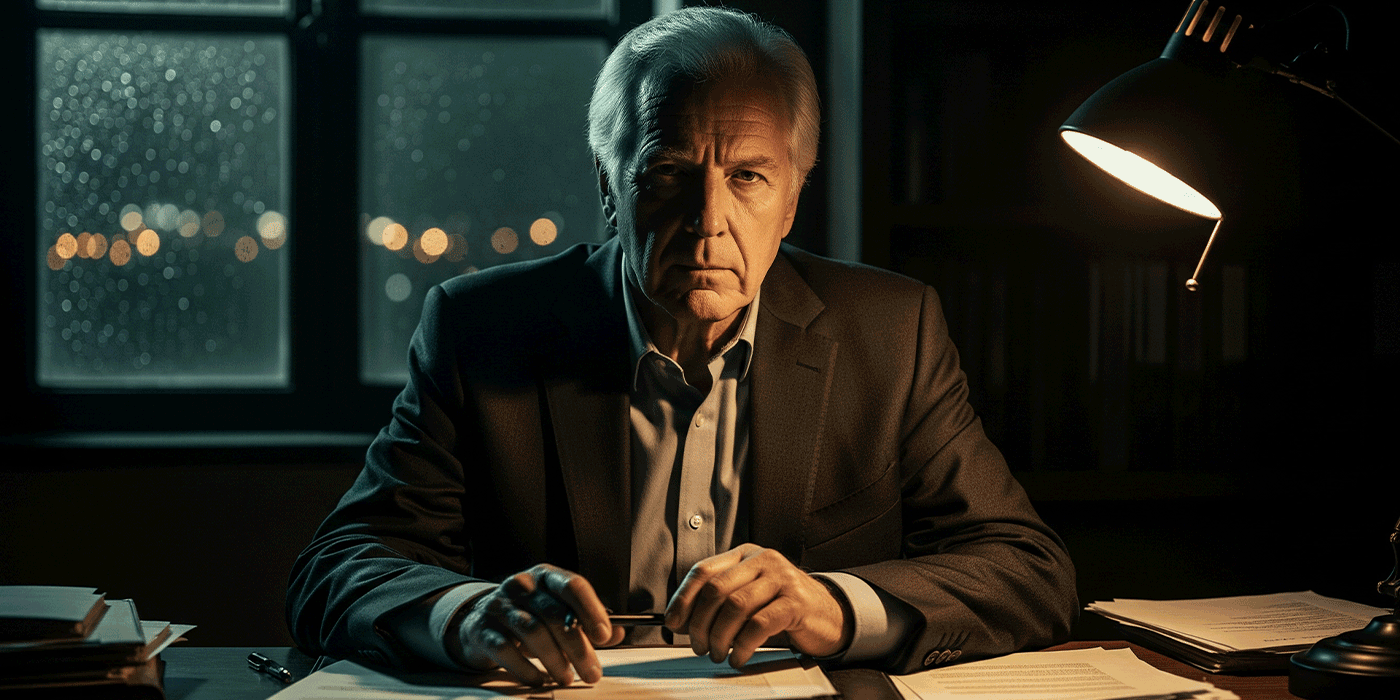
Next War in Venezuela - Douglas Macgregor
The Insider and His Verdict: Biography and an Uncomfortable Truth
Colonel (ret.) Douglas Macgregor is among the sharpest military-strategic critics of American interventionist policy.
Douglas Macgregor is a former U.S. Army colonel, military strategist, and national security analyst. He served for more than 30 years in various command and planning roles and participated in the 1991 Gulf War, where he was involved as a staff officer in planning high-mobility, maneuver-based operations.
Macgregor gained international recognition through his fundamental critique of U.S. military doctrine after the Cold War. Early on, he warned against endless intervention wars, strategic aimlessness, and the illusion of military omnipotence. In multiple books and professional analyses, he examines the structural decline of Western military power, the transformation of modern warfare, and the inability of political elites to adapt to the geopolitical realities of the 21st century.
He held several roles within the U.S. security establishment:
- Served as an advisor within the U.S. Department of Defense
- Considered under President Trump as a potential U.S. ambassador to Germany
- Regular guest in international media and defense policy forums
His analyses are characterized by sobriety, historical depth, and a rejection of moralized war rhetoric. For Macgregor, military power is never an end in itself, but an instrument that must remain subordinate to clear political objectives, realistic means, and calculable consequences.
Venezuela – A War Without Objective and Without a Plan
A military buildup without a clearly defined political objective is not a display of strength, but a symptom of strategic disorientation.
One has to ask: What is the concrete political-military objective? And once that objective is defined — which, at this point, remains unclear — the next question follows immediately: Is it achievable? Can it actually be accomplished?
Glenn Diesen raises the obvious question. The U.S. Navy is expanding its presence off the coast of Venezuela, and the White House signals intentions of regime change. Yet how this is supposed to be achieved remains unclear. Is this genuine preparation for war, or merely an attempt at intimidation designed to extract political or economic concessions?
Douglas Macgregor’s answer is sobering:
💬 “I think this is a very serious buildup. It is designed to do more than intimidate. I believe there is a willingness to intervene in Venezuela.”It should not be forgotten that the United States has had plans for such a scenario on the shelf for years. Venezuela has long been viewed as a potential target — particularly in light of Hugo Chávez, his ideology, and the country’s perceived ties to China and Russia.
The fundamental absurdity of the planning becomes apparent:
- Venezuela is so vast that it is difficult to imagine how 16,000 army troops and 2,500 Marines could meaningfully control it
- The country has a population of roughly 30 million, concentrated largely in coastal regions
- The core question remains: what is the actual political-military objective?
- And the follow-up question: is it even achievable?
War, as anyone with a measure of common sense understands, is by nature so unpredictable that the absence of clear intent becomes fatal. The problem, as Macgregor notes, is that he has heard nothing from the President of the United States about what he actually wants the military to do.
This echoes Lyndon B. Johnson’s intervention in Vietnam. LBJ never clearly articulated what was to be achieved. “We will support the legitimate government and fight communism.” That was a slogan — not a military objective.
The Logic of Narco-Terrorism – Bombing Drug Cartels
Where no coherent strategy exists, slogans and enemy labels become substitutes for thinking.
People often complain about the absence of exit strategies. But the problem is far more fundamental when no strategy has been outlined in the first place.
Glenn Diesen expands on this point. It has become a recurring feature of many conflicts across the political West: the lack of clearly defined objectives and strategies. What exactly are we trying to achieve, and how are we supposed to achieve it? There is constant talk of fighting “narco-terrorism,” but once the idea of bombing Venezuela enters the discussion, the question becomes unavoidable: how, precisely, is that supposed to accomplish this objective?
The predictable consequences of strategic vacuum are clear:
- Venezuela is a large country — it has neighbors, an economy, and a sizable population
- Following historical patterns, the United States has likely already infiltrated Venezuela with a significant number of CIA operatives
- They may also receive support from MI6
- The critical question is what these intelligence assets will do in coordination with mercenary forces
Mercenary forces are easy to recruit; the problem is that they are not always reliable. But when the objective is to ignite a conflict, they can certainly set events in motion. That, in all likelihood, is either imminent or already underway.
Then there is the second issue: two Russian destroyers anchored off the coast of Venezuela. And the question remains — what exactly is that meant to signal?
Russia’s Signal – The Line Has Been Crossed
The presence of Russian warships is not accidental, but a calculated signal to a Washington that has systematically ignored limits.
You have done everything in your power to destroy us in Moscow. You have pushed NATO’s frontier to the outer limits of its operational capacity, and you have likely caused the deaths of roughly 130,000 Russians and nearly 1.8 million Ukrainians.
Douglas Macgregor is unequivocal:
💬 “Obviously, the Russians would not have anchored two warships off the coast of Venezuela, within reach of the U.S. Navy, unless they were trying to send a signal.”That signal is unmistakable. Washington has done everything it could to weaken and destroy Moscow. NATO has been expanded to the very limits of its functional reach.
Russia’s new posture is clear:
- The United States refuses to end the war and continues to fuel it
- Russian forces are capturing Ukrainian boys who have been in uniform for barely a week
- Moscow has abandoned efforts to persuade Washington to de-escalate
- The message now is: we will not let this go unanswered
This is the so-called new multipolar world — the one that allegedly followed the “rules-based liberal order,” a phrase Macgregor often treats with open skepticism. He has never seen evidence of genuine rules beyond those Washington sought to impose unilaterally.
In his assessment, this approach is likely to backfire catastrophically. If the United States were to clash with these Russian warships and sink them — a scenario Macgregor considers entirely plausible — it is impossible to predict what would follow.
Russia possesses the capability to strike targets across a vast expanse — from Lithuania to Romania, from Poland to the French border — and to inflict massive damage in a very short time. For Moscow, this represents something close to the final straw.
Yet Washington continues to operate under the belief that no one can seriously challenge American power, that the United States remains the dominant force on the planet, and that Russia is weak, incapable, and incompetent. This belief is pure illusion — but it is precisely the illusion that has been carefully cultivated.
Latin America Watches – Who Will Stand Up to the “Evil Yankee”?
In a region with a long memory of intervention, every escalation is read as a historical precedent.
If Russia is directly challenged by the United States in the waters off Venezuela, the rest of Latin America will be watching closely. And if Washington pushes forward and Russia responds, this could lead a significant number of Latin American states to quickly align themselves with Moscow against the United States.
The impact on the rest of Latin America will be enormous, regardless of the outcome. The region will observe every move carefully. And if the United States escalates and Russia reacts, many countries may rally behind Russia — not out of ideological alignment, but because they see Moscow as a power at least willing to confront the “evil Yankee.”
The historical lesson is being ignored:
- Latin America has never held much affection for U.S. intervention
- History books are filled with examples of catastrophic foreign interference
- Macgregor wishes he had good news, but he sees none
- What he sees instead is stupidity and self-deception elevated to policy
The objectives — or at least some of them — are not difficult to discern. Venezuela possesses vast natural resources, and several American politicians have openly suggested that, given these resources, it is deeply “unfriendly” for Venezuela to align so closely with Russia and China.
Glenn Diesen raises the obvious follow-up question: Is the objective merely greater control over resources — or is it also to sever Venezuela from these alternative centers of power?
Venezuela as the Trigger – From Simmering to Boiling
Local confrontations can accelerate global dynamics when they strike an already overheated system.
If the United States were to clash with Russia over these two warships off the coast of Venezuela, the slow simmering would suddenly turn into a violent boil. In other words, the temperature would rise sharply, and events would begin to accelerate at a pace that would be difficult to control.
But what would the Russians do next? They have no intention of moving further west. They do not want to govern or administer Ukraine. Yet at some point, they are forced to bite the bullet and do what is necessary to secure their country. That is the position Russia now finds itself in.
The questions being asked in the Kremlin are fundamental:
- Why are we exercising so much restraint?
- The Americans mistake our restraint for weakness — and we are not weak
- Why do the Americans fail to understand what we actually want?
- They fail because they refuse to listen
Washington is not even willing to consider Moscow’s legitimate security interests. It refuses to acknowledge that Russia not only has valid security concerns, but must also be treated as a developed state with superior military capabilities and significant economic potential — not as a backward Third World country.
The underlying question remains unanswered: why is the United States unable to treat Moscow as an equal?
Trump’s Strategy of Strength – When Maximum Pressure Fails
The belief that power projection can compensate for structural decline ignores the realities of a multipolar world.
This, Macgregor argues, is one of the central weaknesses in Donald Trump’s strategy. It rests on the assumption that America’s relative decline in the face of rising powers is merely the result of weak leadership — rather than deep structural change.
Glenn Diesen identifies the core problem. Trump assumes that if sufficient strength is displayed, outcomes will fall into place. But when it comes to Russia and China — two major powers — neither sees any reason to submit, nor any necessity to do so given their capabilities. And if this strategy of maximum pressure fails, it becomes unclear what Plan B is supposed to be.
The new reality of European dependency is increasingly evident:
- Much of Moscow’s resentment is directed at Europe
- European leaders speak openly about stronger deterrence and conflict objectives
- Russian assessments increasingly cite Europe’s escalatory rhetoric
- The question arises whether a direct conflict between Europeans and Russians could emerge
Douglas Macgregor is unequivocal. Russia has no interest in a war with Europe. Such a conflict is the last thing on Moscow’s agenda. Russia wants peace with Europe and seeks economic cooperation, not confrontation.
Nevertheless, Emmanuel Macron has decided to deploy elements of the French Foreign Legion — approximately 2,000 troops — to Ukraine. France’s military leadership has made it clear, however, that it is not capable of deploying additional forces beyond that.
Europe Trapped – Starmer, the King, and 30,000 British Troops
Domestic instability and foreign-policy escalation begin to reinforce each other.
Keir Starmer is in serious trouble after making commitments to deploy 30,000 British troops to the war in Ukraine without consulting or informing key institutions. According to Macgregor, the King has finally intervened.
The situation in London reflects a deeper crisis. Starmer’s unilateral promises to send 30,000 British soldiers into a war with Russia have triggered institutional alarm. Macgregor believes the King has stepped in to put an end to this course of action and would not be surprised if Starmer were forced to resign.
Europe’s most severe problems lie at home:
- Macgregor doubts that the King or the Prince of Wales has any appetite for war with Russia
- They see no strategic logic in such a conflict
- Europe’s gravest challenges stem from mass migration they cannot afford
- Populations they neither need nor genuinely want
If Vladimir Putin is president, Macgregor is confident of one thing: patience toward Europe. If Russia is willing to wait, Europe’s governments will change. They will fall, and new political forces will take power.
Macgregor expects this to occur first in the United Kingdom and France. And if that happens, maintaining power will become extremely difficult for what he calls the “madmen” in Germany.
The AfD and the Return to Rationality
Political shifts emerge where established elites replace strategic reality with moral rhetoric.
Alternative für Deutschland (AfD) is gaining support day by day because it advances what Macgregor describes as a rational agenda: no war. Germany must restore workable relations with Russia. It must rebuild itself as a scientific and industrial power.
The AfD’s growth, in this view, reflects a broader exhaustion with escalation. Its message centers on ending confrontation, restoring economic competence, raising living standards, and climbing out of the strategic and industrial decline into which Germany has fallen.
The Polish problem illustrates the wider regional tension:
- The new president Nowrocki holds pragmatic views on certain issues
- Yet he has so far failed to make a clean break with his predecessors
- Donald Tusk must go
- Poland needs to rid itself of globalist forces pushing the country toward war
Macgregor believes Germans will eventually work their way out of what he calls a state of desperation and vote out Olaf Scholz. They will find a way to end the conflict with Russia because, in his assessment, it makes no strategic sense.
There are already signs of divergence elsewhere: Slovakia and Hungary, and to a lesser extent Serbia — although Serbia, as Macgregor notes, continues to play both sides.
Wrestling Events Instead of Statecraft – Trump’s Leadership Style
Performance and personal affirmation are mistaken for state leadership.
Donald Trump would much rather attend a wrestling event in Las Vegas than sit down with foreign heads of state to discuss policy. That is where he feels comfortable. He enjoys interacting with his supporters.
Trump prefers rallies to diplomacy. He thrives on crowd energy, applause, and direct affirmation, and he equates this with leadership. In his mind, the ability to energize supporters substitutes for governing. Unfortunately, that is not how statecraft works.
The expectation of greatness has been lost:
- Greatness means recognizing the limits of one’s power and interests
- This principle goes back to Henry John Temple: Britain, he argued, had no permanent allies and no permanent enemies, only permanent interests
- There are no lasting friendships in international relations — only enduring interests
- Trump takes everything personally: “I get along with him, he’s my friend”
All of this, Macgregor argues, is nonsense in the realm of international relations. Everything hinges on interests, not personal rapport. He seriously doubts that Trump has ever sat down and asked anyone: “Tell me what our interests are in country X — and then tell me who else has interests there as well.”
He sees no evidence that this kind of strategic thinking has taken place.
A 19th-Century Mindset in the 21st Century
Technological change has stripped traditional symbols of power of their meaning, while political thinking has failed to adapt.
“We need to get out of the 19th century.” Macgregor’s critique is blunt. Too many decision-makers still behave as if it were the era before the First World War: “Send the gunboats.” That, he argues, is the core problem with President Trump’s approach. This is the 21st century.
Glenn Diesen introduces the concept of offshore balancing. Traditionally, the United States sought to avoid a permanent presence on the Eurasian continent, recognizing that such commitments were costly and encouraged the formation of counterbalancing coalitions.
Douglas Macgregor’s response is scathing:
- This is a 19th-century mindset — and we do not live in the 19th century
- Technology has fundamentally changed
- There is no need to park ships off the coast of North Africa to threaten anyone
- The United States possesses the means to destroy others — and itself — quickly and decisively
This constant refrain — “I’ve got a big navy out there, and everyone is impressed” — is, in Macgregor’s view, nonsense.
Edward Luttwak once remarked on the spectacle of an aircraft carrier stationed off the coast of Lebanon: “What a beautiful image.” But the ability to project decisive influence inland from the sea is extremely limited — very limited.
Venezuela – The Choice Between Everything or Nothing
Absolute demands block realistic solutions and render diplomacy impossible.
According to Douglas Macgregor, Venezuela presented Washington with an opening — but once again it was treated as an all-or-nothing proposition. Either the United States gets everything, or it gets nothing. This, he argues, reflects a childish mentality that dominates thinking inside the Beltway.
No one needs to send a gunboat anywhere to inflict serious damage on the United States if it is provoked. That is precisely why Macgregor is deeply concerned about the two Russian warships off Venezuela’s coast. The United States still has a choice. It can acknowledge that Russia has economic interests in Venezuela — and that China does as well. That may be undesirable from Washington’s perspective. It may not be what policymakers prefer. But it is not a reason to go to war.
The missed opportunity is clear:
- The United States should have been interested in asserting its own stake in Venezuela
- That is exactly what Nicolás Maduro offered
- Washington rejected it outright: “He’s a narco-terrorist”
- Call him whatever you like — but he is not a narco-terrorist, and everyone knows it
Once again, the United States defaulted to an all-or-nothing approach. Any attempt to question this logic is met with accusations of weakness: “You’re weak. We have to be strong. We have to intimidate these people.”
Macgregor’s verdict is blunt. This is not strategy. It is madness.
The Cabinet Meeting of Flattery
Flattery distorts decision-making and replaces strategic counsel with theater.
One of the most striking — and, frankly, most depressing — scenes were the cabinet meetings in which members competed with one another to tell the president: “Wow, thanks to your brilliant leadership, you have saved America.”
He was also told quite plainly: “We will not stop buying oil and gas from Russia.” India has not stopped purchasing Russian oil and gas either. The president of South Korea presented him with a replica of the crown of the Korean Khanate. His only complaint was that it was not the original.
The lesson of flattery is unmistakable:
- People have learned how to deal with him
- He loves being flattered
- One of the most depressing spectacles: cabinet meetings turned into competitions of praise
- “Wow, thanks to your brilliant leadership, you saved America” — an outrageous absurdity
This may have worked for Louis XIV, although Macgregor believes even Louis XIV possessed a firmer grasp of reality — despite bankrupting France through excessive wars. Napoleon Bonaparte, by contrast, was far less susceptible to flattery.
That, Macgregor argues, is the core problem. Anyone who has worked with Donald Trump understands the dynamic: advancement comes through praise, affirmation, and constant reinforcement of greatness — not through strategic dissent or honest counsel.
What America Truly Needs – Rationality Instead of World Policing
Rationality begins with acknowledging limits — of power, resources, and control.
The United States, Macgregor argues, must recognize that it is a bad idea to sail around the world starting wars against countries it dislikes. A different path forward is required. This is the 21st century — not the early 19th or early 20th century.
What America needs is rationality and cold, hard calculation. It must accept that launching wars out of preference or hostility is no longer viable. The world has changed, but American strategic thinking has not kept pace.
The necessary agenda is clear:
- Focus decisively on addressing the national debt
- Sit down with those who hold that debt and reach an agreement
- Any serious plan must include spending cuts
- Macgregor sees no indication that anyone is prepared to cut spending
As a result, he believes the United States is heading straight toward the cliff. When it hits, it will shatter — and by then it will be too late. Nothing will change beforehand.
All the talk about adapting to a multipolar world should, in theory, point toward an orderly transition. But if events spiral out of control, that transition will not be managed. It will be chaotic.
Financial Capitalists vs. the Productive Economy
Short-term profit has replaced long-term substance — economically and geopolitically.
“We are not building a productive economy,” Macgregor argues. Instead, the United States is being led by what he calls financial capitalists — people who have made billions through apps designed to skim small amounts of money rather than build anything tangible.
The same dynamic now dominates the broader economy. America is not rebuilding its productive base; it is being guided by financial capitalists who create nothing of lasting value. There are rare exceptions — Elon Musk, Macgregor notes, deserves credit for actually building things and creating jobs — but they are the exception, not the rule.
The absence of strategy is glaring:
- There is no coherent strategic approach in Washington
- No scientific-industrial strategy, no high-technology strategy, no agricultural strategy
- The United States once produced more food than almost any other country on the planet
- Why were a million cattle slaughtered? Why is beef now imported from Argentina?
A series of poor decisions has been made, all driven by short-term profit. This, Macgregor says, is the American problem — the “microwave nation.” Put something in, press a button, and expect a finished product a minute later.
That is not how the world works.
The Micro-Militarism of Decline
Small military actions often serve as acts of self-affirmation for waning power.
The French philosopher Emmanuel Todd points to a recurring phenomenon he calls “micro-militarism” — the tendency of declining powers to strike small military targets in order to assert greatness. Historically, this pattern appears most often during periods of systemic decline.
The United States now confronts societies in China, Korea, Japan, Vietnam, Russia, and Iran — almost everywhere — whose historical experiences and strategic cultures differ fundamentally from its own. Europeans, particularly in Western Europe, have made a fatal mistake by imitating the United States and adopting the same short-term view of the future.
The fundamental questions are unavoidable:
- How long can this continue, and when will it break?
- It will end when it can no longer go on — when everything simply grinds to a halt
- It is clear that a new locomotive is needed
- But no one wants to stop: “That would take too long. That would cost too much.”
The locomotive is already in serious trouble — it is running out of steam. Yet no one wants to admit it. Instead, Americans proclaim: “We are the greatest. We have the best. We are this, we are that. No one can match us.”
Douglas Macgregor believes a reckoning is inevitable. In his view, the lesson will come — whether it is welcomed or not.
The Final Reckoning – Venezuela as a Symptom
When a nation has to remind itself of its greatness every two minutes, it may be losing that greatness in the process.
Glenn Diesen returns to the observation made by Emmanuel Todd. He calls it “micro-militarism” — the tendency of a state to strike small military targets in order to assert its greatness. Historically, this pattern appears most often during periods of decline. As Diesen notes, if a country must constantly proclaim how great it is, that very insistence may signal the loss of genuine power.
Douglas Macgregor’s response is resigned:
- That assessment is absolutely correct — and he does not know how to fix it
- Except by waiting for the locomotive to collapse
- Until everyone gets off the train and asks, “What happened?”
- Only then might something new be placed on the tracks
Venezuela is not the war itself — it is the symptom. A symptom of a strategic vacuum so deep that even the basic question “What are we trying to achieve?” can no longer be answered. A symptom of a nation that believes the rules of international relations have not changed since the 19th century. A symptom of leadership that prefers wrestling events to the discipline of foreign-policy strategy.
The parallels with previous American military adventures are unmistakable:
- No clear objectives
- No strategy for achieving those nonexistent objectives
- No exit strategy
- No consideration of consequences
Vietnam, Afghanistan, Iraq, Ukraine — and now Venezuela. The pattern repeats itself. Intelligence agencies infiltrate, mercenaries are hired, airstrikes are launched. People die, resentment grows, permanent hostility is created. But what is the objective? To plunder resources like Cortés? To enforce the Monroe Doctrine, which failed even in the 19th century? To push Russia and China out of the Western Hemisphere?
The two Russian warships off Venezuela’s coast send a clear signal: the era of unipolar dominance is over. Russia and China will not submit. They have neither the need nor the willingness to do so. If the United States were to attack those ships, the consequences could be felt from Lithuania to Romania, from Poland to the French border.
The unasked questions in Washington are decisive:
- What happens if Latin America watches Russia stand up to the United States?
- What happens if a large number of Latin American states align with Moscow?
- What happens if the slow simmering in Ukraine suddenly turns into violent boiling?
- What happens if Trump has no answer — because there is no Plan B?
The locomotive is out of steam. Thirty-eight trillion dollars in debt. An economy dominated by financial capitalists. A million cattle slaughtered. Beef imported from Argentina. No coherent strategy for anything. And in the midst of all this — plans to invade Venezuela, a country roughly the size of Germany, France, Austria, and Switzerland combined, with a population of 30 million.
Dwight D. Eisenhower understood what a president must understand: the international system, the economy, and the military. Trump understands how to enjoy flattery, attend wrestling events, and talk about golf courses. Cabinet meetings have become theater: “Wow, thanks to your brilliant leadership, you saved America.” Even Louis XIV would have understood statecraft better. Napoleon Bonaparte would never have been so easily swayed by praise.
What Macgregor sees is unmistakable:
- Stupidity and self-deception elevated on stilts
- A 19th-century mindset applied to a 21st-century world
- An obsession with aircraft carriers as symbols of power
- A refusal to acknowledge that technology has changed the rules
The United States possesses the means to destroy others — and itself — quickly and decisively. The ability to project decisive influence from the sea onto land is extremely limited. No one needs to send gunboats anywhere to inflict enormous damage. Yet no one in Washington seems willing to accept this. Instead, the refrain persists: “Send the gunboats. Show strength. We must intimidate them.”
Nicolás Maduro made a generous and lucrative offer. The United States rejected it — not because it was bad, but because Trump’s advisors insisted that Russia and China must be expelled from the region entirely. Everything or nothing. A childish mentality. Anyone who questions it is labeled weak.
The final truth about Venezuela is stark:
- There is no strategy
- There are no clear objectives
- There is no consideration of consequences
- There is only the impulse to display strength, under the illusion that it is sufficient
Macgregor does not know how to fix this — except to wait until the locomotive collapses. Until everyone steps off and asks, “What happened?” Only then might something new be placed on the tracks and sent in a different direction.
Emmanuel Todd is right. Micro-militarism — striking small targets to express greatness — is historically a sign of decline. When a nation must constantly remind itself of its greatness, it may already be losing it.
Venezuela will not be the last war America contemplates. But it may be the war that finally proves the old locomotive no longer runs. That a 19th-century mindset cannot function in the 21st century. That maximum pressure is not a strategy. That flattery does not replace foreign-policy competence. And that decline does not stop simply because it is denied.
Russia will exercise patience. Europeans will overthrow their governments. Latin Americans will watch to see who stands up to the “evil Yankee.” And the United States will learn a lesson.
That is Macgregor’s prognosis. He wishes there were good news.But he sees none.
He sees only: stupidity and self-deception on stilts.
Thank you, Douglas Macgregor.
Sources & Geopolitical References
Substack – US-Edition
This article is also available as a English-language edition on Substack:
How America Will Lose Its Next War in Venezuela - Douglas Macgregor
Original conversation (video)
YouTube-Interview:
Decline Out of Control - Ukraine and Venezuela Wars - Douglas Macgregor
Support Independent Journalism
If you find my work valuable, you can support it with a voluntary contribution here:
Voluntary support via PayPal
Voluntary support via Buy Me a Coffee
Many thanks for your support!

More Articles
How America’s Economic War on Russia - Richard Wolff
An Indictment of 80 Years of Vassal Politics - Larry Johnson
America’s New Imperialism - John Mearsheimer

investigative commentary.