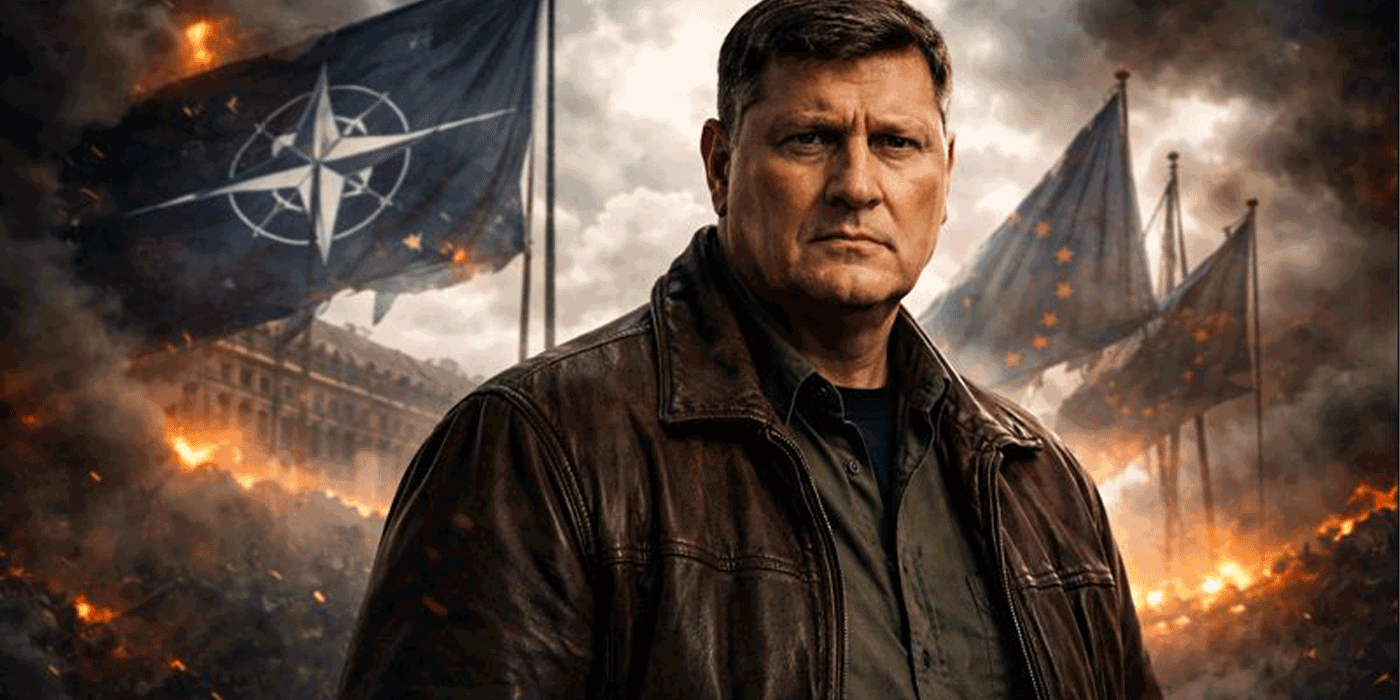
Russia Ignores NATO – Scott Ritter and Pepe Escobar
The Insider: Scott Ritter
From Marine officer to public enemy of official narratives.
Scott Ritter was not just another soldier. He was positioned at the center of the storm. As a senior weapons inspector for the United Nations Special Commission (UNSCOM) in Iraq (1991–1998), and previously as a Marine Corps intelligence officer, he operated at the source of military and strategic intelligence.
His expertise is not disputed:
- Intelligence front line: Direct analysis of ballistic missile systems and weapons of mass destruction during and after the Gulf War.
- The break with the system: In 1998, Ritter resigned in protest, accusing the United States and the UN of abandoning disarmament in favor of geopolitical manipulation.
- The warning: Long before 2003, he argued that the evidence for Iraqi WMDs was fabricated. History confirmed his assessment—and exposed a systemic deception at the highest level.
Today, Ritter is no longer a servant of the state, but one of its most persistent critics. He applies the same analytical precision he once used on Iraqi weapons facilities to dismantle NATO’s strategic assumptions in Ukraine.
💬 “You cannot dismantle an empire by bombing it with lies.”The Geostrategist: Pepe Escobar
Chronicler of the Eurasian century.
Pepe Escobar is not a journalist in the conventional sense. He is a roaming analyst of global power shifts, reading the West’s “Grand Chessboard” strategy against the rising Global South with uncommon clarity.
His focus lies where Western media rarely looks:
- Global nomad: From London to Hong Kong, from Washington to Tehran, Escobar reports from geopolitical fault lines rather than institutional comfort zones.
- Eurasian integration: As the longtime author of “The Roving Eye” at Asia Times, he shaped early understanding of the Belt and Road Initiative and global energy conflicts known as “Pipelineistan.”
- Voice of multipolarity: Across platforms such as RT, Sputnik, and The Real News Network, Escobar documents what mainstream narratives avoid—the erosion of U.S. hegemony and the rise of BRICS.
For Escobar, the world map is not a static diagram, but a contested battlefield of resources, power, and strategic dominance.
💬 “The world is not a playground for morality—it is an arena of geostrategic interests.”Introduction & Context
The global order is shifting faster than Western governments are willing to acknowledge. Scott Ritter and Pepe Escobar describe with unusual clarity how threat-making as a geopolitical tool is losing effectiveness—and how BRICS, Iran, Russia, and China have already shaped a multipolar reality, while the West remains trapped in its own narratives.
What follows is a synthesis of their core arguments on power, miscalculation, and the historical moment in which the old order begins to implode.
What this analysis reveals is not a dispute of opinions, but a structural rupture. The pillars on which Western power rested for decades—deterrence, sanctions, moral authority—lose force the moment they are no longer believed. The decisive factor is not military weakness, but the erosion of narrative control.
The text that follows is therefore not a forecast, but an assessment. It outlines a world in which power is no longer proclaimed, but organized—quietly, over time, beyond Western headlines. Those seeking to understand why threats no longer work, alliances realign, and Europe appears increasingly disoriented will find the contours of an order that has already taken shape.
The Rhetoric of Economic Terror
Threat-making as an expression of hegemonic desperation
Scott Ritter and Pepe Escobar describe the current global confrontation not as a classical Cold War, but as an existential struggle—between a declining hegemonic power acting out of desperation and a rising, strategically grounded BRICS axis.
The language of the West is no longer diplomatic. It is defined by economic coercion, ideological arrogance, and the dangerous assumption that the world can still be controlled through threats alone.
💬 “Sanctions never destroy governments. They destroy societies.” — Scott RitterAt the center of this development is a new form of economic warfare, which Ritter and Escobar describe as the “exposure of the hegemon.” Statements by influential U.S. senators—such as Lindsey Graham or Richard Blumenthal—
reveal the three pillars of this strategy:
- The ultimatum tactic: Negotiation is replaced by a binary choice—submission or economic destruction.
- Moral framing: States making sovereign trade decisions (such as India or Brazil) are criminalized. The term “blood money” is weaponized to impose moral guilt on neutral actors.
- The illusion of control: The West threatens with instruments—most notably dollar dominance—that lose effectiveness precisely because they are used as threats.
The warning directed at the Global South sounds less like policy and more like protection racketeering:
💬 “If you continue buying cheap Russian oil and thereby enable this war, we will destroy you economically. What you are doing is blood money. You are buying cheap Russian oil at the expense of the entire world.”Escobar describes this posture as a “moral perversion of sanctions policy.” It reclassifies the legitimate economic interests of sovereign states as moral crimes. The outrage over “blood money” ultimately masks a desperate attempt to preserve a collapsing power and dollar-based system.
The assessment is unsparing:
- Financial warfare: This is not about human rights, but about undermining the sovereignty of any state unwilling to submit to Washington.
- Psychological maneuvering: The threats reflect a desperate attachment to an era in which a phone call from Washington was sufficient to redirect the global economy.
- The BRICS effect: Emerging powers have decoded this mechanism. They no longer perceive threats as strength, but as anxiety over declining relevance.
BRICS Realism: The Arrogance of Patience
Against Western ideological blindness
While Washington and Brussels react with urgency and agitation, the BRICS states respond with a composure that deeply unsettles Western observers. Threats are no longer interpreted as demonstrations of power, but as symptoms of weakness and ideological distortion.
The strategy of the emerging world order:
- Long-term strategic thinking: China and Russia do not operate within election cycles, but across decades. Their responses are coordinated with precision rather than driven by impulse.
- The Iran case: Tehran provides a textbook example of strategic patience. Despite what amounts to a de facto declaration of economic war by the West, Iran’s responses target the logic behind the aggression. Counter-moves are planned years in advance, grounded in historical continuity, while Western policy reacts in emotional short-circuit.
- Alternative mechanisms: As long as the Russian economy continues to grow and China keeps trade corridors open, Western threats against third countries lose practical effect.
To Western audiences, this posture often appears arrogant. In reality, it reflects strategic maturity. Patience replaces reaction, calculation displaces outrage. The BRICS states have grasped that power does not reside in volume, but in endurance—and that time itself has become a geopolitical resource.
While the West escalates rhetorically, these actors build structures that do not depend on approval. Trade routes, payment systems, and security arrangements take shape beyond moral appeals. This is where the real shift in world order occurs: not through open rupture, but through quiet replacement.
The End of Credibility
Why the threat narrative is collapsing
Threats aimed at economically “crushing” countries such as India, Brazil, or Saudi Arabia have become hollow phrases. The West has lost its most important lever: credibility.
💬 “Sanctions are the modern form of collective punishment.” — (after Richard Blumenthal)What the BRICS axis offers the Global South is the antidote to G7 hegemony:
- Mutual respect: No moral subjugation, but acceptance of national interests.
- Sovereignty: The refusal to sacrifice domestic development for NATO’s geopolitical games.
- Realpolitik: A shift away from ideological prescriptions toward pragmatic cooperation.
Credibility cannot be coerced. It emerges from coherence between words and actions—and that coherence has eroded. When threats are issued more frequently than they are enforced, and moral appeals contradict actual practice, even the strongest rhetoric loses its effect.
For the Global South, this realization is liberating. It allows states to realign decisions with their own interests rather than external expectations. The move away from Western threat mechanisms is therefore not an act of rebellion, but a rational adjustment to a world in which credibility must be demonstrated, not proclaimed.
Russia’s Cold Realism
The nuclear anchor as the final line
While Western policy is driven by strategic hysteria and moral outrage, Moscow operates in a mode best described as “cold realism.” Scott Ritter attributes to the West a fundamental inability to conduct rational threat assessment—trapped within its own propaganda loops.
Russia, by contrast, does not respond to rhetoric, but to physical realities along its borders.
The anatomy of the threat:
- Encirclement as fact: NATO expansion (Finland, Sweden), the militarization of the Baltic region, and pressure in the South Caucasus are no longer perceived in Moscow as political maneuvers. They constitute a physical, existential threat requiring a strictly defensive—but lethal—response.
- Strategic objective: degradation. The Kremlin views NATO not as a security alliance, but as an apparatus whose primary function is the containment and erosion of the Russian Federation.
Why there is (still) no world war:
The sole reason NATO has not engaged Russia directly in a military confrontation is what can be described as the “nuclear anchor.”
- Escalation dominance: Russia retains the capability to escalate any NATO-initiated scenario instantly to an intolerable level.
- The guarantee of sovereignty: The arsenal is not designed for aggression, but for calculated self-defense in a world where international law has lost relevance for the hegemon.
Moscow calculates every risk with precision. It is this emotional detachment—this coldness—that the West lacks, and that it finds most unsettling.
The Oreschnik Moment: The End of Dialogue
Russia stops listening to NATO
The West must accept a new and bitter reality: the “Oreschnik moment” has arrived. This is the point at which Moscow stopped listening. Strategic calculations in Washington aimed at forcing Russia back into a diplomatic framework have become irrelevant.
The Kremlin’s new “internal logic”:
- Indifference as a weapon: Russia no longer reacts to NATO provocations, instead rigidly pursuing its own strategic priorities.
- Strategic deafness: The West continues to send signals, but Moscow has switched off the receiver. Any attempt by NATO to dictate “rules of the game” now falls into a void.
This moment does not represent an outburst, but a withdrawal from the illusion of dialogue. Moscow no longer treats words as signals, but as background noise. Only actions, power balances, and physical realities along its borders retain relevance.
For the West, this condition is difficult to accept because it marks the end of a familiar order. Diplomacy without reciprocity becomes meaningless, deterrence without credibility ineffective. What remains is a strategic vacuum in which old instruments fail and new ones are not yet understood.
The Flank Strategy: Caucasus & Central Asia
How Moscow trades space for focus
While the West celebrates moments of instability it helps trigger in the South Caucasus (Armenia/Azerbaijan), Moscow keeps its eyes on the larger picture.
- Resource trap: Russia allows NATO to burn “valuable resources” and political capital in peripheral geopolitical theaters.
- The Asian shield: In Central Asia, Western destabilization efforts hit a wall. The region is already deeply embedded within the BRICS framework and the Shanghai Cooperation Organization (SCO).
- Existential defense: What the West frames as “intelligence operations” in former Soviet republics is assessed by Beijing and Moscow as coordinated existential threats—and neutralized jointly.
This approach may appear passive, but it is calculated. Moscow tolerates limited instability at the periphery to disperse Western strategic focus. Every secondary theater absorbs attention, personnel, and political energy—resources that are then unavailable elsewhere.
At the same time, a stable order consolidates in the background. In Central Asia, security and economic structures are taking shape without reliance on Western recognition. The flanks thus function not as vulnerabilities, but as filters: they absorb pressure while leaving the strategic core untouched.
The Clash of Two World Orders
From regional conflict to global confrontation
The confrontation has escalated to the level of superpowers. On one side stand the United States and its “hegemonic alliance,” driven by a growing panic over the loss of power. On the other stands a counter-system that no longer accepts instruction or moral arbitration.
💬 “For years NATO treated Russia as a backdrop — now Russia acts without NATO.”This is no longer about power projection.
It is the final clash between two operating systems:
- The Western dogma: An outdated hierarchy built on moral coercion and enforced compliance.
- The multipolar reality: A network centered around Russia, China, and Iran, operating from confidence and historical necessity rather than ideological conformity.
This clash follows no classical logic of war. It is neither symmetrical nor designed for short-term resolution. While one side attempts to impose control over narratives and loyalties, the other organizes its capacity for action beyond those categories. Power is no longer performed—it is structurally embedded.
This is where the turning point lies. The old order does not collapse through a final blow, but through incompatibility. Two systems operate under fundamentally different rules—and only one is capable of adapting to a world in which obedience can no longer be assumed.
The Ring of Fronts: A Three-Front War
Why encirclement fails
The West is attempting to crush Russia in a deadly pincer movement. Yet this strategy collapses under the weight of new alliances and shifting realities.
The three failed vectors of attack:
- Economic (sanctions): Planned as “shock and awe,” ending as a boomerang.
- Military (Ukraine): A war of attrition for which NATO lacks the necessary logistics.
- Political (isolation): Broken by the diplomatic offensive of the Global South.
These three fronts do not reinforce one another; they cancel each other out. Economic pressure generates circumvention mechanisms, military escalation drains resources, and political isolation loses effectiveness as alternatives emerge. The intended pincer remains fragmented.
Ultimately, the encirclement attempt fails due to a fundamental misunderstanding: power does not arise from overextension, but from coherence. While the West attacks simultaneously on all levels, opposing forces consolidate around clear priorities—undermining the very foundation of a multi-front strategy.
The decisive flaw in the Western plan has a name: China.
China’s Axis of Strategic Patience
The sanctions self-inflicted wound
Beijing does not play the role of savior, but that of a cold strategist. China functions as an economic anchor stabilizing the Russian economy—not out of goodwill, but to undermine U.S. hegemony.
The mechanisms of Western failure:
- Accelerated de-dollarization: China uses sanctions as a lesson and blueprint to decouple its system from the dollar.
- A weapon turned on the shooter: Sanctions policy forces Russia and China into a marriage of efficiency.
- Sanctions fatigue: The “blunt sword” of punitive measures now cuts deeper into Europe’s own economy than into Russia’s defense industry.
What was planned as economic annihilation has become a catalyst for Eurasian independence.
China’s approach is not reactive, but systemic. Each Western sanction is treated in Beijing as a data point—analyzed and translated into long-term adjustments. What appears as a short-term economic burden is converted into structural resilience.
The real shift, therefore, lies not in trade volumes, but in time horizons. While Western policy aims for immediate impact, China invests in durability. Patience replaces confrontation; preparation displaces escalation. In this asymmetry lies the decisive advantage—and the reason sanctions steadily lose their strategic effect.
The Weapon of Moral Superiority
Why the old narrative no longer works
The United States is reaching once more into its rhetorical toolbox, deploying the weapon that worked for decades: moral superiority. Washington divides the world into “good” and “evil,” brands geopolitical rivals as morally corrupt, and uses terms like “blood money” to enforce compliance.
But in the Global South—across Africa, Asia, and Latin America—this weapon has gone blunt.
What Washington presents as morality is recognized for what it is:
- A rhetorical fig leaf: A pretext for demanding geopolitical loyalty without offering economic reciprocity.
- The cost-benefit trap: The West demands sacrifices for its wars, yet delivers no solutions for hunger, infrastructure, or development.
The question the Global South now asks is devastating for the G7:
💬 “What does Western morality offer us if it weakens our economies, hinders our development, and drags us into conflicts that are not our own?”The answer is clear: nothing. The foundation of the American narrative is not eroding under external pressure, but through the simple realization of its own futility.
The Shadow War in Brazil
Brazil’s strategic fracture as a BRICS stress test
The BRICS conflict is not fought solely on the battlefields of Ukraine, but in the corridors of power across South America. Brazil has become the epicenter of this struggle.
Under President Lula, the government seeks to position the country as an anchor of the multipolar world. Yet Brazil remains a deeply divided nation.
The two internal fronts:
- The sovereignty camp (Lula): BRICS is understood not as a debating forum, but as a strategic network designed to loosen the grip of Western-dominated institutions.
- The Trojan horse (elites & military): A powerful bloc of security services, military leadership, and entrenched economic elites remains closely aligned with Washington. They view decoupling from the United States not as an opportunity, but as a betrayal of Brazil’s “strategic identity.”
This internal fracture is Washington’s point of entry. The United States watches closely as Lula attempts to break free, while key segments of Brazil’s own military establishment still salute northward.
Washington’s Last Card: Subversion
Escalation instead of acceptance
Washington does not respond to Brazil’s drift away with diplomacy, but with subversion. The tactic is well established: targeted pressure on Brazil’s political and economic establishment to contain Lula.
The message is an unmistakable threat:
- Warning of consequences: Anyone leaving the dollar orbit becomes a target.
- Instrumentalizing elites: The United States leverages its connections within Brazil’s upper classes to stoke fear of the BRICS trajectory.
Lula, however, has adapted. He no longer responds with submission, but with strategic composure. He disregards the warnings because he understands the basic equation of the new era: Brazil gains as a sovereign actor—and loses as a vassal of a declining hegemon.
This form of influence follows no long-term strategy, but the reflex of power preservation. Subversion replaces strategy because accepting the new reality is politically impossible. What remains is an attempt to buy time—even at the cost of growing instability.
For Brazil, this phase represents a critical test. How the country handles external pressure will determine whether it emerges as an independent actor within the multipolar order or remains trapped in old dependencies. The direction is not yet fixed—but the rules of the game have irreversibly changed.
Conclusion: Intellectual Bankruptcy
Why the United States no longer understands the game
The failure of the West is not an accident. It is the result of a deep intellectual paralysis in Washington.
The U.S. leadership elite still believes it can defeat Vladimir Putin or Xi Jinping at the negotiating table through threats and pressure. This is a fatal miscalculation.
The diagnosis is unmistakable:
- Loss of reality: The United States is intellectually bankrupt. It has lived too long inside its own hegemonic bubble, where its rules were treated as universal law.
- Lack of imagination: It is cognitively incapable of grasping the concept of a multipolar world. For Washington, the sovereignty of other states remains an anomaly to be corrected.
- Faulty calculus: The United States plays poker while BRICS plays chess.
Washington is not fighting Russia or China. It is fighting history itself—and that is a battle no power can win.
This bankruptcy is less moral than structural. It manifests in the inability to question core assumptions and to recognize new power configurations as legitimate. Adaptation is replaced by denial, analysis by the repetition of familiar threat rituals.
History, however, cannot be negotiated with. It does not respond to ultimatums, but to capability. Those who cling to obsolete models do not fall through external defeat, but through internal rigidity. That is the true core of Western failure.
The Pathology of Decline
An inability to process reality
The West suffers from a dangerous cognitive dissonance: it confuses its wishes with reality. The intellectual elite in the United States is simply unable to imagine a world in which Washington is no longer the center of the universe.
The diagnosis is paralysis:
- Misinterpretation: It cannot accept that Russia and China are not “anti-American,” but rather pro-sovereignty actors.
- Shock paralysis: The mere fact that other nations make independent decisions without asking for permission triggers total paralysis in Washington.
This pathology does not manifest itself in isolated miscalculations, but in a permanent state of mental blockage. New information is not integrated, but rejected. Reality is not processed, but reinterpreted until it fits the familiar worldview.
The cost of this refusal is high. Those who lose the ability to learn also lose the capacity to steer events. In a changing world, stagnation becomes a form of retreat—and precisely there lies the true dynamic of decline.
The Geometry of Madness
A psychological analysis of fear and incoherence
The psychology behind the Western response is a fragile mixture that Ritter and Escobar identify as the core of the problem:
- Fear: The West senses that its power model is collapsing—not through external force, but through the gradual loss of credibility, economic control, and global influence.
- Incoherence: Decisions emerging from Washington, Brussels, and London no longer follow a coherent strategy. They amount to reflexive improvisations—panic reactions rather than geopolitics.
This underlying psychological tension produces schizophrenic behavior: issuing “consequences” no one takes seriously, while appealing to values that have long since been betrayed.
This internal fragmentation makes coherent action impossible. Fear distorts perception; incoherence destroys planning. What is staged externally as determination is, internally, a permanent state of crisis in which every decision is driven solely by the next reaction.
In this condition, power loses its organizing function. It no longer generates stability, but amplifies the very uncertainty it seeks to contain. The geometry of madness lies in the fact that every movement pushes the system further out of balance—until even corrective measures become part of the problem.
The Farce of Sanctions
PR stunts instead of realpolitik
Sanctions against Russia have devolved into a theatrical performance.
- For domestic audiences: A pure PR exercise designed to simulate action (“We’re doing something!”).
- The reality: Russian oil and gas continue to circulate, trade balances remain stable. Symbolic politics have fully displaced realpolitik.
The function of these measures no longer lies in their foreign-policy effect, but in domestic staging. Sanctions serve as visible substitute action when real leverage disappears. They generate headlines, not structural change.
At the same time, they produce a paradoxical side effect. Every new sanctions package accelerates adaptation outside the Western system. Supply chains are rerouted, payment channels diversified, dependencies reduced. What was intended as pressure increasingly acts as a catalyst for autonomy.
The instrument itself thus becomes a farce. Sanctions lose not only their effectiveness, but also their deterrent value. What remains is ritual—loud, economically damaging to the sender, but strategically hollow. A clear sign that symbolic politics have definitively replaced realpolitik.
The Impossible Geometry of Madness
Why coherent thinking has collapsed
The driving force is the fear of irrelevance. The panic that the dollar may fall—and with it the only real lever of U.S. power—leads to strategic stupidity.
There is no longer any logical consistency in Washington.
One attempts to draw an “impossible geometry”:
- BRICS is to be dismantled.
- At the same time, China is to be integrated into the global economy.
- And in parallel, Russia is to be totally isolated.
These objectives are mutually exclusive. These internal contradictions steadily weaken the alliance and make Western policy fully transparent to Moscow and Beijing—predictable in its own incapacity.
These contradictions are not tactical mistakes, but symptoms of a strategic vacuum. Without a clear objective, policy fragments into contradictory impulses that neutralize one another. Decisions no longer emerge from planning, but from fear of losing control.
In such a configuration, predictability becomes a weakness. Not because it signals strength, but because it exposes the absence of orientation. The impossible geometry of madness lies in the fact that every new measure makes the lack of coherence more visible—and further undermines the position it seeks to defend.
The Danger of Unpredictability
Chaos vs. Iron Logic
The real danger to global stability today lies in the incoherence of the West. When a superpower no longer acts rationally but emotionally and unpredictably, the risk of unintended escalation increases dramatically.
The contrast could not be sharper:
- The West: Driven by fear, moral dogma, and chaos.
- BRICS: Operating with an “iron logic.” They act according to interest, not ideology.
It is precisely this reliability that magnetically attracts the Global South—and pushes the West into isolation.
Unpredictability is not a sign of strength, but a symptom of internal instability. In international politics, it does not deter—it destabilizes, because it destroys planning certainty and increases the likelihood of miscalculation.
The appeal of the new power centers is built on the opposite principle. Reliability, predictability, and sober interest-based calculation generate trust. In a fragmented world, stability becomes the scarcest resource—and the decisive currency of geopolitical influence.
The Looming Implosion: Europe as the Primary Casualty
A Chronicle of Self-Abandonment
When the history of this conflict is written, the loser is already clear: Europe. The continent is the greatest victim of its own “strategic hysteria.” The EU finds itself trapped in a geopolitical straitjacket: it loudly demands “autonomy,” yet remains dependent on decisions made exclusively in Washington.
The totality of dependence goes far beyond the military sphere. This loss of freedom has spread like a cancer across all sectors:
- Energy policy: The purchase of expensive U.S. fracking gas instead of affordable pipeline energy.
- Technology & economy: Submission to sanctions that actively deindustrialize Europe’s own productive base.
- Political culture: The erosion of the ability to define and defend national interests.
While the United States brutally defends its hegemony, Europe pays the price—without any strategic benefit of its own.
💬 “The greatest crisis of the West is not geopolitical — it is psychological.”This self-abandonment is no accident. It is the result of years of convenience. Europe outsourced strategic thinking and delegated political responsibility. Autonomy was invoked rhetorically but never practiced—until dependence became habit.
The moment external guarantees begin to erode, the internal void becomes visible. The continent still possesses resources, history, and economic substance, but no longer a shared strategic vision. The looming implosion does not arise from external pressure, but from the absence of its own political will.
Hysteria as State Doctrine
The Extended Arm of the Hegemon
“European hysteria” is the symptom of a paradoxical condition. Elites in Berlin, Paris, and Brussels sense that the unipolar world is collapsing. Yet instead of adapting, they cling frantically to the old order—because they lack both the courage and the vision to imagine an alternative.
The consequence is fatal: Europe no longer acts as a sovereign actor, but as the “extended arm” of American foreign policy.
- Economic self-destruction: Accepting sanctions that actively ruin its own economy.
- Foreign wars: Assuming military risks for conflicts that do not serve European interests.
- Missed history: While the Global South forges new alliances (BRICS), Europe chains itself to a sinking ship.
In this way, the continent—without ever stating it openly—becomes the “greatest loser” of a dynamic it no longer controls.
This posture is not a strategy, but an escape from responsibility. Instead of articulating its own interests, Europe adopts foreign priorities and calls submission “loyalty.” The political class no longer governs; it merely administers—always hoping that the status quo might survive one more cycle.
Hysteria thus becomes state doctrine. It replaces analysis, accelerates misjudgments, and blocks course corrections. In a phase of global reordering, this is fatal: those who remain trapped in a permanent state of emergency miss the moment when real agency must be redefined.
Political Infantilism: The Eternal Child
Scott Ritter’s Unsparing Diagnosis
Europe is, at its core, an “adult child” that was never allowed to grow up. It exists in a state of double subordination:
- Economically: A vassal of the G7.
- Militarily: An obedient subordinate of NATO.
- The result: Both structures are dominated by the United States.
Europe’s leaders are trapped in political infantilism. They behave like defiant adolescents pretending to be in charge, while in reality they are waiting for instructions. They simply do not understand how sovereignty works.
This immaturity is not an individual flaw, but a systemic outcome. Decades of external protection have withered independent strategic thinking. Responsibility was outsourced, decision-making replaced by compliance.
Political maturity, however, does not emerge from protection—it emerges from risk. Those who are never forced to stand by their own decisions lose the capacity for self-governance. This is Europe’s core dilemma: it demands autonomy without ever having built the foundations required to sustain it.
The Collapse Scenario
When Washington Pulls the Plug
Ritter’s warning is bleak and precise: the danger to Europe does not come from Moscow, but from its own incapacity.
What happens when the United States steps away?
If Washington one day decides to shift its strategic focus toward Asia and pulls the financial or military “plug,” Europe will not fight — it will collapse.
- The reason: not because Russian tanks roll westward, but because Europe “does not know” how to breathe without a guardian.
- The pathology: this dependency has become habit — a reflex that has extinguished independent strategic thinking. Europe speaks of “strategic autonomy,” yet behaves like a helpless protectorate.
Such a rupture would not unfold gradually, but abruptly. The absence of external leadership would expose, within a very short time, how fragile Europe’s own structures truly are. Decision-making would stall, coordination would disintegrate, and responsibility would be passed along rather than assumed.
The real collapse, therefore, would not be military, but political and psychological. Europe would face the task of acting independently for the first time in decades — only to discover that the capacity to do so has been systematically unlearned. Not external threat, but internal emptiness would be the trigger of the breakdown.
The Price of Convenience
The Closing Statement
Ritter and Escobar conclude with a verdict that allows no appeal: Europe has elevated immaturity into a virtue.
The continent wanted to enjoy the benefits of freedom, but never accept the responsibility that comes with it. It lived comfortably in the shadow of hegemony and called that shadow “order.” That order is now collapsing — not through external violence, but through internal emptiness.
Those who never learned to stand on their own will fall the moment the guardian leaves the room.
Convenience has proven to be a strategic dead end. It produces stability only as long as external guarantees exist. Once those guarantees disappear, no solid foundation remains on which independent action can be built.
The price of this posture is now coming due. Not in the form of a sudden collapse, but as a gradual erosion of agency, orientation, and self-confidence. An order that is not sustained from within cannot survive — it disintegrates the moment protection is withdrawn.
Thank you, Scott Ritter & Pepe Escobar.
Sources & Geopolitical References
Substack – US-Version
This article is also available as a US version on Substack:
Russia Ignores NATO - Scott Ritter & Pepe Escobar on the New World Order
Original conversation (Video)
YouTube-Interview:
Russia Ignores NATO — BRICS WAR Erupts - Ritter & Escobar
Support Independent Journalism
If you find my work valuable, you can support it with a voluntary contribution here:
Voluntary support via PayPal
Voluntary support via Buy Me a Coffee
Vielen Dank für deine Unterstützung!

More Articles
How America’s Economic War on Russia - Richard Wolff
An Indictment of 80 Years of Vassal Politics - Larry Johnson
America’s New Imperialism - John Mearsheimer

investigative commentary.