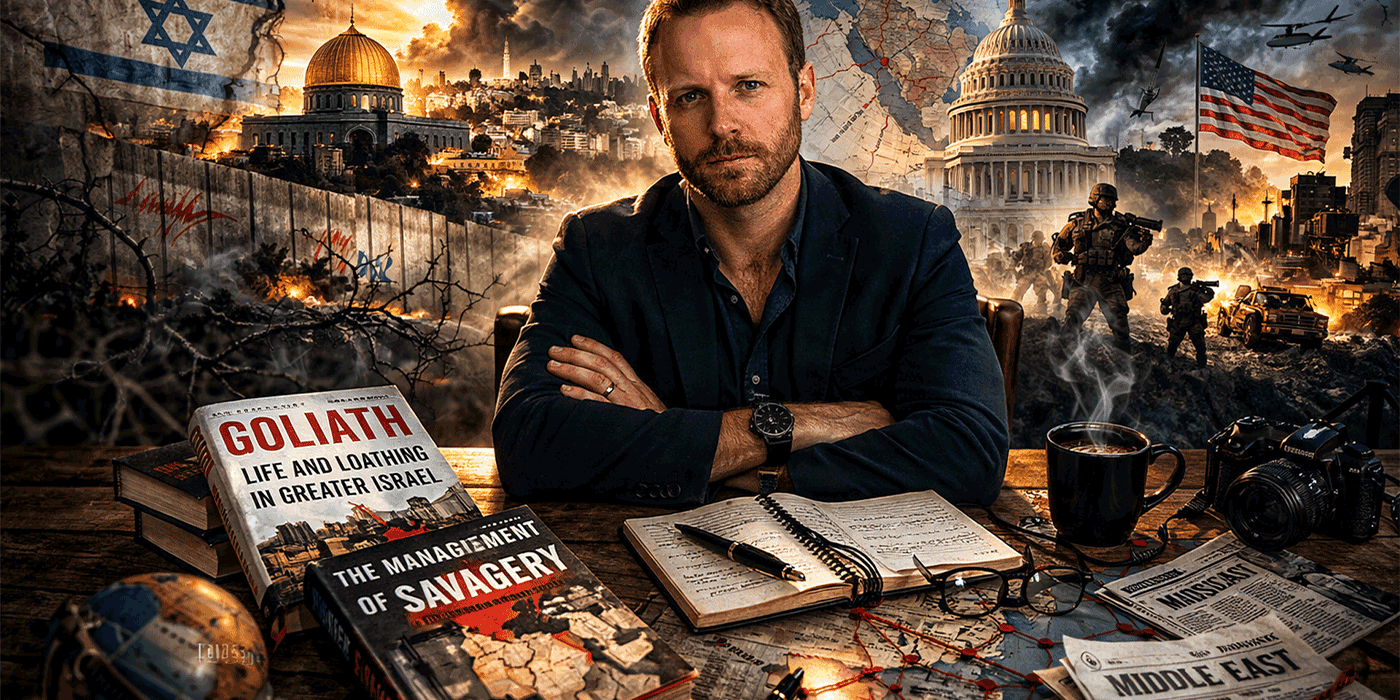
Death of International Law - Max Blumenthal
The Insider and His Verdict: Biography and Uncomfortable Truth
An investigative journalist who built his reputation by challenging the dominant narratives of Western foreign policy.
Max Blumenthal is an American investigative journalist, author, and documentary filmmaker known for his reporting on U.S. foreign policy, war propaganda, and the politics of regime change. He is the founder and editor-in-chief of the independent investigative outlet The Grayzone, a platform focused on exposing covert operations, media manipulation, and the geopolitical strategies of Western governments.
Blumenthal was born on December 18, 1977, in Boston. He studied history at the University of Pennsylvania, where he developed an early interest in political journalism and international affairs.
Before founding The Grayzone, Blumenthal worked as a journalist and columnist for several major publications. His reporting and commentary appeared in outlets such as The Nation, The Daily Beast, Al Jazeera English, and The Huffington Post. Over time, his work increasingly focused on the intersection of media narratives and U.S. military intervention.
Blumenthal gained international attention through several investigative books, including:
- Goliath: Life and Loathing in Greater Israel — a controversial study examining Israeli society, nationalism, and the political realities of life under occupation.
- The Management of Savagery — an investigation into how Western military interventions and intelligence strategies contributed to the rise of jihadist movements across the Middle East.
Blumenthal gained international attention with several books investigating propaganda, extremism, and the politics of war. His best-known works include Goliath: Life and Loathing in Greater Israel, a controversial study of Israeli society and politics, and The Management of Savagery, which examines how Western intervention and intelligence operations helped shape the rise of jihadist movements in the Middle East.
In 2015 he launched The Grayzone as an investigative project focused on uncovering what he describes as the hidden architecture of modern geopolitical conflict: covert operations, information warfare, sanctions regimes, and the political economy of war. The outlet has published investigations into U.S. policy in countries such as Syria, Venezuela, Ukraine, and Cuba.
Blumenthal’s work is both widely cited and heavily contested. Supporters view him as a rare Western journalist willing to challenge official narratives about war and intervention. Critics argue that his reporting often aligns with the perspectives of governments targeted by U.S. foreign policy. This polarization has made him one of the most controversial figures in contemporary geopolitical journalism.
Despite the controversy, Blumenthal has established himself as a prominent voice in independent investigative media. Through books, documentaries, and The Grayzone’s reporting, he continues to examine how propaganda, intelligence networks, and economic interests shape the global political landscape.
Max Blumenthal dissects the January 3rd assault on Caracas, exposing the backroom deal-making, state-sponsored plunder, and systematic demolition of the post-war legal order — revealing that Trump’s “Golden Age” is little more than organized crime dressed in the language of democracy, and that what is on trial in New York is not Nicolás Maduro, but the entire architecture of international law that the United States itself helped build.
January 3rd - What Actually Happened in Caracas
It was, in many ways, a terrorist assault on Caracas — the kidnapping of a head of state and his wife, the massacre of their presidential guard, thirty-two Cuban officers killed, civilians dead — and not a single U.S. casualty.
Glenn Diesen opens with the question that most Western media has systematically refused to ask directly: what actually happened on January 3rd? The public narrative — a lawful arrest of a narco-terrorist mastermind by a justice-seeking superpower — collapses on contact with the documented facts. Max Blumenthal, editor of The Grayzone and one of the few journalists tracking this story in real time, was awake late enough to observe events unfold as they happened. His assessment is unsparing.
This was a kinetic assault on a sovereign capital. Delta Force executed a HALO operation — high-altitude, low-opening — directly into Miraflores Palace. It was prepared years in advance. And it was telegraphed, almost comically, in the Jack Ryan television series, where the CIA sketched out precisely such an operation against a Venezuelan head of state.
Fiction became operational blueprint. The presidential guard was mostly massacred. Thirty-two Cuban officers were killed. Multiple civilians died. Maduro’s wife, Cilia Flores, demanded to accompany her husband as he was being taken — according to Diosdado Cabello, one of the most important power brokers in the Chavista movement, she may have saved his life in the process.
The military picture that emerges is damning on multiple levels:
- Venezuela’s communication systems were taken out before the raid began, severing all coordination capacity
- The two major military bases capable of an instant defensive response were bombed in advance
- U.S. drones continue to operate in Venezuelan airspace after the operation concluded
- The assault flew at approximately one hundred feet; no helicopters were downed; it proceeded almost entirely unimpeded
The former Venezuelan foreign minister Jorge Arreaza — a confidant of acting president Delcy Rodríguez, former son-in-law of Hugo Chávez, and someone who knew Maduro intimately — flatly denied any inside betrayal or high-level stand-down order. Blumenthal takes him at his word, not out of naivety, but because the institutional logic holds: coordinating a deliberate military collapse at the leadership level, without exposure, would have been essentially impossible within the tight-knit Chavista command structure.
The simpler explanation, consistent with the available evidence, is a catastrophic failure of intelligence and counterintelligence — one that left Venezuela’s defenses exposed at precisely the moment the U.S. chose to strike.
Whether there was a decision not to scramble the Sukhoi jets for a counterattack — because at that point, engaging directly with American forces would only escalate the casualty count without changing the outcome — remains unclear. What is not in question is the nature of the operation itself. It was not an arrest. It was a raid on a sovereign capital, executed by the special forces of a foreign power, against a sitting head of state who had committed no act on American soil.
The Chavista State Survives - and That Changes Everything
The success of the Bolivarian movement, after twenty-five years of crushing pressure, assassination attempts, street riots, and economic strangulation, is simply this: regime change has not occurred. The institutions are intact. The movement is still governing.
The political reality that Washington either failed to anticipate or chose to ignore is that removing Maduro physically from Caracas is not the same thing as removing the Chavista state. Diosdado Cabello is in the streets, addressing the nation, visibly in command of the colectivos — the organized militant base of the Bolivarian movement. Defense Minister Vladimir Padrino López, announced dead in early chaotic reports, is alive. The military structure remains intact. Acting president Delcy Rodríguez, a Chavista stalwart with deep ideological commitment to national sovereignty, is governing from Miraflores.
Blumenthal’s point here is fundamental: if Trump has to deal with anyone, he has to deal with this movement, because this movement controls the institutions. Maduro remains the president under Venezuelan constitutional law. Rodríguez is not a figurehead installed to manage a transition toward American-approved governance — she is a co-architect of the Bolivarian project, and she has made explicit her commitment to securing Maduro’s return.
This institutional continuity creates a strategic impasse that Washington has not publicly acknowledged:
- Trump cannot install a compliant government — there is no exogenous opposition force capable of filling the vacuum
- The Guarimbas violent riots failed; the “humanitarian corridor” strategy failed; Juan Guaidó’s internationally recognized presidency failed; every instrument of regime change tried over a decade has failed
- Venezuela’s PDVSA managerial class was purged of opposition figures in 2005 — the anti-Chavista opposition has no lever inside the oil sector
- The Chavistas’ fundamental offer to Washington is unchanged: us or catastrophe, stability or civil war
The Bolivarian Revolution, Blumenthal emphasizes, is at its base a nationalist revolution. Not a Cuban export of communist ideology, not a Soviet-model imposition — simply a determination that Venezuela should control its own resources, set its own terms with foreign oil companies, and refuse the neocolonial framework that ExxonMobil and its Washington patrons attempted to impose when Chávez forced a renegotiation of extraction contracts in 2005. That determination has not changed. Rodríguez holds it as firmly as Maduro did. The deal-making that Trump now seeks must be made with this movement, on terms this movement finds acceptable — or not at all.
The Deal That Was Always Available - and Who Destroyed It
Ric Grenell was in Caracas negotiating directly with Maduro. A deal was within reach. It was sabotaged — not by Caracas, but by Washington’s own proxy opposition, which didn’t actually want a deal and had no interest in freeing the prisoners it claimed to champion.
The most clarifying detail in Blumenthal’s account concerns not January 3rd itself, but the year preceding it. Trump’s envoy Ric Grenell traveled to Caracas for direct negotiations with Maduro. The terms on the table were straightforward: an extension of Chevron’s drilling license in Venezuela — granting revenue to the Venezuelan state — in exchange for Venezuela accepting the return of deported Venezuelan migrants from the United States. A transactional deal that served both sides’ immediate interests and required no ideological capitulation from either party.
It was sabotaged. Not from Caracas, but from within the Washington policy apparatus itself.
The Venezuelan opposition, led by María Corina Machado, refused to provide the names of the political prisoners they publicly claimed to want freed. This was not an oversight or a bureaucratic failure. As Grenell himself has stated, Machado’s faction had no interest in a deal — because a deal with Maduro would have granted him legitimacy, revenue, and political stability, precisely the outcomes her entire strategy was designed to prevent. The objective was not to secure the release of prisoners. The objective was to delegitimize the Venezuelan government entirely and hold out for full regime change.
The cynicism of the obstruction is almost baroque in its indifference to the people ostensibly being protected:
- Machado’s faction refused to name the political prisoners they claimed were being tortured — even when those names were the only thing standing between those prisoners and release
- Marco Rubio, rather than routing a deportation flight directly to Caracas as direct negotiations required, diverted it to El Salvador’s Cecot prison under his ally Nayib Bukele
- The detainees — fewer than half convicted of any crime, only three of 250 for violent offenses — were stripped, beaten, publicly humiliated on camera, and incarcerated alongside MS-13 members
- Their testimony to 60 Minutes about what took place inside Cecot was subsequently spiked by Trump media allies, protecting Rubio and Stephen Miller from the embarrassment of their own policy
Grenell was sidelined in the process. The Cuban-American network around Rubio — led by figures like Mauricio Claver-Carone, a man who has made regime change in Havana his life’s work — understood that any negotiated settlement would close the door on their decades-long project. So they destroyed the negotiation. Then they spent months preparing the January 3rd operation, framing Venezuelan migrants as Tren de Aragua gang members and constructing the legal and propaganda infrastructure for what followed.
The conclusion Blumenthal draws is damning and precise: Rubio did not send those migrants to a torture prison because he ran out of options. He sent them there specifically to prevent the option of direct negotiation from remaining viable — because direct negotiation would have required acknowledging Maduro as a legitimate counterpart, which would have undermined everything the Cuban-American hardliners had built their careers on.
Plunder as Policy - The Architecture of Trump’s Golden Age
At its base, for Trump and his cronies, this is just about plunder — maximizing profits off the carcasses of global capitalism for Trump’s inner circle, and imposing a regime of terror across the Americas to destroy any force that might get in the way.
Trump has described his desired deal from Venezuela in terms that are almost refreshingly transparent: 30 to 50 million barrels of oil sold directly to the United States, with Venezuela required to use the resulting revenue to purchase American products. He frames this as economic development and mutual benefit. Blumenthal frames it differently, and with more precision: this is the Monroe Doctrine reinterpreted through the logic of organized crime.
The detail that has received almost no coverage in mainstream Western media is this: the revenue from these Venezuelan oil sales will not be deposited in the U.S. Treasury. It will be held in offshore accounts — outside the control of any institution even nominally accountable to the American public, outside congressional oversight, outside Federal Reserve visibility, and effectively inside a discretionary fund that Trump Incorporated and the CIA could access for purposes entirely of their own choosing.
The financial architecture of the deal reveals what the operation is actually for:
- Offshore accounts mean no congressional oversight, no public audit trail, no institutional accountability to American citizens
- The fund becomes available for CIA black operations — covert regime-change projects, proxy forces, political destabilization campaigns anywhere on the planet
- It functions as a privatized extraction mechanism, enriching the specific network of individuals who designed and executed the Venezuela policy
- The Monroe Doctrine is not being updated — it is being privatized, its proceeds routed around democratic accountability
Diesen frames the contrast that crystallizes the absurdity for European audiences: European governments at least maintained the fiction of democratic justification when supporting American foreign policy adventures. They required a dictator to denounce, human rights to defend, democracy to promote.
Trump simply says he wants the oil. The ideological cover that the human rights industrial complex provided for a generation of regime-change operations has been stripped away, and what remains is unmediated extraction. The human rights lobby that championed Machado as a democratic hero is now discovering, belatedly, that it was always functioning as the ideological vanguard of resource capture — and that the Trump administration no longer needs the cover it provided.
The Bolivarian Revolution, in this frame, was never really about socialism or Cuban influence. It was about Venezuela refusing to be an American gas station on American terms. And that refusal is precisely what twenty-five years of maximum pressure was designed to break.
The Cartel That Wasn’t - A CIA Drug Operation Hiding in Plain Sight
The “Cartel of the Suns” was not a Venezuelan criminal organization — it was a CIA creation, established during the Reagan era, shipping cocaine into the United States through a network of Venezuelan National Guard generals that the agency controlled.
The 2020 indictment of Nicolás Maduro mentioned the “Cartel of the Suns” thirty-two times, presenting it as a functional criminal organization — a genuine narco-terror syndicate with Maduro at its apex, operating with the protection of the Venezuelan state. The superseding indictment, unsealed on the day of the January 3rd raid, quietly downgraded the same organization to a “loose network.” This is not a minor editorial revision. It is a partial admission that the foundational premise of the prosecution was legally indefensible — and that the DOJ knew it.
Blumenthal had been saying for some time that the Cartel of the Suns, as described in the 2020 indictment, did not exist as a functioning organization. The Washington Post and France 24 reached the same conclusion through their own reporting, publishing it three days after the raid. The DOJ apparently arrived there somewhat earlier, which is why the language was changed before Maduro’s trial could open.
The history that Blumenthal traces is a layered record of institutional self-protection spanning decades:
- The original “Cartel of the Suns” was exposed in the Reagan era by 60 Minutes and the New York Times: it was a CIA-run drug trafficking operation using Venezuelan National Guard generals — who wore sun patches on their uniforms — to ship cocaine into the United States, ostensibly to gather intelligence on drug trafficking networks
- The term disappeared from public discourse after that exposure and did not resurface until 2014, when the U.S. began targeting Hugo “El Pollo” Carvajal, former head of military intelligence under Chávez
- The DC-9 aircraft known as “Cocaine One,” central to the key flight allegation in the indictment — a flight from Venezuela’s Simón Bolívar Airport to Campeche, Mexico, allegedly carrying tons of cocaine — was owned by a U.S. shell company associated with a Jeb Bush associate
- When Carvajal sought to call the DC-9’s owner as a witness in his own trial before Judge Hellerstein, the judge refused to allow it — a ruling that prevented testimony potentially demonstrating CIA control of the flight
The significance of that refusal is hard to overstate. The owner of that aircraft, if called to testify, could plausibly have provided evidence demonstrating that the drug shipment the indictment describes was a CIA operation, not a Venezuelan government conspiracy. Judge Hellerstein blocked that testimony. The same judge will preside over Maduro’s trial in June. The political and operational context in which the United States has been waging covert and overt war against Venezuela for a quarter century will apparently also be inadmissible in Maduro’s defense.
Carvajal’s own trajectory is instructive. He was Chávez’s most loyal general. He became a public Maduro critic. He sought asylum in Spain and sided with Guaidó. He was extradited to the United States in 2023, convicted of the narco-terror conspiracy, and offered a secret plea deal: a potential fifty-year sentence reduced to a few years, in exchange for serving as star witness against Maduro. He also pledged, in a direct letter to Trump, to provide evidence that Smartmatic voting machines were used to rig the 2020 election in favor of Joe Biden. This is the evidentiary foundation of the United States’ case against the president of Venezuela.
One Mafia Prosecuting Another - The Weaponization of American Law
This is one mafia against a phony narco-terror conspiracy — a sophisticated mafia operation. You have to give them credit for pulling it off. But it is government by gangsterism.
Blumenthal’s characterization is deliberately harsh, and he does not walk it back. The Southern District of New York is one of the most powerful prosecutorial offices in the world. Its convictions carry global credibility and have brought down heads of criminal organizations, financial fraud networks, and corrupt politicians across multiple continents. The machinery of American federal justice — the grand jury, the plea deal, the cooperating witness, the sealed indictment, the extradition treaty — is genuinely formidable.
Here, that machinery has been deployed in the service of a geopolitical objective rather than in pursuit of justice. The architecture Blumenthal describes is systematic: identify a target, construct an indictment around a criminal framework whose own origins lie in CIA activity, extradite or kidnap the target, install a cooperating witness whose testimony has been secured through sentencing leverage, appoint a judge who has already demonstrated his willingness to suppress inconvenient discovery, and proceed to trial.
The verdict’s purpose is not to determine guilt or innocence. It is to establish a global precedent: that the United States can prosecute any foreign leader it chooses, in its own domestic courts, by its own domestic rules, with witnesses it has cultivated through its own coercive machinery.
The parallel with the Julian Assange prosecution is not rhetorical — it is structural:
- Assange was not a U.S. citizen; he committed no act on American soil; the “crime” was journalism that embarrassed the national security establishment
- Maduro is not a U.S. citizen; he committed no act on American soil; the “crime” is governing a country that controls resources the United States wants
- In both cases, the Southern District served as the designated venue; in both cases, deterrence rather than justice was the operative purpose
- The message to every journalist, diplomat, and foreign leader is identical: American domestic law can reach you anywhere, at any time, for any reason Washington designates
The difference between the two cases is the First Amendment. In Assange’s situation, the constitutional protection for journalism eventually created a legal complication that made the prosecution untenable on American soil. In Maduro’s case, there is no comparable constitutional protection available to a foreign head of state in an American federal court. The verdict, if it comes, will confirm that the United States has claimed universal jurisdiction over anyone it designates as an enemy — and that no institution, domestic or international, is positioned to contest that claim.
The Legal Order on Trial - From The Hague to New York
Under the International Court of Justice ruling in Democratic Republic of the Congo v. Belgium, it is illegal to kidnap a head of state and place him on trial in a national court — that procedure requires an ICC indictment and transfer to The Hague.
The post-war international legal order was constructed on a specific set of principles: sovereign equality of states, immunity of heads of state from domestic prosecution in foreign courts, the primacy of the International Criminal Court for crimes of the magnitude alleged against Maduro, and the absolute prohibition of extrajudicial abduction as a substitute for legitimate legal process.
These principles were not abstractions — they were institutional architecture, built over eighty years, largely with American participation and often at American insistence. The Nuremberg framework, the Geneva Conventions, the UN Charter, the Vienna Convention on Diplomatic Relations: the United States helped build all of it.
What happened on January 3rd violates all of it simultaneously.
Blumenthal is explicit on the ICJ precedent: the DRC v. Belgium ruling established that a sitting or former head of state cannot lawfully be seized and tried in a foreign domestic court. The mechanism for prosecuting a head of state for serious crimes is an ICC indictment, followed by transfer to The Hague — the same procedure that produced the indictment of Benjamin Netanyahu. That procedure was not followed. Maduro was not indicted by the ICC. He was taken from his residence in Caracas by American special forces operating without any international legal authorization.
The implications of this precedent, if allowed to stand unchallenged, extend to every government on earth:
- Sovereign immunity — the principle that a head of state cannot be arrested by a foreign power — is effectively abolished for any state that cannot credibly threaten military retaliation against the United States
- Any sufficiently powerful state can now abduct a foreign leader, construct a domestic indictment, and proceed to conviction in its own courts, with its own rules, and its own hand-selected witnesses
- Russia and China are watching: the seizure of the Russian tanker Marinera in the North Atlantic — in coordination with the UK, without legal process — is part of the same pattern of testing what can be done without consequence
- Chinese envoys were in Miraflores Palace meeting with Maduro in the hours before the raid; their presence was known to U.S. planners; the timing was a deliberate signal about the vulnerability of Belt and Road investments across the hemisphere
The message travels further still. Blumenthal draws the connections with care: this is a warning to every country in the Sahel that has expelled French forces and sought Russian security partnerships, to every government that has invited Chinese investment in strategic sectors, to every state that has made sovereign decisions about its resource contracts that conflicted with Western corporate interests. The Monroe Doctrine, updated for the age of offshore slush funds and Delta Force raids, now carries a simple message: you are within American reach, or you will be made to be.
The Achilles’ Heel - What the Empire Cannot Absorb
One helicopter down in Caracas would have been an absolute disaster for Donald Trump. This is one of the central calculations in the debate now underway in Washington about what comes next.
The debate inside Republican circles that Blumenthal describes is not about the morality of what happened in Venezuela. It is about the calculation of sustainable cost. When does a kinetic operation become too costly to absorb? The Venezuela operation appeared to provide a reassuring answer: American casualties can be avoided if the operation is executed with sufficient speed, surprise, and asymmetric advantage against a military that was not equipped to respond to what it faced. The precedent was set, the Iraq syndrome declared broken, and the question of Iran was immediately put on the table by the same network that had been pushing for it since 2003.
Iran is a categorically different calculation. Iran has sophisticated air defense systems that were not present in Caracas. It has ballistic missiles capable of reaching American military assets distributed across the region. It has developed proxies across the Middle East with independent operational capacity. It has the ability, if it chooses to exercise it, to close the Strait of Hormuz and produce oil price consequences that would dwarf any short-term military objective.
A strike on Iran that produces significant American casualties — or triggers a regional escalation that impacts American service members in Iraq, Syria, or the Gulf — would not produce a clean victory. It would produce the kind of catastrophe that historically ends presidencies and breaks political coalitions.
The political constraints that remain operative even after Venezuela:
- Congress is beginning to reassert war powers authority — a bipartisan resolution forcing Trump to seek congressional authorization for further military action against Venezuela has already been passed in the Senate
- A similar resolution on Iran, if it came to a vote, would create an institutional barrier that the Israeli government and its American allies are now racing to preempt by acting before the legislative momentum builds
- The American public’s tolerance for a new major war, at a moment of domestic economic anxiety and visible immigration enforcement brutality, is not comparable to the post-September 11 window that enabled the Iraq authorization
- Trump’s own political position is more fragile than it appeared in January — the accumulation of economic grievances is generating sustained public anger that his advisers apparently underestimated
The Venezuela operation succeeded because it was fast, clean by American standards, and invisible to most of the American public. The Iran option carries none of those characteristics. Whether the faction that wants it can act before the institutional and political constraints close in is the question that Blumenthal leaves open — with appropriate caution about the limits of what can be predicted from the outside.
The Monroe Doctrine Privatized - Reading the Fine Print
Trump’s claim to own Venezuela’s oil is false. There has been no regime change. He cannot tell Delcy Rodríguez what to do, because behind her are the institutions of the state — and behind those institutions is a movement that has survived everything Washington has thrown at it for twenty-five years.
Trump has said publicly that the United States is “running Venezuela.” He has stated that acting president Rodríguez may keep her position provided she complies with American instructions. He has announced an oil deal as though its terms have already been accepted by Caracas. The gap between these declarations and the actual situation on the ground is considerable — and Blumenthal maps it carefully.
Rodríguez is not an instrument of American policy. She is a Venezuelan patriot, in the precise sense that Arreaza used the term: someone who does not want her country destroyed, who has watched what happened to Libya and to Colombia, and who understands that her leverage with Washington is the stability that the Bolivarian state provides. The offer she can put on the table is the one Arreaza articulated directly: with us in power, Venezuela is stable, and your investment in Venezuelan oil is secure. Without us, you have a decade of civil conflict, regional destabilization, and a migration crisis of a scale that makes the current situation look manageable.
The demands Trump has publicly stated are structurally unachievable on the terms he has described:
- Cutting Venezuela’s ties with Russia and China would require abandoning its principal economic and security relationships in exchange for nothing that the Trump administration has demonstrated it can deliver reliably
- “Running Venezuela” through a nominally sovereign acting president is the Libya model — and Libya remains destabilized after fifteen years of post-intervention chaos
- Holding Venezuelan oil revenue in offshore accounts controlled by Trump’s network is not a trade deal — it is a demand for tribute, and no functioning state with institutional capacity accepts tribute voluntarily
- The Venezuelan military is not a comprador force trained at Fort Benning; it has ideological and institutional loyalty to the Bolivarian project that cannot be purchased through a deal negotiated over Maduro’s imprisoned head
The realistic endpoint, Blumenthal suggests, involves a transactional arrangement that falls well short of Trump’s public declarations: some oil revenue flowing to American buyers, some political prisoners released, some formal distancing from Russia at the margins — in exchange for sanctions relief and an end to active destabilization efforts.
Maduro would have made that deal a year ago. Rodríguez will likely be willing to make something comparable, if the terms don’t require ideological capitulation and if the offshore fund structure is renegotiated. But the maximalist position Trump has staked out publicly creates a political problem for both sides: accepting less than he declared will be framed as a defeat, and offering more than Caracas can accept will prolong the stalemate.
The Trial in June - What Is Actually Being Adjudicated
This case will determine whether international law exists anymore. Most people watching will already say it doesn’t. A conviction would put the final nail in the coffin.
The trial of Nicolás Maduro — currently scheduled for the Southern District of New York in June, before Judge Hellerstein, with Hugo Carvajal as star witness — is not, at its core, a criminal proceeding. It is a political performance designed to produce a specific international precedent. The mechanics Blumenthal describes make the predetermined quality of the exercise clear enough: a cooperating witness who secured his plea deal by agreeing to testify against Maduro and to provide election fraud allegations against Joe Biden; a judge who has already demonstrated his willingness to suppress evidence central to the defense; an evidentiary foundation that the DOJ itself has partially retracted by downgrading the “Cartel of the Suns” from a criminal organization to a loose network between the 2020 indictment and the superseding document unsealed on raid day.
The DOJ apparently recognized that the original framing was too legally vulnerable. The revision is not a concession to accuracy. It is a tactical adjustment designed to protect the prosecution from the most obvious line of attack while preserving the conviction the administration requires. What the administration requires is not justice. It is a verdict — a piece of paper that can be presented to the world as the conclusion of a legal process, however fraudulent that process may be.
What a conviction would establish as durable global precedent:
- Any state with sufficient military and judicial power can abduct a foreign head of government, construct a domestic indictment with cooperating witnesses secured through sentencing leverage, and obtain a conviction in its own courts
- The ICJ framework on sovereign immunity — the principle established in DRC v. Belgium — is effectively inoperative against any state willing to ignore it with sufficient force
- The ICC process, which the United States has systematically undermined for decades by refusing to ratify the Rome Statute, is confirmed as irrelevant when Washington prefers a different and more controllable venue
- Every government in the world must henceforth treat American domestic law as a potential weapon that can be aimed at its leadership for geopolitical rather than legal reasons — and calibrate its foreign and economic policy accordingly
The Assange parallel that Blumenthal draws is structural, not rhetorical. In both cases, an individual was targeted not for acts committed on American soil, not for crimes under any internationally recognized legal framework, but for posing an inconvenience to the American national security establishment. In both cases, the Southern District served as the chosen venue.
In Assange’s case, the First Amendment eventually created a complication that made the prosecution untenable domestically — an Australian journalist doing journalism could not be convicted under the Espionage Act without implications that the American press establishment could not accept. In Maduro’s case, there is no comparable constitutional protection available to a foreign head of state standing trial in an American federal court. There is only the quality of the evidence — and the judge has already decided what evidence will be allowed.
The Broader Message - Caracas to Tehran, the Sahel to Beijing
Venezuela is a message to Russia, to China, to every country in the Sahel that has tried to adopt a multipolar model and control its own resources. The message is being delivered in the language Washington speaks most fluently: force.
Blumenthal is explicit about the intended audience for what happened on January 3rd. The raid was not designed only to secure Venezuelan oil or physically remove Maduro from Caracas. It was designed to be seen — specifically by the governments and movements that have been building alternative relationships to Western hegemony over the past decade, calculating that American power was sufficiently constrained by the failures of Iraq and Afghanistan that such alternatives were now viable.
Russia was watching when the Marinera tanker was seized in the North Atlantic. Moscow stood down rather than trigger a military confrontation with the United States over a single vessel — and the entire world noted it. China was watching when its envoys were meeting with Maduro in Miraflores Palace, hours before the Delta Force arrived. Beijing has vast investments in the Orinoco Belt, in Venezuelan mineral extraction, in construction and infrastructure projects across Latin America. The timing of the raid — with Chinese envoys present in the palace — was not accidental. It was a signal, delivered with precision, about the vulnerability of Chinese economic relationships in the Western Hemisphere to American kinetic intervention.
The implications cascade through every region where multipolarism has been advancing:
- The Sahel governments — Burkina Faso, Mali, Niger — that expelled French forces and sought Russian security partnerships are calculating what Venezuela’s example means for their own exposure
- Iran, which has been in the crosshairs of the same Washington network since at least 2003, is watching what Venezuela’s example implies for the value of negotiated agreements with an administration that will not honor them
- Cuba and Nicaragua, named explicitly in Trump’s expanding catalog of targets alongside Greenland, Mexico, and Colombia, understand that the Venezuela operation has removed whatever inhibitions remained about direct state action in the Western Hemisphere
- Every government that has made sovereign decisions about resource contracts, currency arrangements, military basing rights, or diplomatic relationships that conflicted with American preferences is now recalibrating its vulnerability
This is not a picture of omnipotent empire acting with unlimited impunity. Blumenthal is careful about the limits. Venezuela is not conquered. The Bolivarian state is intact and governing. Russia and China are not passive actors. The American public’s tolerance for new wars is not unlimited, as the midterm trajectory makes clear. But the directional signal is unmistakable: this administration has decided to reassert hemispheric dominance by force, and to demonstrate to the wider multipolar world that the legal frameworks it cannot control will simply be ignored — and that the institutions theoretically capable of holding it accountable, from the UN Security Council to the ICC, cannot in practice do so.
The Final Reckoning - What Government by Gangsterism Actually Means
Venezuela owns Venezuela. Trump does not own it. The golden age of American plunder runs directly into the nationalist bedrock of the Bolivarian Revolution — and what is on trial in New York in June is not Nicolás Maduro, but the question of whether any constraint on American power still exists.
Glenn Diesen’s summary captures something essential: the United States has, for the first time in the post-war period, abandoned even the pretense of legal and democratic justification for coercive foreign policy. Previous administrations required a human rights narrative, a democracy promotion framework, a multilateral coalition, a UN resolution. Failing those, they at least required the performance of seeking them. Trump requires none of it. He says: we want the oil. The cover is gone.
This has produced a split in the American policy establishment. The Cuban-American hardliners who drove the Venezuela policy for decades — and who sidelined Machado when her maximalist agenda proved operationally impossible — got their military operation and still don’t have regime change. The neoconservatives who see Venezuela as proof that Iraq syndrome is broken are newly emboldened but face a categorically more dangerous Iran calculation. The pragmatists around Grenell, who understood that a transactional deal was always available and who were sidelined for wanting it, have not been proven wrong — they may yet be vindicated by the constraints that Rodríguez’s institutional position imposes on what Trump can actually extract.
The fundamental tensions in Washington’s Venezuela position remain structurally unresolved:
- Maximalist public declarations — we are running Venezuela — cannot be squared with the reality that the Bolivarian state controls all institutions and is making no moves toward American-approved governance
- The offshore fund structure that would enrich Trump’s network requires Venezuelan cooperation that Rodríguez has no obvious incentive to provide on terms that would require her to explain it to her own movement
- Any deal that grants Venezuela sufficient revenue and legitimacy to stabilize will be denounced by the Cuban-American hardliners as capitulation and used against Trump domestically
- Any further military escalation inside Venezuela risks producing the American casualties that would detonate the political coalition supporting Trump’s foreign policy agenda
Blumenthal ends where he began: this is government by gangsterism. Not a malfunctioning version of democratic foreign policy, not a temporary deviation from American norms that will self-correct when a more principled administration takes office, but a system functioning precisely as the most powerful actors within it have decided it should function. The Southern District of New York is a weapon, not a court. The “Cartel of the Suns” is a legal fiction constructed to justify an operation whose real purpose is resource capture and hemisphere-wide intimidation. The rule of law is being performed, not enforced.
Whether the Bolivarian state can survive not just the physical removal of Maduro, but the sustained pressure of a newly emboldened Washington operating without institutional constraints, is the question on which everything depends. Blumenthal’s measured assessment is that the movement is still there, the institutions still function, and the deal that was available a year ago through Grenell is still available if Washington wants it on terms Caracas can accept. But the forces inside the Trump administration that prefer permanent destabilization to a manageable settlement have not exhausted their capacity for damage.
The question Glenn Diesen began with — what actually happened on January 3rd? — has an answer that is simultaneously precise and devastating. A state with the most powerful military in human history conducted a kinetic assault on the capital of a sovereign nation, kidnapped its head of state, constructed a prosecution around fabricated evidence, and scheduled a trial whose verdict has already been determined by the geopolitical requirements of the administration pursuing it. The question that follows is simpler, harder, and more consequential: what, across the entire architecture of international order, can be relied upon to prevent it from happening again?
The honest answer, which neither the United Nations nor the International Criminal Court nor the Western press is currently positioned to give, is: very little. And that is the most important fact to have emerged from Caracas on January 3rd — more important than the operational details of the raid, more important than Maduro’s fate, more important than the oil deal’s final terms. The answer to that question will shape the world that follows from this moment, for every government that has ever believed it was protected by the rules it did not break.
Thank you, Max Blumental.
Sources & Geopolitical References
Substack – US-Edition
This article is also available as a English-language edition on Substack:
The Gangster State and the Death of International Law - Max Blumenthal
Original conversation (video)
YouTube-Interview:
Venezuela - Deal-Making, Plunder & the Rule of Law - Max Blumenthal
Support Independent Journalism
If you find my work valuable, you can support it with a voluntary contribution here:
Voluntary support via PayPal
Voluntary support via Buy Me a Coffee
Many thanks for your support!

More Articles
How America’s Economic War on Russia - Richard Wolff
An Indictment of 80 Years of Vassal Politics - Larry Johnson
America’s New Imperialism - John Mearsheimer

investigative commentary.