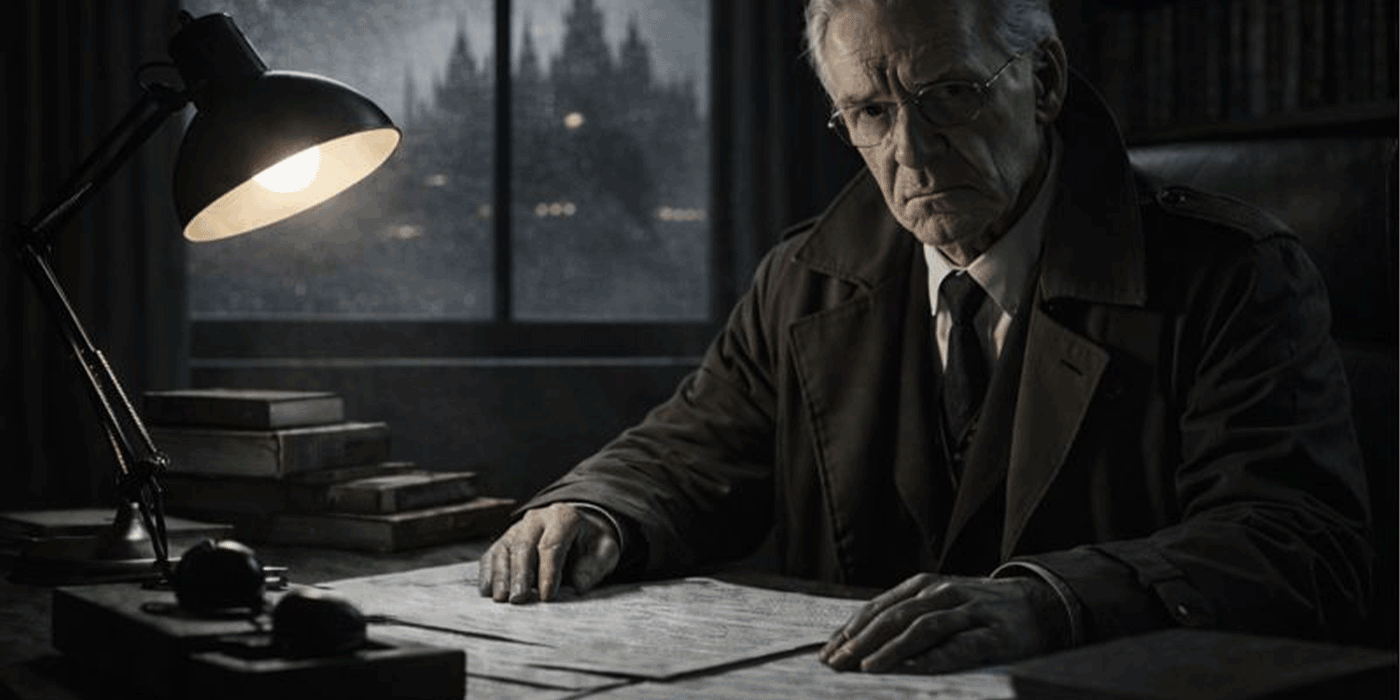
Trump’s Terror Cards and Putin’s Blitz - John Helmer
Trump’s Terror Cards and Putin’s Blitz - he New Era of Covert Warfare – John Helmer
The Insider and His Verdict
Helmer’s analysis is not an outside commentary, but the distillation of decades spent observing covert power politics.
John Helmer is the longest-serving foreign correspondent based in Russia and has lived in Moscow since 1989. He has held key academic and political roles, including teaching political science at Harvard University and serving as an adviser to U.S. President Jimmy Carter and to the Greek government under Andreas Papandreou.
Helmer is known for his uncompromising investigative style. His work focuses on exposing corruption, the entanglement of political and economic elites, and the geopolitical strategies of NATO and the U.S. national security establishment. He is the author of multiple books on Russian politics and the editor of Dances with Bears, one of the most authoritative insider platforms on Russian and Eurasian geopolitics.
💬 “If you want to explain war, you cannot spare the power apparatus behind it.”Helmer writes where Western interpretive authority ends. His analyses dismantle power structures, strip away war narratives, and identify interests systematically excluded from mainstream discourse. This is not opinion journalism—it is conflict and power analysis set against the established narrative.
John Helmer examines the dangerous escalation of U.S. regime-change operations from Syria to India and explains why Trump’s apparent peace rhetoric conceals the most aggressive phase of covert warfare in decades.
Al-Qaeda in the White House – Normalizing the Unthinkable
What once marked an absolute red line is now staged with smiles and sold as diplomatic reality.
The leader of Al-Qaeda travels to Washington and speaks with Donald Trump—what would have been unthinkable a decade ago is now reality, and hardly anyone seems to notice the irony.
John Helmer begins with the historical rupture:
💬 “You see the leader of Al-Qaeda going to Washington and speaking with Donald Trump. The image shows Trump talking and laughing.”Ahmad al-Sharaa al-Jolani, the acting president of Syria, was received in the Oval Office—the same man who spent years on international terror lists. The images are surreal, but they mark a fundamental shift in American strategy.
The new phase of covert operations:
- Massive force against Iran has failed and been put “on hold”
- Venezuela: no legal basis for strikes on land targets
- Syria: regime change achieved, now the phase of consolidation
- The division of influence between Turkey, the United States, and Israel is complete
Helmer is explicit:
💬 “We are now in a phase of covert operations.”Trump’s strategy of overwhelming force—the so-called annihilation strategy—has failed. Iran now possesses a credible air-defense deterrent coordinated with Russia. In Venezuela, the U.S. government currently believes it lacks a legal foundation for direct attacks. But this does not mean covert operations are ending—on the contrary, they are being intensified.
The Strange Meeting – No Nameplates, No Press Conference
When protocol disappears, politics begins where the public is excluded.
The way Ahmad al-Sharaa al-Jolani was handled in Washington reveals more about U.S. intentions than any official statement—it amounted to one of the first covert state visits in modern history.
Helmer dissects the peculiar details:
💬 “The White House calendar showed a meeting scheduled for 11 a.m., but there was no entry for the subsequent meeting in the Cabinet Room. In the Cabinet Room, there were no nameplates on the table. That is highly unusual, because almost all meetings with foreign dignitaries have nameplates so both sides know who they are speaking to—especially the president.”The three hidden agendas:
- Money and energy: an International Monetary Fund program to privatize Syrian resources
- Military objectives: forcing Russia out of its bases
- Preparing Syria as a platform for a renewed attack on Iran
What the photographs reveal is an effort to militarize the discussions. General Charles Q. Brown Jr., Chairman of the Joint Chiefs of Staff, and Defense Secretary Peter Hegseth were both seated in the second row. The primary military objective is unmistakable: to expel Russia from its bases in Syria, prevent Moscow from maintaining a significant military role there, and turn Syria into a platform for a potential future U.S. strike on Iran.
Donald Trump read from a prepared script on his desk. The choreography was carefully staged to appear cordial. But there was no press conference, no press briefing—nothing Trump could have said publicly without exposing the hidden agendas. Helmer describes al-Jolani’s visit as “one of the first covert state visits,” a clear signal that the United States is constructing Syria as a platform for covert operations against its adversaries.
The Role of Ambassador Barrack – Trump’s Real Estate Ally as a Key Figure
In covert wars, careers matter less than loyalty and business models.
When a Lebanese real estate developer who has done business with Trump for years functions as ambassador and special envoy, it reveals everything about the real priorities at play.
Helmer identifies a central figure:
💬 “Trump refers to the appointment of what he called ‘a very good ambassador, a friend of mine, who is Lebanese.’ That is Ambassador Barrack—Tom, I believe I’ve got his first name right—Barrack, who is of Lebanese origin and a real estate developer who has done business with Trump for many years.”Tom Barrack is officially ambassador to Turkey and special envoy for Syria. He was present at the Oval Office meeting and seated in the front row.
The commercial dimension:
- Making money in Syria is a central objective
- The International Monetary Fund leadership has issued statements on privatization
- Syria commits to the commercialization of its resources
- Iranian and Russian debts are entirely ignored by the IMF
Before Ahmad al-Sharaa al-Jolani appeared at the White House, he had already met with IMF leadership. The Fund issued multiple statements indicating that, in exchange for the resumption of a U.S.-led IMF program, Syria would commit to privatization. The scale of Syria’s external debt to Russia and Iran is completely disregarded by the IMF—most likely to be written off.
Russia’s Limited Options – Naval Base, Debt, and Strategic Balancing
Moscow is not playing for victory, but for damage control inside a battlefield orchestrated by others.
“Not much” is the short answer—Russia is navigating a narrow path between preserving its bases and avoiding a clash with its strategic partner, Turkey.
Helmer is asked what Russia can actually do to counter what the United States is attempting in Syria. His answer is blunt:
💬 “Not much would be the short answer.”Russia’s two or three core objectives have been clear in nearly every statement since February. Moscow wants to retain its naval base in Tartus and its air base at Khmeimim. It also seeks to recover part of Syria’s outstanding debt—estimated at between $30 and $50 billion—originally understood to be repaid partly in resources: concessions for joint Russian–Syrian development of oil, phosphates, and fertilizers.
The triangular division of Syria:
- Israel pushes further north
- Turkey presses southward
- The United States moves from east to west
- Russia attempts to intervene as a disruptive factor
On February 15, President Vladimir Putin emphasized Russia’s official position during the first phone call: support for the unity, sovereignty, and territorial integrity of the Syrian state. In practical terms, this means Moscow rejects the partition and will attempt to support any movement inside Syria that counterbalances Israel, Turkey, and the United States.
Russia therefore seeks to maintain sufficiently functional relations with Ahmad al-Sharaa al-Jolani so that he sees value in balancing the three powers against one another.
The Fundamental Problem – Turkey as a Strategic Ally
Not all losses are equal; some alliances outweigh entire countries.
Losing Turkey as an ally in the war against Europe and NATO on the Ukrainian battlefield would pose a far greater risk for Moscow than the loss of Syria.
Nima Alkhorshid raises the decisive question: is it not, in reality, Turkish intelligence that stands behind everything unfolding in Syria? Helmer’s answer is unequivocal:
💬 “There is no doubt that al-Jolani was partly financed by Qatar, but organized, planned, directed, and controlled by Turkey. Without Turkish weapons, without Turkish leadership, without Turkish protection, al-Jolani’s advance southward from Idlib could not have happened. This was a Turkish operation.”Russia’s strategic dilemma:
- Moscow understood and anticipated this from the outset
- The decision not to challenge the Turkish operation was highly contested
- Discussions between October and December were serious and deeply divisive
- Turkey remains a strategic ally in the war against Europe and NATO
The problem for Russia is structural. Turkey is a strategic ally in the ongoing confrontation with Europe, the United States, and NATO on the Ukrainian battlefield, as well as in resisting the sanctions war. Losing Turkey in this context would be far more damaging for Moscow than losing Syria.
As a result, Russia’s approach must remain extremely cautious—balancing where possible, disrupting where necessary, but avoiding a direct rupture with Ankara.
Al-Jolani’s Balancing Act – Attempting to Emancipate Himself from His Controllers
Weak actors survive not through strength, but by carefully balancing greater powers.
From his perspective, the attempt to secure as many allies as possible is understandable—it provides leverage against the Turkish handlers who control him.
Helmer explains al-Jolani’s strategy:
💬 “The more support he can show from Putin on the one hand and from Trump on the other, the more he can demonstrate a Russian military presence in Syria and an American military presence as well—including playing basketball with them.”The reference to basketball is not metaphorical. Prior to the White House meetings, someone from U.S. Central Command actually played basketball with al-Jolani.
The logic of the weak:
- Accumulate as many allies as possible to reinforce a Syrian-Arab identity
- Use that support as leverage against Turkish controllers
- Demonstrate both Russian and American military presence
- Convey to President Recep Tayyip Erdoğan the impression that the client has become independent
The more al-Jolani can show that he is balancing between major powers, the more he can project to Ankara the image of a former client who has matured and may now be autonomous.
Helmer poses the rhetorical question:
💬 “And if you were him, wouldn’t you do the same?”This is a game Syrians have played since the country’s founding and its escape from French colonial rule.
Israel and Turkey – The Unresolved Triangle
Syria is no longer a state, but a projection surface for competing expansions.
Israel is dissatisfied with Turkish advances in Syria, and Turkey is dissatisfied with Israel—Syria has become the arena of conflict between three expansionist powers.
Nima Alkhorshid asks about the possibility of an Israeli strike on Lebanon or a U.S. strike on Iran. Helmer responds with measured clarity:
💬 “Israel is conducting almost constant attacks on southern Lebanon—small tactical operations, somewhat larger ones, with varying range. Lebanese sources describe a continuous process of Israeli pressure. So there are constant Israeli attacks on Lebanon.”Turkey’s drive for Mediterranean dominance:
- Control of the Mediterranean coastline would represent a major strategic gain
- Pressure on northern Lebanon, similar to Turkey’s control of northern Cyprus
- Turning the eastern Mediterranean into a Turkish sea
- A strategic objective extending as far as Libya
From the Turkish perspective—as interpreted in Moscow—control of the Mediterranean coastline would be an exceptionally valuable strategic asset. Turning the eastern Mediterranean into a Turkish sea has long been one of President Recep Tayyip Erdoğan’s strategic ambitions. There is a clear Turkish drive to dominate the eastern Mediterranean—and Israel naturally stands in the way.
The tactical advantage for weak regimes such as al-Jolani’s lies in this very rivalry. They can attempt to secure U.S. backing to deter the Turks, or Turkish backing to deter the Israelis—using one power to balance against the other.
Ukraine – Trump’s “Let Them Fight It Out”
Behind simple slogans lies a deliberate acceleration of the war.
Donald Trump speaks in catchphrases—but behind his simplified rhetoric lies a faster Russian offensive and the collapse of the illusion of a Ukrainian victory.
Nima Alkhorshid draws the connection:
💬 “I don’t think the entire conflict in West Asia can be explained without taking the war in Ukraine into account. Everything is connected to what is happening there.”Helmer agrees and analyzes the Russian advance:
💬 “The acceleration of the Russian advance has to be acknowledged. The Russian ground advance has clearly become faster. Their ability to inflict rising casualty rates on Ukrainian defenders and to force capitulations is increasing.”The electronic warfare campaign:
- A forced choice between light without heating or heating without light
- Eastern regions heavily targeted—Kharkiv, Poltava, Sumy
- Destruction of the capacity to sustain reserves and supply lines
- Further west: pressure to negotiate on Russian terms
With winter approaching, the electronic warfare campaign presents Ukraine with a stark choice between electricity and heat. Unlike in October 2022 or 2023, President Vladimir Putin is currently not limiting the scope of electronic warfare. The eastern regions are being hit hardest because they represent the logistical backbone of the front.
Further west, the campaign forces cities such as Kyiv to recognize that a political solution now requires negotiations with the Russian side—on Russian terms.
Covert Operations as the Continuation of War
A surrender can mark the end of a war—or its transition into another form.
They are preparing a base in Lviv—that would be their way of continuing the war against Russia, even if it initially appears as capitulation.
Donald Trump has repeatedly said, “Maybe we should let them fight it out.” In Moscow, this is understood as encouragement for an accelerated offensive—not to risk Russian losses, but to intensify electronic warfare, advance territorial gains, and complete control of the four regions. Trump appears to be signaling: keep going, end it quickly. He abandons the idea of a ceasefire and chooses the other C-word instead—capitulation.
Surrender as continuation:
- Will Volodymyr Zelenskyy remain in power, or will figures like Zaluzhnyi or Poroshenko take his place?
- An anti-corruption campaign against Zelenskyy’s allies is underway
- A siphoning rate of 10–15 percent of foreign aid funds
- The Azov Movement prepares a fallback position between Kyiv and Lviv
But what does surrender actually mean? There are covert operations by the Central Intelligence Agency, MI6, and others to prepare the general staff for surrender—and continuation. Does the Azov movement—the neo-Nazi base—already understand that the war will be lost? They are preparing a command structure in Lviv. That would be their method of continuing to draw money from the West and sustain the war against Russia.
These are covert operations designed to reshape the Ukrainian regime so that it initially appears as capitulation, while in reality functioning as a continuation of the conflict.
Russia’s Conditions – Demilitarized Zone and NATO Withdrawal
Russia’s demands were never secret—they were simply systematically ignored.
No intelligence sharing, no targeting, no operational involvement by any NATO power in Ukraine—the Russian position has always been clear, but it was never accepted.
Nima Alkhorshid asks about the fate of the Ukrainian armed forces after a potential settlement. Helmer points to the 32-point Istanbul framework:
💬 “The details would have to be negotiated, but they were never negotiated. There was never an attempt by the United States to acknowledge these conditions or to negotiate them. Nor was there ever any willingness on the part of the British, French, or Germans.”Russia’s conditions in detail:
- A demilitarized zone deep enough to protect against long-range attacks
- No intelligence sharing, no targeting, no NATO participation
- Withdrawal of all foreign personnel, agents, and military planners
- A limited self-defense capability with light weapons for policing functions
Ukraine is already, de facto, a NATO warfighting platform. Russia’s position is straightforward: all foreign forces must be withdrawn. What would remain is a limited self-defense capacity with relatively light weapons to maintain internal order—essentially a policing function.
Between this supervised force and Russian territory would lie a demilitarized zone from which no heavy weapons could be deployed against Russia. Beyond that would be the line marking the four new Russian regions plus Crimea.
The Delhi Attack – Terror as a Card Against India
Terror is not random; it is a political signal—especially when timing aligns.
It is striking that Donald Trump once criticized regime-change policies—and now appears to be doing precisely what he previously condemned, emerging as the primary face of that very approach.
Nima Alkhorshid turns to the terror attack in Delhi:
💬 “We had a terror attack in Delhi, in India. How do you place this within the broader context of what is happening under the Trump administration?”Helmer lays out the facts:
💬 “In the past 48 hours there was a car bomb explosion near the Red Fort in Old Delhi. Indian security forces quickly identified the source—it was part of a planned terror operation by Jaish-e-Mohammed (JEM), which maintains its base and receives military support in Pakistan.”The critical questions surrounding the attack:
- Nearly three tons of explosives had been seized beforehand
- JEM resumed operations after its defeat in the April–May conflict
- A public statement indicated encouragement by U.S.–Pakistani relations
- Timing: two weeks before President Vladimir Putin’s state visit on December 6
The three individuals in the vehicle were killed, along with at least six uninvolved bystanders. It appears the perpetrators may have acted in panic as the organization came under increasing pressure and its weapons and explosives caches were being seized.
Did they act out of desperation? Did they deliberately target the Red Fort, a symbol of Indian independence? Were the explosives detonated accidentally—or was the explosion calculated?
Pakistan, Trump, and the Russian Visit
Diplomacy erodes when violence becomes an indirect message.
The central question in India is this: was the resumption of JEM activity encouraged by Pakistan because Islamabad feels emboldened by President Donald Trump’s close relationship with General Muneer?
Helmer identifies the core issue:
💬 “Everyone I speak to asks the same question—it is being discussed everywhere—namely whether this resumption of JEM activity was encouraged by Pakistan because Pakistan feels emboldened by the close relationship President Trump has developed with General Muneer, the head of the Pakistani military and the de facto head of state.”The strategic dimension of timing:
- The major event in India: President Vladimir Putin’s state visit on December 6
- Was the operation coordinated with the timing of Putin’s visit?
- An attempt to damage India’s relationship with Russia on the eve of the visit?
- Trump’s jealousy of Prime Minister Narendra Modi’s ability to resist U.S. pressure
Why did this happen now? The timing raises unavoidable questions. December 6 marks President Putin’s state visit to Delhi. Was there an operation designed to coincide with that visit? The proximity and political weight of the Russian visit are central to the analysis.
According to Helmer’s sources, there is a prevailing belief in India that President Trump harbors resentment toward Prime Minister Modi—specifically toward Modi’s demonstrated ability to resist U.S. demands.
India’s Resistance – Trade, Military, Russia, Iran, Venezuela, China
Resistance is not expressed in speeches, but in economic and strategic decisions.
This resistance manifests in trade and military choices involving Russia, Iran, Venezuela, China, and India—these are the primary forms of opposition to the Trump doctrine of annihilation.
Helmer poses the critical question:
💬 “Is India viewed by parts of the Trump administration—the covert actors, the military commands—as a potential ally, or as a country acting against U.S. interests because China is seen as the primary target?”Prime Minister Narendra Modi maintains outwardly cordial relations with Donald Trump. At the same time, India demonstrates resistance across all decisive domains.
The unanswered questions:
- Was the attack part of preparations aimed at undermining India’s relationship with Russia?
- An accidental detonation—or part of a broader operation?
- Why does the United States continue to pursue aggressive regime-change strategies?
- To what extent is this approach directly approved by Trump?
These represent the core forms of resistance to the Trump doctrine of annihilation and to covert U.S. regime-change operations. Was the attack effective? It may have been an accident—but one embedded in a preparation designed to damage India’s relationship with Russia on the eve of, or during, President Putin’s visit.
These are substantial questions—and they leave behind significant question marks.
Australia 1975 – The First Apology for a Regime Change
Some chapters of history are not forgotten—they are deliberately suppressed.
November 11, 2025 marks the 50th anniversary of the dismissal—and, to Helmer’s knowledge, no U.S. president had ever before apologized for a CIA operation to overthrow a government.
Nima Alkhorshid recalls the historical date:
💬 “Today is the 50th anniversary of the regime change and coup that removed Australia’s elected government.”Helmer corrects the record:
💬 “On November 11, 1975, Gerald Ford was president, and this is the 50th anniversary. For many Australians, it is a deeply significant day of remembrance.”What followed was unprecedented in the history of American regime-change operations.
Carter’s unique apology:
- In July 1977, President Jimmy Carter sent Warren Christopher to Sydney
- A personal meeting with the dismissed prime minister, Gough Whitlam
- A formal apology for CIA interference in the dismissal
- A pledge that such an operation would not be repeated
What the Carter administration did had no precedent. In July 1977—Carter had been president for only about six months—he dispatched Deputy Secretary of State Warren Christopher to Sydney to personally apologize to Whitlam.
The CIA acknowledged its interference and promised that it would not happen again. As far as Helmer is aware, no U.S. president has ever apologized for a CIA operation to overthrow a government—let alone that of a friendly state.
The Second Dismissal – Zelman Cowen and the CIA
The most dangerous operations are those for which no files are ever released.
The second dismissal was a plan to remove Kerr and replace him with a new governor-general—I know this because the new governor-general was my mother’s brother.
Helmer reveals a personal connection of historical significance:
💬 “By 1977, Kerr as governor-general had become deeply polarizing. He had developed a serious drinking problem and had to be replaced. The second dismissal was a plan to remove Kerr and replace him with a new governor-general. I know this because the new governor-general, Zelman Cowen, was my uncle.”The covert operation to replace Kerr:
- Zelman Cowen was the choice of the U.S. government and the Central Intelligence Agency
- Malcolm Fraser told Helmer he had never heard of Cowen
- Fraser was vague about where the choice came from—not from him
- The United States still refuses to release documents related to Cowen
Helmer had promised not to repeat what was said until Fraser had passed away. Fraser told him that the selection of Cowen did not originate with him.
Helmer subsequently attempted, before the U.S. federal court in Washington, to obtain State Department and CIA files related to Zelman Cowen. The requests were denied. Cowen is dead. The only documents ever released concern menus at state banquets.
The U.S. refusal to disclose information about this Australian figure stands in stark contrast to transparency in other historical cases.
Australia Today – So Submissive That No One Needs to Be Removed
The greatest success of covert influence is invisibility.
The major achievement of U.S. influence is that both the Australian Labor Party and the conservative bloc have become so compliant—so reliable and controllable—that there is no longer any need to remove anyone from office.
Helmer draws the conclusion:
💬 “When Australians ask on this anniversary whether something like this could happen again—the answer is: it is not necessary.”Both the Australian Labor Party and the conservative or national-liberal side have become so deferential toward the United States—so trustworthy and manageable from Washington’s perspective—that regime change is no longer required.
The measure of success:
- Penetration of a government comparable to what some know from Greece
- Patterns that some will also recognize from within the United States
- And what remains as resistance? Iran, Russia, India, China, the DPRK, Venezuela
- These are the resisting states—not successes of covert operations
This level of governmental penetration is familiar to observers in parts of Europe, particularly Greece. Some will recognize similar dynamics inside the United States itself.
And what stands against it? Iran. Russia. India. China. The Democratic People’s Republic of Korea. Venezuela.
These are the resisting countries—states that have not become covert-operation successes.
The Final Warning – Covert Operations as the New Normal
War has changed its form—not its objective.
From Syria to Ukraine, from India to Australia, Trump’s rhetoric conceals the most aggressive phase of covert warfare since the Cold War.
The balance of John Helmer’s analysis is stark. Trump’s strategy of overwhelming force has failed—against Iran due to coordinated Russian air defense, and against Venezuela due to the absence of legal justification. But this failure does not mark the end of American regime-change ambitions. On the contrary, it signals a transition into a new phase of covert operations—more dangerous than open confrontation precisely because it is harder to detect and counter.
The patterns of covert warfare:
- Syria: regime change achieved, now consolidation against Russia and Iran
- Ukraine: surrender as continuation, with the Azov movement preparing for a long war
- India: terror operations aimed at weakening the state ahead of Putin’s visit
- Australia: so fully controlled that regime change has become unnecessary
In Syria, Donald Trump receives the former leader of Al-Qaeda in the Oval Office—without nameplates, without a press conference, and with concealed military and commercial agendas. Ambassador Barrack, Trump’s real estate associate, sits in the front row while senior military officials coordinate objectives: expelling Russia from its bases and turning Syria into a platform against Iran. The International Monetary Fund enforces privatization, while Iranian and Russian debts are simply ignored.
In Ukraine, Trump abandons the ceasefire and opts for capitulation—but not as an end, rather as a continuation. Electronic warfare forces cities to choose between electricity and heat. Covert operations prepare regime change, while the Azov movement builds a fallback structure in Lviv. Russia’s conditions—a demilitarized zone, NATO withdrawal, and the removal of all foreign forces—were never accepted and never negotiated.
💬 “War does not end with negotiations—it retreats into the shadows.”In India, a car bomb explodes near the Red Fort—two weeks before President Vladimir Putin’s state visit. Despite defeat in the April–May conflict, Jaish-e-Mohammed resumes operations, emboldened by Trump’s close relationship with Pakistan’s General Muneer. The timing is not accidental. The objective is clear: to damage India’s relationship with Russia and weaken Modi’s resistance to U.S. pressure.
In Australia, the success of influence operations is so complete that regime change is no longer required. Both the Labor Party and the conservative bloc have become so compliant, so predictable, that no dismissal is necessary. Carter’s 1977 apology for the first dismissal is absent from current coverage of the 50th anniversary. The second dismissal—the CIA-backed selection of Zelman Cowen—is not discussed at all. The documents remain classified, even though all principal actors are dead.
The Resisting States – The Last Remaining Hope
Not all states have surrendered; some have learned how to turn pressure into deterrence.
- Iran: credible air-defense deterrence coordinated with Russia
- Russia: accelerated advance in Ukraine, dominance in electronic warfare
- India: Modi retains the ability to resist U.S. pressure despite terror operations
- China: uninterrupted economic ascent
- Venezuela: effective defense against U.S. attacks
- Democratic People’s Republic of Korea: absolute refusal to submit
What remains as resistance to this form of covert warfare? Iran. Russia. India. China. The Democratic People’s Republic of Korea. Venezuela. These are the resisting states—not covert-operation successes like Australia.
They have understood that economic dependency is used as a weapon. They prioritize autonomy. They refuse to follow the path Australia has taken—and the path Europe is now taking.
Trump’s rhetoric—“Let them fight it out,” “We are withdrawing”—conceals the most aggressive phase of covert warfare since the Cold War. While he speaks of peace, the CIA builds platforms in Syria. While he promises troop withdrawals, covert operations prepare the continuation of the Ukraine war through proxy forces. While he maintains cordial relations with Modi, Pakistan is encouraged toward terror operations.
💬 “Peace is not being negotiated here—it is being used as camouflage.”The choice is now explicit: resist like Iran, Russia, India, and China—or capitulate like Australia, where the chains have become so comfortable that no one notices they are confined.
Helmer has shown how covert operations function today: not through open invasions, but through carefully staged meetings without nameplates, real estate developers acting as ambassadors, terror attacks timed weeks before state visits, and anti-corruption campaigns designed to prepare regime change.
The final lesson is unmistakable. Trump’s “America First” does not mean retreat—it means covert warfare on every continent, coordinated from Washington, financed through institutions like the IMF, and executed through terror groups, extremist networks, and compromised political classes.
The question is not whether these operations are taking place.
The question is whether the resisting states will remain strong enough to survive them.
Thank you, John Helmer.
Sources & Geopolitical References
Substack – US-Edition
This article is also available as a English-language edition on Substack:
The New Era of Covert Warfare - John Helmer
Original conversation (video)
YouTube-Interview:
Trump playing his terror cards - Putin strikes fast - John Helmer
Support Independent Journalism
If you find my work valuable, you can support it with a voluntary contribution here:
Voluntary support via PayPal
Voluntary support via Buy Me a Coffee
Many thanks for your support!

More Articles
How America’s Economic War on Russia - Richard Wolff
An Indictment of 80 Years of Vassal Politics - Larry Johnson
America’s New Imperialism - John Mearsheimer

investigative commentary.