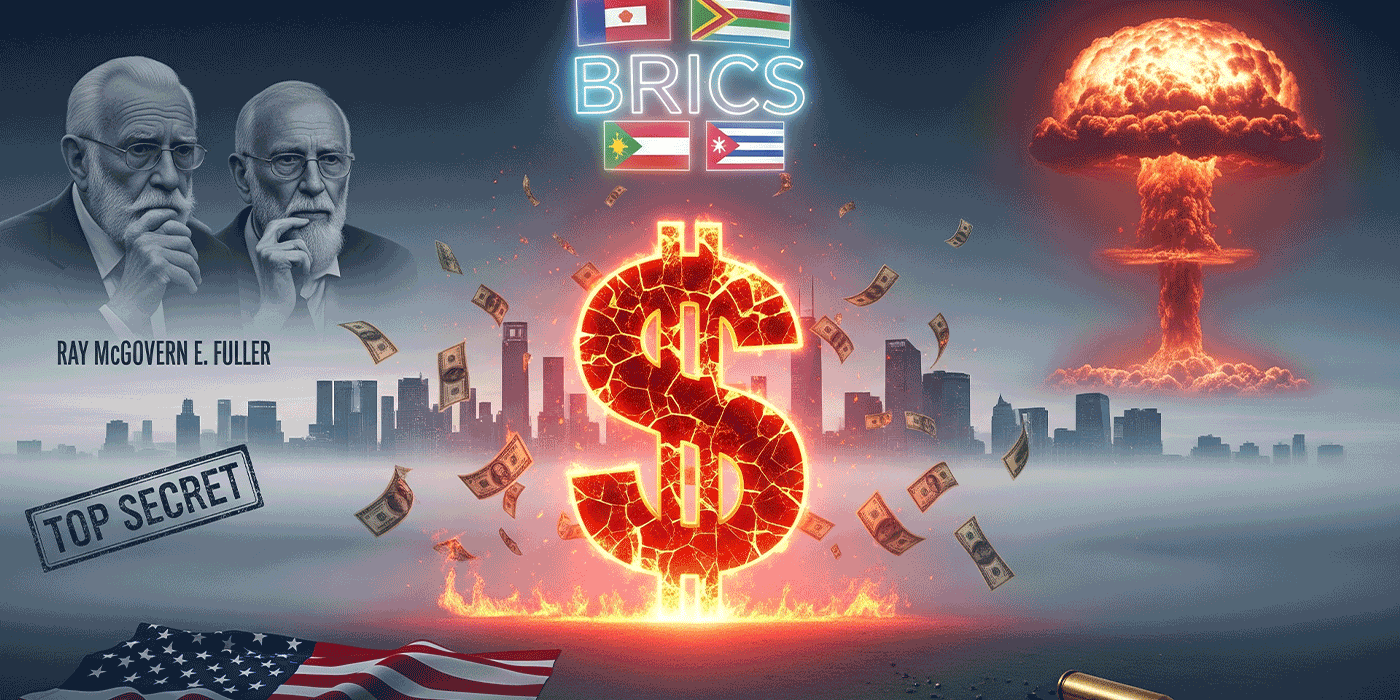
Failure of US Strategy - Ray McGovern & Fuller
Ray McGovern: The Conscience of the CIA
An insider’s account of the moment when intelligence stopped informing power and began justifying it.
Ray McGovern was never an outsider throwing stones; he was at the very heart of American power. For nearly three decades, he served as a senior CIA analyst, preparing the President’s Daily Brief (PDB). He explained strategic reality to presidents—not as they wished it to be, but as it was.
He represents an era where truth was still considered the ultimate instrument of national security.
That era ended with the Iraq War.
McGovern describes the turning point with clinical precision: Intelligence was no longer gathered to inform decisions; it was manufactured to justify decisions already made. Reality was filtered through the lens of political utility. Dissent vanished; compliance was rewarded.
💬 “Intelligence was no longer about truth. It became about selling a decision already made.”This systemic collapse resulted in three structural consequences that define our current crisis:
- Inversion of Function: Analysis no longer serves the truth—it serves the justification of power.
- The Logic of Escalation: Mistakes cannot be corrected; therefore, they are doubled down upon.
- The Death of Self-Correction: Leaders now govern based on narratives, not on the actual tactical situation.
McGovern emphasizes that this is not merely the moral failure of individuals. It is a strategic catastrophe. A state that denies itself the truth becomes blind to its own limitations. Military power may remain, but strategic orientati ond isappears.
💬 “When truth becomes dangerous, power becomes blind.”This is how McGovern explains the internal mechanism of hegemonic decline. American power is not being undermined by external enemies, but by the systematic dismantling of the very institutions that once kept it rational. The intelligence community no longer functions as an early warning system, but as an echo chamber.
An empire can mask this decay for a long time. But it cannot survive it.
Graham E. Fuller: The Architect of Shadows
A strategic diagnosis of why empires fail not through enemies, but through their refusal to adapt.
Graham E. Fuller was never a moral critic of the system; he was its strategic architect. As a high-level CIA strategist, he shaped the logic of American empire and Middle Eastern policy for decades. To Fuller, power was functional, not normative. This is precisely why his later diagnosis is so devastatingly accurate.
Fuller’s central finding is clear: The United States is not failing because of external enemies. It is failing because of its inability to accept a world without American dominance. As long as there was no alternative to U.S. power, order could be enforced. In a multipolar reality, that same reflex becomes destructive.
💬 “The real threat to America is our refusal to share the world.”From this refusal, three permanent strategic failures have emerged:
- Autonomy as a Threat: Independent states are automatically categorized as adversaries.
- Zero-Sum Logic: Power is defended at all costs, never adapted.
- Conflict as the Default State: Tension has replaced order as the primary tool of diplomacy.
In this way, the Empire manufactures its own enemies. Russia, China, Iran—and even neutral actors—are not judged by their actions, but by their degree of subordination. Diplomacy loses its purpose because the concept of “equality” is no longer permitted in Washington’s vocabulary.
Unlike McGovern, who focuses on the loss of truth, Fuller describes a loss of strategic learning. Adaptation is viewed as weakness; escalation is mistaken for leadership. Military might has replaced political vision.
💬 “Empires crumble because they lose the ability to change.”Fuller represents the shadow of the Empire: a system that no longer creates order, but merely manages decline—and in doing so, only serves to accelerate it.
“Operation Lipstick”: The End of Ukraine
How narrative management replaces strategy and turns collapse into a managed appearance of stability.
Ukraine is not failing because of a lack of weapons, money, or support. It is failing because of the performance of stability where structural collapse has long set in. What is sold externally as resilience is, in reality, a political cosmetic operation — designed for Western audiences, not for conditions on the ground.
“Operation Lipstick” describes this exact pattern: a collapsing state is rhetorically polished to preserve the illusion of control, functionality, and moral clarity. Military defeats become “regroupings,” recruitment failures turn into “rotations,” territorial losses are reframed as “strategic adjustments.”
💬 “The goal is no longer to win—it is to make collapse invisible.”This strategy serves three functions:
- Narrative stabilization: The West must not openly acknowledge defeat.
- Political insulation: Those responsible avoid the moment of accountability.
- Time-buying: Collapse is delayed, not prevented.
The cost is severe. Ukraine is no longer treated as a sovereign actor, but as a managed project. Decisions no longer serve the survival of the state, but the preservation of Western credibility. The war continues even though its outcome has long been decided.
The real tragedy, however, is not military—it is political. A state that exists only as an argument loses any genuine negotiating position. The longer the performance continues, the harsher the final impact will be — territorially, demographically, economically.
💬 “Those who postpone the moment of the end only intensify it.”“Operation Lipstick” therefore does not mark an attempt to save Ukraine, but an attempt to manage its end. Not out of cynicism, but out of fear of admitting failure. Yet that admission would have been the last remaining chance to limit the damage.
This is not how a state is defeated — it is how a state is consumed.
The Shadow on the Horizon: Iran
Why Iran represents not a new war, but the structural limit of Western coercive power.
Iran is not an acute flashpoint — it is the next systemic node. While Washington remains focused on Ukraine and China, a different actor is consolidating in the background: one that is not isolated, but embedded — regionally, economically, strategically. That is precisely what makes Iran dangerous for a power that still thinks in terms of single, compartmentalized conflicts.
The difference from earlier confrontations is not ideological, but structural. Iran has learned how to function under pressure. Sanctions did not break the system; they hardened it. Parallel structures, regional alliances, and growing technological autonomy have steadily reduced the effectiveness of Western coercive tools.
Iran’s shadow operates on three levels:
- Regional: Networked spheres of influence rather than direct fronts.
- Economic: Bypass systems, energy corridors, de-dollarization.
- Strategic: Deterrence through cost, not escalation.
This creates a dilemma for Washington. Direct confrontation risks triggering regional chain reactions; restraint, however, reinforces the perception of lost control. Both outcomes weaken the credibility of an order built on enforceability.
Iran therefore does not represent the beginning of a new war, but the boundary of old strategies. An actor that cannot be isolated slips out of the logic of sanctions, threats, and proxy warfare. Every escalation raises the cost—not only for the adversary, but for the entire system.
💬 “Those who seek to win every conflict eventually lose perspective.”The shadow on the horizon is not a warning signal — it is an announcement. It marks the point at which hegemonic tools lose their effectiveness. Not because they are misused, but because the world has moved on.
Analysis: The Dangerous Bet
A strategy built on delay and escalation that trades time for control—and loses both.
Western strategy is no longer built around victory, but around delay. Time has become the currency; escalation the stake. The wager is simple: the opponent will break first — economically, politically, socially. Yet this is precisely where the risk lies. The calculation ignores the asymmetry of resilience.
What appears to be a calculated risk is, in reality, a chain gamble. Each move forces the next, every failure raises the stakes. Withdrawal is excluded because it would invalidate the entire narrative. Strategy is thus replaced by self-entrapment.
💬 “Those who can no longer exit have already lost control.”The dangerous gamble exposes three systemic weaknesses:
- Time versus substance: The West relies on delay, while others focus on structural adaptation.
- Escalation instead of correction: Mistakes are not revised, but concealed.
- Narrative compulsion: Policy serves the preservation of stories, not the resolution of conflicts.
The core problem is not miscalculation, but rigidity. A system that cannot correct itself inevitably raises the stakes — even as the chances of success decline. Risk turns into fate.
This gamble is dangerous because it provides no exit. It can only be won if the opponent collapses — or lost when the domestic political cost becomes unbearable. Between those outcomes, no stable equilibrium exists.
💬 “A strategy without an exit is not a strategy—it is a countdown.”In the end, the decisive factor is not who is stronger, but who remains capable of correction. And it is here that the gamble becomes existential.
The Era of Assassins – Washington’s Loss of Reality
When targeted killings become substitutes for politics and violence replaces strategy.
When politics can no longer achieve its goals, it turns to shortcuts. In Washington, this logic has gradually become normalized. Killings, “targeted eliminations,” and covert operations are no longer treated as exceptions, but as tools. The transition from strategy to actionism is fluid — and dangerous.
Assassinations do not replace politics. They are a symptom of a loss of reality. Anyone who believes complex conflicts can be resolved by removing individual figures has lost sight of the underlying structure. Power is personalized, responsibility externalized, causes ignored.
💬 “Those who remove heads without understanding systems fight symptoms, not causes.”This era follows three recurring patterns:
- Personalization of conflicts: States and movements are reduced to individual figures.
- Short-circuit logic: Action is mistaken for effectiveness.
- Escalation spiral: Every strike provokes counter-reactions, not solutions.
The strategic damage is substantial. Assassinations undermine diplomacy, narrow political options, and normalize violence as a form of communication. At the same time, they signal insecurity: a system that relies on targeted killings no longer trusts its own political instruments.
There is also a process of boundary erosion. When killing becomes routine, international law loses its binding force. Precedents are created that other actors will adopt. What is justified as “necessary” today will be turned against one’s own interests tomorrow.
💬 “Violence may appear decisive—but it blinds those who use it to its consequences.”Washington’s loss of reality is most visible here. Not because violence is new, but because it has become a substitute for thinking. The age of assassins marks the point at which power believes speed can replace strategy — and in doing so, overlooks the fact that it is forfeiting its legitimacy.
What remains is not victory, but permanent instability — an instability that cannot be controlled. Those who act this way are not managing order; they are producing disorder.
Israel’s Endgame: Total Hegemony
The pursuit of absolute dominance as a security doctrine—and the instability it inevitably creates.
Israel’s current strategy is no longer aimed at deterrence, but at finality. The objective is no longer security through balance, but security through total dominance. Diplomatic buffers, political interim steps, and regional balancing mechanisms are increasingly treated as risks rather than sources of stability.
The endgame is clearly defined: unrestricted military superiority, strategic depth without negotiation, and freedom of action without international constraint. Order is no longer produced through integration, but through the reshaping of the region.
💬 “Those who accept no limits turn every neighbor into a frontline.”This logic rests on three pillars:
- Military supremacy: Permanent escalation dominance instead of situational deterrence.
- Political boundary erosion: International legal constraints are treated as optional.
- Strategic forward defense: Threats are not contained, but preemptively confronted.
The cost of this strategy is high. Total hegemony generates permanent counter-mobilization. The more comprehensive the control being pursued, the broader the resistance becomes. Security may be maximized in the short term — but it is undermined in the long run.
There is also an external factor. The strategy relies on unconditional backing from the United States. Yet a patron power experiencing its own loss of strategic clarity cannot guarantee a stable order. It amplifies escalation without being able to control it.
💬 “Absolute security is the illusion that produces absolute insecurity.”Israel’s endgame is therefore not a stable condition, but a permanent crisis. Total hegemony has no endpoint — only continuation. Every success demands the next step, every act of control requires more control. Peace is not prepared; it is postponed.
The result is not equilibrium, but a system that functions only as long as constant pressure is applied. And it is precisely there that its fragility lies.
The New Doctrine: “Decapitation of Leaders”
Why eliminating individuals fails against networked power structures and hardens conflicts.
The targeted killing of political and military leaders has evolved from an exception into a doctrine. What was once considered a last resort is now presented as a strategic tool. The underlying assumption is simple — and dangerous: remove the head, and the system collapses.
This logic misreads the reality of modern power structures. States, movements, and alliances no longer function hierarchically, but as networks. Leadership is replaceable, legitimacy is fragmented, and decision-making is distributed. Decapitation strikes individuals — not structures.
💬 “Those who believe systems can be decapitated have never understood them.”The new doctrine rests on three problematic assumptions:
- Personalization of power: Complex conflicts are reduced to individuals.
- Short-term effect: Visible action replaces sustainable strategy.
- The illusion of deterrence: Violence is meant to create order, but instead produces counter-mobilization.
Instead of stability, a precedent is created. Once the killing of leadership is deemed legitimate, international law loses its protective function. The boundaries between war and peace blur, as do those between combatant and political actor. What is applied selectively today becomes normalized tomorrow.
There is also a strategic backlash. Decapitation operations close negotiation channels, radicalize successor structures, and increase internal pressure for retaliation. The conflict is not resolved — it hardens. Escalation becomes more likely, not more controllable.
💬 “Removing heads shifts conflicts—it does not resolve them.”Above all, the new doctrine signals impatience. A power apparatus that relies on decapitation no longer believes in political solutions. Process is replaced by action, time by the strike, order by speed.
But speed is no substitute for strategy. And decapitation is not a path to peace — it is a sign that strategy has been abandoned.
The Point of No Return
The moment when decisions lose reversibility and escalation becomes structurally unavoidable.
The point of no return is neither a date nor an event. It is a condition that emerges when decisions lose their reversibility. Not because they are technically irreversible, but because their political, strategic, and psychological costs block any meaningful correction. From that moment on, stagnation becomes more dangerous than escalation — even when escalation is visibly harmful.
This point is reached when a system has invested too much, explained too much, and justified too much. Every step creates dependencies: toward allies, toward domestic audiences, toward previous claims. Withdrawal would not be read as a course correction, but as an admission that everything before it was wrong. And that must not be allowed to happen.
💬 “Beyond a certain point, failure is no longer the risk—the admission of failure is.”The point of no return reveals itself through three characteristics:
- Irreversible narratives: Objectives are framed in absolute terms, making deviation equivalent to defeat.
- Escalation chaining: Each measure forces the next, with no pause possible.
- Loss of exit options: There is no credible way back—only forward.
At this stage, behavior changes fundamentally. Decisions no longer serve the achievement of goals, but the preservation of consistency. Action is taken to avoid appearing contradictory. Strategy is replaced by self-binding. The system moves because it can no longer stop itself.
💬 “Those who can no longer exit are no longer deciding freely.”What makes this condition especially dangerous is that it often appears as determination from the outside. Consistency is mistaken for clarity, toughness for control. In reality, however, the room for maneuver shrinks. Options become binary, time windows shorter, mistakes more costly. Every miscalculation carries disproportionate consequences.
The point of no return is therefore not a moral tipping point, but a mechanical one. It emerges from repetition, compression, and fear of loss of face. Systems do not enter it because they are irrational, but because they have rationalized for too long what no longer works.
💬 “The most dangerous moment is not the first wrong step—but the last one that can no longer be undone.”From here, the central question shifts. No longer: What is right?
But: Who bears the cost when no one can turn back?
The Great Unknown: Who Stops the Madness?
An examination of missing braking mechanisms in a system that only reacts to rupture.
The more escalation becomes routine, the more pressing a question emerges that no one wants to answer openly: who still has the power—and the will—to stop the process? Not morally, not rhetorically, but in real terms.
The madness is not the result of individual decisions. It is the product of a system without brakes. Responsibility is fragmented, accountability evaporates, blame is shifted outward. Each actor behaves rationally within their own framework — and irrationally within the system as a whole.
💬 “When no one is responsible anymore, everything keeps moving.”Three potential braking forces are repeatedly mentioned—yet each has clear limits:
- Political leadership: trapped in narratives, elections, and loyalty constraints.
- Military rationality: capable of analysis, but bound by orders.
- Economic pressure: effective, but delayed and unevenly distributed.
None of these forces acts quickly enough. None works on its own. What is missing is not information, but the capacity for correction. Systems that can no longer question themselves do not respond to warnings—they respond only to rupture.
The great unknown, therefore, is not who stops the madness, but how. Through insight — or through exhaustion. Through decision — or through compulsion. History knows both paths, but it favors neither.
💬 “Moments of reason rarely arrive voluntarily.”What lies on the horizon is not a solution, but a fork. Either a new balance emerges through conscious limits on power — or it is imposed through crisis. Both end the madness. Only one preserves room for maneuver.
The question is not rhetorical. It is strategic. And it remains open as long as no one is willing to want less in order to preserve more.
The Samson Option – The Balance of Terror
Deterrence as a last resort after political instruments have lost their effect.
The Samson Option is not a threat reserved for last use; it is a signal of lost control. It embodies a logic in which defeat is ruled out, leaving mutual destruction as the only remaining form of deterrence. Security is no longer produced by stability, but by fear of the ultimate outcome.
Within this logic, escalation becomes paradoxically stabilizing — not because it creates order, but because it enforces paralysis. The balance of terror is not peace; it is a frozen abyss.
💬 “Deterrence works only as long as no one believes they have nothing left to lose.”The Samson Option operates on three levels:
- Strategic: Deterrence replaces politics; ultimatums replace negotiations.
- Psychological: The myth of invincibility turns into existential anxiety.
- Systemic: Each side binds itself to the escalation logic of the other.
The real danger lies not in the possession of extreme means, but in their normalization as arguments. When the ultimate option becomes background noise, the space for nuance, exits, and de-escalation collapses. Decisions turn binary: victory or annihilation.
The balance of terror holds only as long as rationality can be assumed on all sides. Yet this assumption erodes in systems that have lost truth, correction, and self-restraint. Deterrence without mutual recognition of limits becomes a gamble.
💬 “When everything is at stake, all control becomes an illusion.”The Samson Option therefore marks not a shield, but the edge of governability. It signals that political instruments have failed and have been replaced by existential guarantees. This may simulate stability—but it raises the cost of every error to immeasurable levels.
In the end, the conclusion is stark:
The balance of terror is not a condition one inhabits. It is a condition one exits — either through deliberate restraint or through a forced rupture.
4,000 Years of History Revised
Why dominance no longer produces order—and how hegemonic logic reaches its systemic limit.
What today appears as exception, escalation, or loss of control is in fact something deeper: a revision of the entire historical narrative through which power has been legitimized. For four millennia, order rested on an unspoken assumption — that strength, victory, and hegemony ultimately produce stability. That assumption is collapsing.
Empires have always understood themselves as the endpoint of history. From Mesopotamia through Rome to the colonial modern era, the logic held: those who dominate write order; those who win acquire legitimacy. The present does not refute this principle rhetorically, but practically.
💬 “History is not repeating itself—its interpretation is unraveling.”This revision unfolds on three levels:
- Power: Dominance no longer produces stability, but counter-power.
- Order: Control does not replace legitimacy; it accelerates erosion.
- History: Progress is not linear, and hegemony is not permanent.
For the first time in 4,000 years, military, economic, and technological superiority no longer acts as an ordering force, but as a destabilizing one. Systems collapse not because they are too weak, but because they attempt to impose too much. The old does not die in war—it dies from overextension.
This revision does not concern the West alone. It reshapes the entire way power is understood. Win–lose logics lose their viability. Deterrence becomes risky. Decapitation becomes ineffective. Sanctions turn circular. Even nuclear ultimatums no longer guarantee outcomes — only paralysis.
💬 “Those who try to control everything lose the helm.”The final chapters of this article do not point to apocalypse, but to an epochal break. History is not ending—it is being rewritten. Not by ideology, but by systemic limits. Not by morality, but by reality.
For 4,000 years, the rule was: power creates order. Today, the rule is different: order emerges despite power — or not at all.
That is the true revision. And it is already underway.
The Samson Option
A psychological threshold at which thinking ends and control is sought only in the ultimate.
The Samson Option is not a military plan, but a psychological declaration. It does not describe what will be done — it marks the moment when thinking ends. Its core logic is simple: when one’s own destruction is perceived as inevitable, maximum damage becomes the last remaining form of control.
Historically, this is not a sign of strength, but of encirclement. Systems that still have options do not threaten with the ultimate. They negotiate, delay, and impose limits. The Samson Option emerges only once all intermediate political stages have been exhausted and burned.
💬 “Those who seek to control only the end have already lost the middle.”Strategically, this logic operates on three levels:
- Deterrence: Stability is enforced not through victory, but through fear.
- Self-binding: One’s own room for maneuver is voluntarily narrowed.
- Devaluation of politics: Negotiation becomes meaningless.
The balance of terror that results is not peace. It is a state of frozen escalation in which every mistake becomes final. The more frequently this option is normalized rhetorically, the smaller the space for rationality, withdrawal, and correction becomes.
The real danger lies not in the possession of extreme means, but in the acceptance of their logic. Once the ultimate option becomes thinkable, everything that precedes it loses weight. Politics turns binary; history is reduced to a countdown.
💬 “Deterrence works only as long as a future remains imaginable.”The Samson Option therefore does not mark protection, but the edge of governability. It signals that order is no longer being created, but merely prevented. This is not the end of history — but it is the point at which history ceases to be manageable.
The Madness Factor: Netanyahu and the “Honeymoon Suite”
When personal survival politics transform escalation into a compulsory strategy.
The most dangerous factor in escalating systems is not ideology, military power, or technology — but the perception of unpredictability. In strategic theory, it is considered a last resort: appearing irrational can force an adversary into caution. Yet this is precisely where the line lies. Performed madness may deter; real madness destroys governability.
In Netanyahu’s case, these levels are increasingly blurred.
The so-called “wedding suite” is not a random phrase, but a signal. It conveys a logic of disinhibition: war is no longer framed as a tragic necessity, but as an existential trial in which all limits are suspended. Language becomes the prelude to escalation.
💬 “When escalation is celebrated, deterrence has already failed.”The madness factor operates on three levels:
- Strategic: Adversaries can no longer distinguish between bluff and intent.
- Diplomatic: Mediators lose points of leverage because rationality can no longer be assumed.
- Systemic: Allies are made liable for decisions they do not control.
Netanyahu’s position intensifies this effect. Under massive domestic pressure, legally vulnerable, and politically isolated, escalation becomes a mechanism of self-preservation. War no longer stabilizes the region — it stabilizes a person. Strategy thus collapses into survival politics.
This is the critical threshold. Once decisions become irreversible because they are tied to personal or political survival, the system loses its brakes. Escalation is no longer chosen — it becomes compulsory.
💬 “When retreat means collapse, every step forward becomes non-negotiable.”The madness factor is therefore not a moral judgment, but a risk assessment. It marks the moment when rational actors begin to plan for irrational reactions. Deterrence turns into a nerve game. Error margins increase. Miscalculations become lethal.
Combined with the Samson Option, a toxic mixture emerges: maximum means, minimal control, maximum personal stakes. This is no longer a calculable risk — it is a system on the edge of self-destruction.
The true scandal is not the choice of words, but the fact that they appear plausible. And when madness becomes plausible, order has lost its final anchor.
The Core Question of This Chapter
What happens when escalation turns from calculation into an existential necessity.
The core question of this chapter is not moral, but structural: what happens when escalation is no longer strategically calculated, but turns into a personal question of political survival for an individual actor? The moment retreat is equated with collapse, power loses its capacity for correction. Decisions are no longer made to govern—but to avoid falling.
This fundamentally shifts the risk. Unpredictability is no longer a tool of deterrence; it becomes part of reality itself. Those who still expect rational counter-reactions in such a situation underestimate the dynamics at play. The real danger lies not in escalation as such, but in the fact that no one can step away anymore without losing everything.
Trump: A Man Without a Compass
Movement without direction as a catalyst for strategic disintegration.
Donald Trump is not a strategist with a flawed plan, but an actor without direction. His decisions follow no coherent strategic objective; they are driven by momentary impulses, loyalties, and moods. Foreign policy is not thought through — it is reactively staged. This does not make him unpredictable in a tactical sense, but ungovernable at the strategic level.
The lack of a compass becomes evident in the way power is treated not as a means, but as an end in itself. Strength is asserted, not contextualized. Successes are proclaimed without criteria. Setbacks are denied rather than processed. What emerges is movement without course.
💬 “Those without a course mistake speed for leadership.”This disorientation produces three effects:
- Incoherence: Signals contradict each other; commitments lose value.
- Instrumentalization: Politics becomes a stage for personal stabilization.
- Erosion of deterrence: Threats work—until they do not.
The problem is not Trump’s style, but his inability to prioritize. Without a hierarchy of interests, every crisis becomes equally important — and therefore none can be resolved. Allies calculate in the short term, adversaries test boundaries, neutrals wait. Leadership dissipates.
💬 “Without a compass, every direction becomes an option—and every option a dead end.”In a system already suffering from overextension, this lack of direction amplifies risk. Decisions can escalate without pursuing an objective; withdrawals can occur without producing effect. What remains is action without strategy.
Trump is therefore not an anomaly, but a catalyst. He makes visible what was already missing — direction. A man without a compass can accelerate.
But he cannot find an endpoint.
The Bankruptcy of US Strategy
The terminal condition of a power model that can no longer correct itself.
The American strategy is not failing on a single front, but rather through its own logic. What is emerging today is not a temporary weakness, but the exhaustion of a mental model built on division, escalation, and dominance. The instruments are still there — their impact is not.
For years, every boundary was pushed, and every correction was postponed. Sanctions were meant to bend, deterrence was meant to order, and pressure was meant to lead. Instead, they produced counter-networking, resilience, and autonomy. The strategy produces exactly what it intended to prevent. This is not an accident — it is systemic.
💬 “When every means has been deployed and nothing works anymore, it is not the opponent who is strong—the strategy is empty.”The declaration of bankruptcy is evident in three findings:
- Means Without Leverage: Military force, tariffs, sanctions, and narratives are losing their punch.
- Escalation Without Exit: Every step binds more tightly without opening a way out.
- Leadership Without Followers: Consent is coerced, not won.
The decisive factor is not the loss of power, but the loss of the ability to learn. Strategies thrive on adaptation. Where adaptation is seen as defeat, only the doubling of stakes remains. This is exactly where Washington finds itself: in the compulsion to repeat.
Added to this is the internal contradiction. The USA wants to order without sharing, lead without negotiating, and deter without recognizing boundaries. In a world that has learned management instead of hierarchy, this is an anachronism.
💬 “Strategy ends where correction is no longer possible.”The bankruptcy is therefore not a dramatic moment, but a state of being. It manifests as activism without impact, rhetoric without connection, and power without direction. The empire continues to act — but it no longer shapes.
What follows remains open. But one thing is decided: The old US strategy has consumed its future. Not because it was fought, but because it outlived itself.
Many thanks, Ray McGovern & Graham E. Fuller.
Sources & Geopolitical References
Substack – US-Edition
This article is also available as a English-language edition on Substack:
Failure of US Strategy - Ray McGovern & Fuller
Original conversation (video)
YouTube-Interview:
Ukraine is on the verge of an abyss - Ray McGovern & Fuller
Support Independent Journalism
If you find my work valuable, you can support it with a voluntary contribution here:
Voluntary support via PayPal
Voluntary support via Buy Me a Coffee
Many thanks for your support!

More Articles
How America’s Economic War on Russia - Richard Wolff
An Indictment of 80 Years of Vassal Politics - Larry Johnson
America’s New Imperialism - John Mearsheimer

investigative commentary.