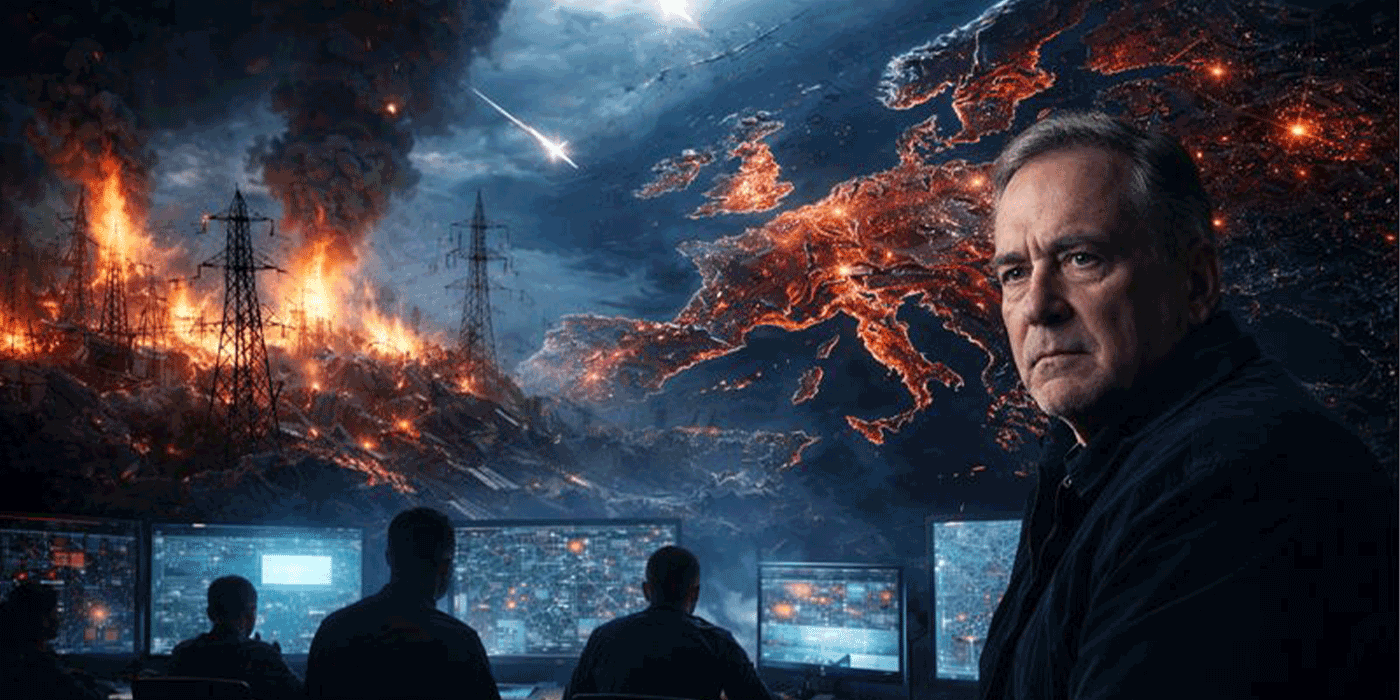
Winter Without Power - Larry Johnson
The Insider’s Judgment: Biography and Uncomfortable Truth
Larry Johnson is a former U.S. intelligence officer, CIA analyst, and counter-terrorism specialist with extensive experience inside America’s national security establishment.
During the 1990s, he served with the CIA and later at the U.S. State Department, where he worked on terrorism analysis, asymmetric warfare, and international security operations. His career unfolded during the formative years of America’s post–Cold War interventionist strategy.
After leaving government service, Johnson became a prominent and outspoken critic of U.S. foreign and military policy. He is now known for his uncompromising assessments of Western power, focusing on the structural limits of NATO, the realities of modern industrial warfare, and the strategic consequences of prolonged proxy conflicts—particularly in Ukraine.
Johnson’s analysis is characterized by a data-driven, operational perspective, emphasizing manpower, production capacity, logistics, and sustainability over political messaging. He consistently challenges mainstream narratives about Russia’s weakness and highlights the long-term risks of escalation.
💬 “Wars are not won by narratives, but by production, logistics, and time.”While Russia systematically dismantles Ukrainian infrastructure, signaling the endgame, Europe sleepwalks into catastrophe – trapped between American war fatigue, its own powerlessness, and the growing rage of a population that can no longer bear its elites.
The Balance of Power: From 1:3 to 3:1 in Three Years
“These are the death throes of Ukraine”
Larry Johnson, former CIA analyst and counterterrorism expert at the U.S. State Department, paints a picture that is systematically excluded from Western media: The military situation in Ukraine has completely reversed in three years.
Summer 2022 – Russia’s Weakest Moment:
- Approximately 250,000 Russian soldiers total
- Spread across 1,200 miles of front
- No concentration possible
- Ukraine: 600,000-700,000 active soldiers plus National Guard
The numbers told a clear story: Russia was hopelessly outnumbered. In September 2022, Moscow had to mobilize reservists because so many contract soldiers had left. Western analysts saw Russian collapse approaching.
Today – The Complete Reversal:
- 1.3-1.5 million Russian soldiers (deployed, reserve, or in training)
- 32 million men with military experience as strategic reserve
- 700,000 soldiers actively in combat
- Ukraine: 300,000-350,000 soldiers, probably fewer
General Syrskyi, Ukrainian Commander-in-Chief, admitted three weeks ago that the Russians enjoy a two-to-one advantage. If Russia has 700,000 soldiers in the field and there’s a 2:1 ratio, that mathematically means: Ukraine has at most 350,000 soldiers left.
Johnson puts it bluntly:
💬 “What we are witnessing right now are the death throes of Ukraine.”Western propaganda continues to proclaim that Russia’s economy is in ruins, refineries are destroyed, Moscow can barely gain ground. Reality tells a different story.
Missile Power: 600-800 Combined Attacks Every Other Day
“If Ukraine wants to shoot down 300 drones with Patriot missiles, that’s an entire year of Lockheed Martin production – in a single day”
For weeks now, Russia has been demonstrating a capability that makes a mockery of all Western analyses: Almost every other day, Moscow launches between 600 and 800 combined missile and drone attacks.
Why This Matters:
In 2022, 2023, and even in the first half of 2024, Russia never showed the ability to deploy so many drones and missiles in sustained attacks. Back then, the West spoke of one attack per month or every two months. Now it’s almost every other day.
This means: Russia has production capacities that Ukraine clearly doesn’t have – and that the West cannot replicate either.
Ukraine’s Counter-Response:
Ukraine launched 145 drones yesterday – not an insignificant number. But Russia claims to have shot down the majority of them. The hits on Russian oil refineries affect facilities near the Ukrainian border, and they aren’t taken out of operation for weeks or months – usually just for a few days.
The so-called damage to the Russian economy is minimal. Russia, on the other hand, is now intensifying its campaign against:
- Energy centers
- Power plants
- Railways (crucial for transporting supplies and troops)
- Factories and other important production facilities
The Patriot Trap:
Johnson explains the economic absurdity of Ukrainian air defense: “An average Russian drone costs less than $100,000 – maybe $50,000, maybe $25,000. Each Patriot missile costs about $7 million, and you have to fire two of them to destroy the drone.”
The calculation: $14 million to destroy something worth $25,000.
Lockheed Martin can only produce 550-600 of these missiles per year. If Russia sends 300 drones and Ukraine tries to shoot them all down with Patriot missiles, that’s an entire year of production – in a single day. There are 364 days left.
The math simply doesn’t work. Russia has systematically weakened Ukraine’s air defense system. What remains can only provide very limited support and cannot shoot down ballistic or hypersonic missiles.
The Consequence:
Russia now has much more flexibility in deploying fixed-wing aircraft (dropping glide bombs) and rotary-wing aircraft (helicopters).
Infrastructure Destruction: Winter Without Power
“From Sumy and Poltava – recurring power outages are causing civilians to leave the country”
Russia is not only attacking military targets. The destruction of civilian infrastructure – especially the energy grid and railways – has a dual effect:
Military:
The railways are crucial for transporting supplies and troops to the front. Without functioning rail connections, the Ukrainian army cannot maintain its defensive lines.
Civilian:
Especially in the northeastern regions – around Sumy and Poltava – recurring power outages that may persist long-term are causing civilians to leave the country.
Johnson sees this as “a more comprehensive attack on the economy.” Russia is entering a new phase of the war of attrition in which it is able to conduct operations along the entire 1,200-mile front.
Western Propaganda vs. Reality:
Trump and European politicians have basically pawned off the Ukraine mission to Europe – but not completely disengaged. This morning there was a HIMARS attack on Belgorod that killed two people and knocked out power. This HIMARS system was fired by U.S. personnel – the U.S. military remains involved.
The messages from Washington and Europe say:
- The war is stalled
- Russia’s economy is in ruins
- Refineries are destroyed
- Russia is making hardly any progress
- There’s no way Putin can win
Then comes reality: Russia launches 600-800 combined attacks almost every other day. The Russian economy is growing, factories are running, supply chains are intact.
The Russian Economy: Growth Despite Sanctions
“They’re now producing in a way that doesn’t drain resources from other parts of the economy”
The West likes to emphasize: “Oh, they have 8 percent inflation and their economy has slowed down.” Johnson methodically dismantles this narrative.
2022-2023: The Adjustment Phase
During these years, Russia actually had to accept pain – investments and resources were concentrated on:
- Building tanks
- Producing artillery shells
- Starting drone manufacturing
- Improving various missiles (Kinzhal, Iskander)
That was costly. Resources were diverted from other parts of the economy.
2024-2025: The Production Phase
Now these factories and production facilities are running. Supply chains are intact. They’re now producing in a way that doesn’t drain resources from other parts of the economy.
Inflation: A Sign of Competence
Russia recognized it had an inflation problem and took targeted measures to cool the economy and reduce inflation. This can increase unemployment or have other impacts – but Russia addresses the problem directly.
Johnson asks provocatively: “Do you hear anywhere in Europe or the United States that someone is taking positive political and economic steps that might increase unemployment or have other impacts because they’re trying to address a specific problem?”
The answer is no. Russia has shown that it is immune to political pressure and willing to take unpopular measures when they are economically necessary.
The Fundamental Conclusion:
When you step back and look at the whole picture: Russia is able to produce the material required to sustain this modern warfare operation.
Neither Ukraine nor Europe, including the United States, are capable of this. They have proven themselves incapable.
Valdai and Putin’s Optimism: The Most Relaxed Putin in Years
“He didn’t shy away from difficult topics – he knows this is the endgame”
Glenn Diesen had just been at the Valdai Forum in Sochi and asked Putin questions there. His observation is remarkable:
💬 “Given the dangerous situation with all the escalations, he was nevertheless very calm – very... I’ve never seen him in such good spirits before, telling so many jokes. It was somewhat unusual. He didn’t seem like someone who was too worried.”Johnson confirms: “He was probably as relaxed and optimistic as ever. He didn’t shy away from difficult topics.”
Criticism from Foreign Diplomats:
Some foreign diplomats and military leaders at Valdai wondered: Why don’t the Russians do what the Americans tried in Iran – launch a decapitation strike? They know where all the political leaders in Ukraine are located.
So why this slow, grinding war where they wear down and bleed out the Ukrainian army bit by bit, instead of simply targeting the political leadership?
Johnson’s Answer:
“Putin is a true advocate of international law. Unlike the United States, unlike the Zionist state of Israel, who disregard international law at every opportunity, I believe Vladimir Putin doesn’t want to create a precedent that says it’s okay to assassinate political leaders.”
Because where do you draw the line then? It’s better to defeat them, put them on trial, and subject them to due process.
Why Putin Can Be Relaxed:
There’s no evidence that the Russian economy is under increasing pressure because of the war. In fact, the opposite is the case. Putin knows and understands that what’s happening now on the front lines in Ukraine is the endgame of this entire military operation.
When Trump called him a “paper tiger,” Putin responded with humor: “We’re not just fighting Ukraine – we’ve been fighting NATO for three years, and they haven’t defeated us yet. So if we’re a paper tiger, what does that make them?”
This shows how he thinks – with confidence and a sense of the absurdity of Western propaganda.
Europe’s Desperation: When Everything Was Bet on One Card
“European elites have bet everything on this card – and now that the U.S. has handed over the war, they must deal with the security problems and economic costs”
Diesen identifies Europe’s central dilemma: “As we, I suspect, reach the final stages of the war and everything falls apart, there’s obviously a lot of desperation coming from Europe now.”
Why Europe Can’t Turn Back:
European elites have bet everything on the Ukraine card:
- Massive financial commitments
- Political legitimacy tied to “victory”
- Energy dependence on the U.S. after Nord Stream
- Economic sanctions that have destroyed their own economy
Now that the United States has handed this war over to the Europeans, they must deal with the resulting security problems and economic costs.
Europe’s Three Options:
- Escalate – hoping to keep the war going or still defeat Russia
- Pull the U.S. back in – through provocations that Washington can’t ignore
- Capitulate – and thus accept the end of their political careers
Overall, European elites seem willing to escalate if necessary. As cities like Kupyansk and Pokrovsk fall very quickly, we’ll soon see dramatic developments there.
The Nuclear Threshold: Tomahawks and F-35s as Triggers
“Putin has already said: If that happens, all options are on the table – which means: nuclear weapons”
Johnson identifies the fundamental danger of European escalation plans: The weapons the West would use are nuclear-capable – and Russia must assume they carry nuclear weapons.
The Tomahawk Scenario:
What’s the United States’ plan – launch a Tomahawk missile attack on Russia?
Putin has already said: If that happens, since these missiles are considered nuclear-capable, all options are on the table – which means: nuclear weapons.
The F-35 Scenario:
Or will the United States simply deploy F-35 jets with conventional bombs?
The problem with that: As soon as an F-35 enters Russian airspace, Russia must assume it has a nuclear bomb on board, because it’s capable of carrying one.
And they don’t fly around with a transponder saying: “No, we’re nuclear-free. No nuclear weapon on board.”
British Insanity:
Johnson calls these plans “pretty crazy – which, as you know, is somehow typical, the usual approach, the hallmark of the British.”
Crazy plans that were always elaborate, even in World War II, but never really worked, never really contributed to ending the war.
Now they’re trying to start a war, and they have only very limited means.
Russian Intelligence and British False-Flag Plans
“Russian defectors are supposed to stage an attack somewhere in Poland or Romania – then they’d be caught and confess to being sent by Russia”
Russian intelligence reports that the British have “hatched some plan”:
The Scenario:
- Deploy Russian defectors who switched to the Ukrainian side two or three years ago
- Have them stage an attack somewhere – either in Poland or Romania
- Then they’d be caught and confess that they were sent by Russia
- Goal: Provoke a military response
Johnson sees the typical pattern of British operations in this – elaborate but ultimately ineffective.
British Escalation Rhetoric:
British involvement in attacks on Russia is becoming increasingly open. Media reports show they’re directly involved in attacks deep inside Russian territory.
British Defense Minister Ben Wallace argued that Crimea must be “strangled” again – made uninhabitable.
The Russians responded by calling him a terrorist. The rhetoric is obviously escalating more and more.
But It’s Not Just the British:
The EU is looking for legal grounds to intercept and seize Russian merchant ships. Johnson comments dryly: “They can make up any law they want – it’s still piracy. It remains an act of war.”
There are also plans to intercept Russian missiles and drones over western Ukraine from Polish territory, with the argument that Russia can’t respond because it’s still in Polish airspace.
“We’re basically changing the rules of the proxy war and assuming the Russians will simply accept all the new rules we set up.”
Europe’s Fragmentation: The Growing Bloc of War Opponents
“The Czech Republic is now aligning with Slovakia, Hungary, and possibly Austria”
Johnson identifies a growing bloc within the NATO-EU world that is decidedly opposed to going to war with Russia:
The New Eastern Bloc:
- Slovakia
- Hungary
- Czech Republic
- Possibly Austria
With the electoral victory in the Czech Republic, a new constellation is emerging. These countries want to cultivate relations with Russia, not escalate.
The Personal Anecdote:
Johnson recalls a terrorism briefing about twenty years ago when Czechs and Slovaks had just separated: “At the end we presented a single certificate for completing the course. The Slovak was there, and the Czech was there, and I laid it in front of me – I didn’t know who to give it to. Well, they both grabbed for it and started pulling on it.”
Now, instead of arguing, they all agree: “It would be crazy to go to war with Russia. They won’t do it.”
The Weakness of Warmongers:
Scholz in Germany isn’t getting stronger, he’s getting weaker. Public rejection of his policies is increasing. The same applies to Macron in France – he’ll be under enormous pressure to call new elections because they’ve failed to form a credible government.
Keir Starmer in the United Kingdom? His poll numbers are in single digits. Johnson believes: “If people had the choice to either vote for Keir Starmer or get a colonoscopy, most would choose the colonoscopy.”
Why Russia Doesn’t Need to Escalate:
“Given all that, I see no incentive for the Russians to expand the war at this point, because they recognize they have Ukraine on the ground. They’ll just keep going – it’s an anaconda-like pressure that keeps squeezing, squeezing, squeezing – and one day the whole thing will collapse.”
Angela Merkel’s Blame Assignment: Poland and Baltics Blocked 2021 Negotiations
“Poland and the Baltic states are partly responsible for this war because they blocked negotiations in 2021”
Angela Merkel stated in an interview with Hungarian media that Poland and the Baltic states are partly responsible for this war because they blocked negotiations in 2021.
This statement is remarkable for several reasons:
1. Merkel Breaks the Silence
The former Chancellor thereby confirms that there actually were negotiation possibilities in 2021 – and that these were deliberately sabotaged.
2. Intra-European Blame Assignment Begins
When a figure like Merkel publicly blames Poland and the Baltics, it shows that the European elite is beginning to hold each other responsible for the coming disaster.
3. Germany vs. EU Bureaucracy
Chancellor Friedrich Merz wants Germany to take on a larger role, which has brought him into direct conflict with von der Leyen and the EU bureaucracy.
This fragmentation is visible not only between countries but also between national governments and the EU center in Brussels.
The Growing Gap Between Leadership and People:
If you look at France, Germany, the United Kingdom, Romania, and many other countries – governments no longer represent the public particularly well. Their unpopularity is becoming increasingly obvious.
Diesen poses the fundamental question: “Can you remember any other epoch in European history – say, in the last thousand years – in which there was such great disagreement or separation between leadership and the population?”
The Pre-Revolutionary Moment: When Nobody Wants Their Government Anymore
“It really feels very pre-revolutionary at the moment”
Diesen responds to Johnson’s question without hesitation: “In all these countries – no, it really feels very pre-revolutionary at the moment.”
What This Means:
It’s about political legitimacy, the economic situation, the social situation. And there’s a growing sense that it doesn’t matter who you vote for because you get the same result.
The Italian Example:
Even when you succeed in electing the people you wanted, like in Italy – they got Meloni – once she’s elected, she fits very well into the European apparatus and turns against everything.
A good source in the Italian establishment told Diesen: Meloni has more or less recognized herself that “we’re heading for a big wall. This is going to go very wrong.”
But she does nothing. She just keeps going straight ahead because everyone else is doing the same.
The Opposite of Leadership:
“So they know this will end in catastrophe, but they’re not changing course, which is somehow the opposite of leadership.”
When things go from bad to worse, there’s no leadership that could change it. The public will increasingly have the incentive to mess up the whole system.
Diesen’s conclusion: “I would say this is a pre-revolutionary moment.”
Johnson’s Confirmation:
“Yes, so that – and I think the Russians recognize that.”
Minority Governments: When 34% Are “Winners”
“The winner received 34% of the vote – that means two-thirds of the population have a different opinion”
Johnson analyzes the structural problem of European democracies:
The Czech Example:
The “winner” – Johnson deliberately puts this in quotes – received 34 percent of the vote. “I’m not particularly good at math, but that’s about a third. That means two-thirds of the population have a different opinion than this one third.”
The German Example:
“The AfD is leading with 28 percent.” That’s not even a third – that’s barely more than a quarter.
The Systemic Weakness:
Minority parties get a relative majority of votes and suddenly become the influential force. This leads to general weakness in governing.
“When you see this kind of fragmentation of political systems where there’s no clear consensus on the way forward, it makes these societies vulnerable to the kind of authoritarian leadership that often emerges in the midst of a crisis.”
When the Crisis Comes:
“And a crisis will come when these countries decide to attack Russia in any way.”
Russia’s Response: Iskander on Strategic Targets
“They will attack each of these countries and inflict damage on them”
Johnson outlines what will happen if Europe actually attacks Russia:
The Russian Response:
“Russia will strike back, and I’m sure they’ll use the Iskander missile at strategic locations in Germany, France, the United Kingdom, or Italy – against military and war-relevant production facilities.”
They will avoid civilian casualties as much as possible, but they will attack each of these countries and inflict damage on them.
Europe’s Dilemma:
This puts Europe in an impossible position. Their only possible response is: “Will we launch a nuclear bomb?”
Because unlike Europe, Russia has ballistic missile defense systems – not one hundred percent reliable, but still capable of countering many of these ballistic missile threats.
The Double Catastrophe:
“When an economic collapse coincides with a military defeat, then real chaos spreads across Europe.”
And the United States? “We’re not far from that either. We have the luxury of two oceans, but the division currently taking place in this country is real and significant.”
Foreign Policy as Domestic Political Escape
“The worse things get domestically, the more they turn to foreign policy”
Diesen identifies a classic pattern: “The worse things get domestically, the more they turn to foreign policy as a safe area to make policy and try to create some unity.”
Why Foreign Policy Is “Safer”:
It’s easier to avoid criticism of the government when the topic shifts to foreign policy and war. If you then criticize your government, you can be accused of being on the side of the opponent – and suddenly you’re a traitor.
That’s a good method for dealing with opposition when you’re extremely unpopular.
The Examples:
- Starmer in the United Kingdom
- Merz in Germany
- Macron in France
They’re obsessed with foreign policy and seem to barely care about domestic issues anymore.
The Obsession with Weakening Putin:
Ben Wallace (British Defense Minister) said about “strangling” Crimea: Crimea is a special place in Putin’s pride, so it must be destroyed.
The assumption: Putin is the great Satan, the latest reincarnation of Hitler. If we can undermine him, everything will be fine.
The Problem with This Logic:
The main opposition to Putin doesn’t come from someone who wants to capitulate, but from people who think Putin is far too restrained.
They believe he has weakened Russia’s deterrence. The fact that Europeans are openly talking about attacking Russia, and that they call Russian nuclear deterrence blackmail that shouldn’t even be considered respecting – they see this as too much accommodation.
Diesen states: “I’m just saying, the assessment seems completely wrong. If we simply weaken Russia, make Putin look weak, then they somehow believe he has to back down. I mean, no – the opposite will be the case. Bombs will rain down on Europe.”
The Unlearned Lesson from World War II
“If you kill enough civilians, you undermine the people’s will to support the government – it had exactly the opposite effect”
Johnson turns to the fundamental strategic miscalculation that the West hasn’t corrected since World War II:
The Bombing Doctrine:
In World War II, the West operated on the assumption: If you kill enough civilians, you undermine the people’s will to support the government, thus accelerating capitulation.
“Well, once again, it had exactly the opposite effect. It led to people turning against those from outside.”
The Modern Parallel: Hamas
The proposed peace plan calls for Hamas to give up its weapons. But they’ve gotten so many new recruits – not just Hamas, but other Palestinian organizations too.
Children who lost their mother, father, brother, sister, cousin, aunt, uncle, or grandmother – they want revenge.
“So this militaristic approach has exactly the opposite effect.”
Why Putin Doesn’t Have to Kill All Ukrainians:
“They’re taking care of that themselves. All he has to do is make it impossible for them to continue fighting.”
And that’s exactly what the Russians are doing right now:
- Eliminating manpower
- Destroying factories
- Disrupting communication routes (railways)
- Shutting down power plants
Winter on the 22nd Floor Without Power:
“Winter is coming, and nobody wants to live in a dark apartment, especially not if you live on the 20th floor of a high-rise and the only way up and down is the stairs.”
Johnson himself had a condo on the 22nd floor in Florida: “A couple times I said: ‘Oh, I’ll take the stairs.’ Ha! Yeah, that’s strenuous, exhausting training – you almost kill yourself by the time you get to the top.”
People will leave and go elsewhere. Ukraine is defeating itself – Russia just has to create the conditions under which staying becomes unbearable.
Trump’s Paper Tiger Comment and Putin’s Response
“We’ve been fighting NATO for three years and they haven’t defeated us yet – if we’re a paper tiger, what does that make them?”
When Trump called Putin a “paper tiger,” he responded with remarkable composure and humor:
💬 “We’re not just fighting Ukraine – we’ve been fighting NATO for three years, and they haven’t defeated us yet. So if we’re a paper tiger, what does that make them?”Johnson comments: “And he did it with a sense of humor. That shows how he thinks.”
What This Response Reveals:
- Self-confidence – Putin knows Russia is militarily and economically stronger than three years ago
- Strategic patience – He doesn’t let himself be provoked by Western rhetoric
- Realism – He understands that NATO has been trying to defeat Russia for three years – and is failing
Western propaganda continues to proclaim that Russia is on the verge of collapse. Reality on the front tells a completely different story.
Three and a Half Years Without Success: Not a Single Moment When the West Won
“Can we name a moment when the Europeans or Americans made a decision that proved effective?”
Johnson poses the fundamental question:
💬 “We’re now three and a half years into the special military operation. Can we name a moment when the Europeans or Americans made a decision that actually made sense and proved effective in weakening Russia and thwarting its military ambitions?”The Answer: No.
It was exactly the opposite. Every Western decision has made Russia stronger:
- Sanctions forced Russia to build its own production capacities
- Weapons deliveries demonstrated Western weakness (too little, too late)
- Rhetoric united the Russian population behind Putin
- Isolation drove Russia into the arms of China, India, and the Global South
The Unlearned Lesson:
The West still holds to the bombing doctrine today – which already didn’t work in World War II and is currently failing again in Gaza.
The Final Phase: Kupyansk, Pokrovsk, and the Coming Collapse
“These European decisions are designed to provoke a Russian response – but Putin doesn’t fall for the bait”
Diesen mentioned at the beginning of the conversation that cities like Kupyansk and Pokrovsk are falling very quickly. These developments are significant because they are strategic hubs.
Why Russia Doesn’t Respond to Provocations:
“These European decisions are designed to provoke a Russian response, but I don’t believe Putin falls for the bait.”
The Russian strategy remains:
- Systematic destruction of Ukrainian infrastructure
- Attrition of the Ukrainian army
- Patience – time is working for Russia
European False-Flag Desperation:
The closer the end comes, the more desperate European attempts to provoke a response through staged incidents.
Russian intelligence warns of British plans to use Russian defectors for false-flag attacks in Poland or Romania.
But Russia won’t be provoked. Ukraine is defeating itself – all Russia has to do is wait.
The Endgame: America Survives, Europe Disintegrates
“The next victims of this proxy war could be the Germans”
Geography determines fate. Johnson is clear in his prognosis:
Why America Will Survive:
“America is 6,000 kilometers away, on the other side of the ocean. In America, it doesn’t really matter if more countries in Europe are destroyed.”
The economic logic from an American perspective is cynical: “For the United States, it’s very, very good when European politicians, their European vassals, push the American war forward, because they make money from it. They sell weapons and make big profits.”
Why Europe Will Disintegrate:
“Many forces in the EU will not follow Brussels and Germany down this path.”
The disintegration won’t be imposed from outside but is an internal consequence of suicidal policies.
Ukrainian Losses:
Patrik Baab mentioned in another interview numbers that never appear in Western media: “Ukraine is bleeding out. According to leaked information, losses have reached 1.7 million dead and missing soldiers.”
1.7 million. This number gives a sense of the scale of the catastrophe.
Johnson adds: “And the next victims of this proxy war could be the Germans.”
Putin’s Quote About European Rope
“If you asked Europe to hang itself, it would ask: ‘Do you have to use European rope?’”
Putin formulated Europe’s self-destruction in a sentence that Patrik Baab quoted in his interview and that captures the entire absurdity of the situation:
💬 “If you asked Europe to hang itself, it would ask: ‘If you want to hang us, do you have to use European rope?’”Europeans insist on carrying out their own destruction with European means – and even pay for it.
What This Means:
- Europe is destroying itself
- It insists this be done with European resources
- It pays the U.S. for selling them the tools
- It calls this “solidarity” and “values”
Self-destruction as virtue – that is the essence of current European policy.
Thank You, Larry Johnson.
Sources & Geopolitical References
Substack – US-Edition
This article is also available as a English-language edition on Substack:
How Europe Is Destroying Itself - Larry Johnson
Original conversation (video)
YouTube-Interview:
Europe's Prerevolutionary Moment - Larry Johnson
Support Independent Journalism
If you find my work valuable, you can support it with a voluntary contribution here:
Voluntary support via PayPal
Voluntary support via Buy Me a Coffee
Many thanks for your support!

More Articles
How America’s Economic War on Russia - Richard Wolff
An Indictment of 80 Years of Vassal Politics - Larry Johnson
America’s New Imperialism - John Mearsheimer

investigative commentary.