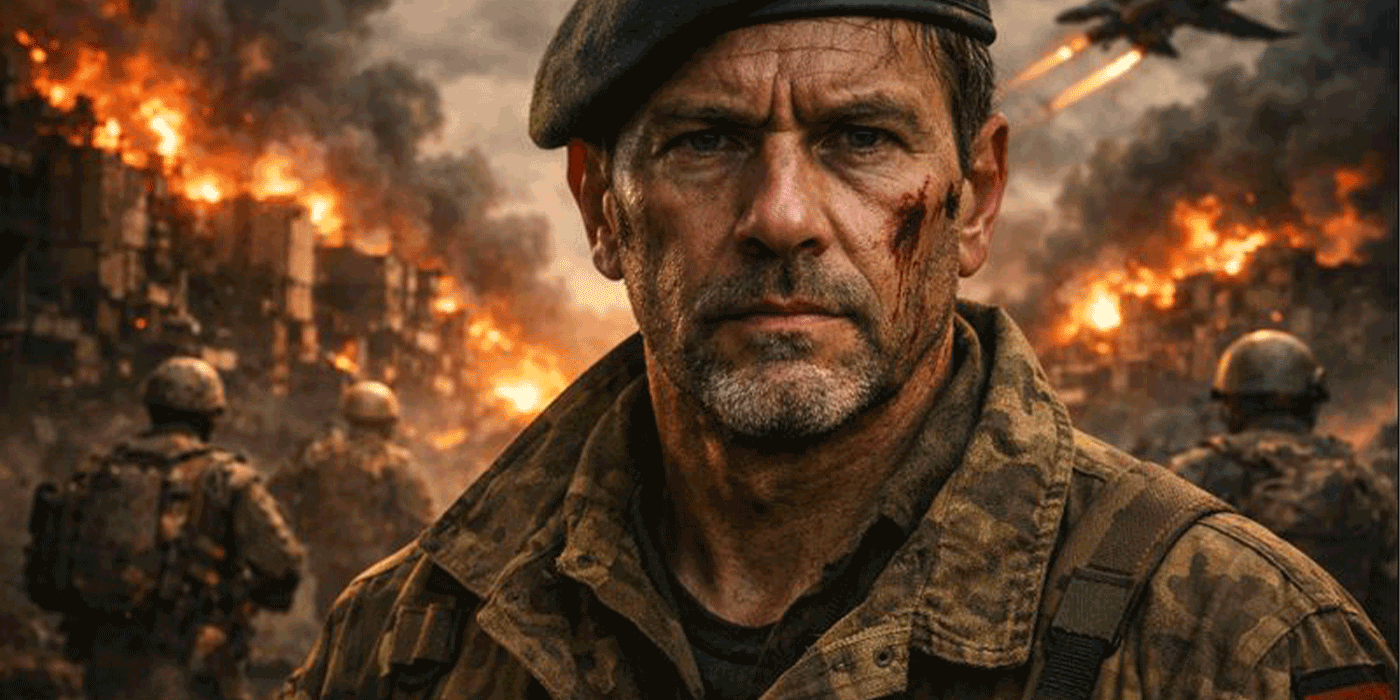
Green Beret on war in Gaza - Tony Aguilar
Biography: Anthony “Tony” Aguilar
The Betrayal of Gaza: Tony Aguilar breaks his silence – a Green Beret’s testimony.
Anthony “Tony” Aguilar is a retired Lieutenant Colonel of the U.S. Army Special Forces and a highly decorated Green Beret with more than two decades of operational experience. He served in the major wars of the past decades – in Iraq, Afghanistan, and across the broader Middle East – operating in urban combat zones where civilian infrastructure collapsed and war became a permanent condition.
After his retirement, Aguilar worked as a security specialist for a subcontractor of the Gaza Humanitarian Foundation. He was deployed to Gaza, officially to support the protection of humanitarian aid operations. Within 41 days, he terminated his assignment. In protest.
Today, Aguilar has come forward as a whistleblower. He testifies that the operation in Gaza was not primarily designed to supply the civilian population, but functioned as part of a system aimed at control, forced displacement, and violence against unarmed civilians.
💬 “I have seen war. But nothing I have experienced comes close to what I saw in Gaza.”The Scale of Destruction
Aguilar’s account does not describe collateral damage, but a condition of total and irreversible destruction.
💬 “Everything was destroyed. There were no signs of life anywhere. It was worse than what you see in war. It was annihilation.”This assessment does not come from a civilian observer or a political commentator. Aguilar previously served in Baghdad, Mosul, and Fallujah, operated under combat conditions in Afghanistan, and took part in missions in Syria. Gaza, however, defied comparison. For him, it was no longer a conventional war zone, but a space in which destruction had become a permanent state.
What he witnessed was widespread, systematic, and final: entire neighborhoods no longer existed, there was no reconstruction, no areas of retreat, no functioning supply lines. The civilian population was not living among the ruins – they were living inside them.
💬 “Nothing I have seen in my entire career comes even close to what is happening in Gaza – and continues to happen.”This observation forms the starting point for everything that follows. For Aguilar, it quickly became clear that such destruction is not a byproduct. It is the framework within which all subsequent measures – displacement, control, hunger, and violence – become possible in the first place.
The Strategy of Displacement
Here, Aguilar describes the systematic use of humanitarian structures to forcibly move the civilian population.
The second aspect that shocked Aguilar concerns the central role of the Gaza Humanitarian Foundation. According to his testimony, this was not a misguided aid mission, but the instrumentalization of humanitarian assistance itself – as a deliberate, planned, and consciously executed operation aimed at displacing the civilian population.
Aguilar does not describe this intent as a later development, but as the starting point of the entire planning process:
💬 “From the very beginning, the plan was to establish humanitarian transit zones for the entire population of Gaza, in order to push them south and concentrate them in this incredibly large and expansive tent city.”The system of displacement (as of May 2025):
According to Aguilar, the displacement has already been operationally implemented. Existing camps for internally displaced persons – Nasser, Khan Younis, Mawassi, and Rafah – were not dismantled, but functionally repurposed. They no longer serve protection, but the management of movement.
The remaining section of the Rafah camp was cleared, and people were pushed into the central corridor. At this exact location, “Secure Distribution Site 1” was subsequently established. Living space was replaced by control.
The objective of this system is explicit: to move the population from the north – from Jabalia and Gaza City – through the central areas and all the way to the far south, back to Rafah near the Egyptian border. Movement follows a fixed axis. Return is not предусмотрено.
The Fear of the “Final Solution”
The concern focuses on the next logical step of a process that is already being implemented in practice.
The realization that this exodus was planned—and continues to exist as an intended future outcome—left the Green Beret deeply shaken. Equally disturbing to Aguilar is the involvement of the United States and the silence of the international community.
The current offensive—Operation Gideon’s Chariots 2, the ground assault on Gaza City—accelerates this process: Palestinians are pushed from the north into the central areas, and from there further south, toward the humanitarian transit zone in the far south.
The existential fear:
Aguilar fears the next step, which he describes as a “final solution.”
💬 “I fear that day, because there are discussions about moving all Palestinians out of Gaza to another location. That is not appropriate. That is not acceptable.”Given that every prior Israeli announcement—whether invasion, occupation, or evacuation—has been carried out, Aguilar sees a real risk of a humanitarian catastrophe. For him, this is no longer about abstract scenarios, but about existential consequences: hunger or death.
For Aguilar, the “final solution” represents the last step in this process—a point at which displacement becomes irreversible. He issues an urgent warning against this step. And he calls on the world to act before it is reached.
The Mask of Humanitarian Aid
At this point, the boundary between humanitarian assistance and political-military control becomes blurred.
Tony Aguilar describes a dark chain of planning and execution. According to his testimony, the Israeli government was “the head behind the plan,” while the Gaza Humanitarian Foundation functioned as the implementing body—as a tool.
With this assessment, the former Green Beret delivers a harsh indictment of the GHF. He does not argue against its official role; he exposes it by reducing it to absurdity:
💬 “The Gaza Humanitarian Foundation does not feed the population; the Gaza Humanitarian Foundation allows the population to starve under the cover of humanitarian aid.”Catastrophic figures:
According to Aguilar, the numbers confirm a deliberate strategy of under-supply. Since its founding on May 26, the Gaza Humanitarian Foundation has covered not even three percent of the population’s daily food requirements. Ninety-seven percent of the need has gone unmet.
For Aguilar, these figures do not reflect a logistical failure or a start-up phase. They mark a condition in which under-supply is structurally embedded. Hunger does not appear as a consequence of external circumstances, but as a sustained reality.
💬 “People are dying. People are starving.”The Illusion of “Meals”
Aguilar exposes how statistical aid is systematically detached from real-world sustenance.
A central element of the Gaza Humanitarian Foundation’s public narrative is the claim that millions of “meals” are being distributed. For Aguilar, this is precisely the illusion. What is being handed out are not ready-to-eat meals, but raw supplies—food items that still require preparation.
Under conditions of destruction and displacement, however, everything required for preparation is missing: water, cooking facilities, fuel. Food therefore exists on paper, not in the daily reality of the people.
💬 “They talk about meals, but they are not meals.”For Aguilar, this is not a logistical failure, but part of the system. Aid is counted, not made effective. It produces figures for reports—while people continue to starve.
In this way, assistance becomes a numerical abstraction and loses all practical meaning. Provision exists as a metric, not as survival. In this contradiction, Aguilar sees not failure, but structure. Hunger is not eliminated—it is administrated.
An Actor of Genocide?
From the totality of these structures, Aguilar draws a conclusion that even for him marks a breaking point.
From the structures he describes, Aguilar reaches a conclusion that deeply unsettles even himself. In his view, the Gaza Humanitarian Foundation is not a misguided aid organization, but an active component of a destructive system. In his words: an actor of genocide.
💬 “The Gaza Humanitarian Foundation is an actor of genocide.”To convey the gravity of this claim, Aguilar turns to a historical comparison that he himself characterizes as extreme. He emphasizes explicitly that he is not drawing an equivalence, but pointing to structure and responsibility.
💬 “If this were World War II and the Holocaust, then the United States—the Gaza Humanitarian Foundation—would be the one turning the knob on the gas chamber. We are complicit. We are part of it.”Aguilar criticizes what he describes as the GHF’s attempt to mislead and deceive the American public, based on the assumption that Americans are not sufficiently informed to grasp the true nature of what is taking place. He rejects that assumption:
💬 “Americans are informed, and they are becoming more informed every day.”Aguilar views this complicity not as an abstract notion, but as concretely grounded. The Gaza Humanitarian Foundation, he argues, is politically shielded, financially supported, and operationally protected. As a result, the United States is not merely a bystander, but a participant in the system that sustains hunger, displacement, and control.
For Aguilar, this is the point at which silence no longer signifies neutrality, but complicity.
The Undeniable Connections
The refusal to provide transparency becomes, in itself, an indicator of political and operational entanglement.
What Aguilar describes is not a lack of information, but systematic insulation. The connections between the Gaza Humanitarian Foundation and the Israeli contracting companies executing operations on the ground are, according to his testimony, clearly present—but deliberately obscured from public view.
According to Aguilar, the GHF operates within a structure designed to avoid transparency. When asked directly about its donors and decision-making channels, the organization refused to provide any information. Such behavior, he notes, is unprecedented in the humanitarian sector.
- When a GHF spokesperson was directly asked about its donors, the response was:
This is particularly explosive given that the organization receives 30 million U.S. dollars from the U.S. government (via USAID), while simultaneously refusing to disclose its donors or account for how the funds are used.
💬 “The GHF must be supported or shielded by a ‘power within the government’ that enables this unprecedented level of secrecy. The direct connection to the Israeli government, however, is clear.”The Profit-Driven Facade
Here it becomes visible how commercial actors embed military logic into humanitarian operations.
At this point, Aguilar describes the moment when the humanitarian facade collapses entirely. Operating under the umbrella of the Gaza Humanitarian Foundation is not an aid organization, but a profit-oriented American company: Safe Reach Solutions (SRS).
According to Aguilar’s testimony, SRS is not a humanitarian actor, but a paid contractor. Its role is not to provide aid, but to carry out military directives at the operational level. What matters most, he emphasizes, is the clarity of the command structure.
Aguilar provides direct evidence:
- Client: The Israel Defense Forces (IDF) are the customer of Safe Reach Solutions.
- Statement: On June 8, Aguilar was told by SRS’s operations manager in Kerem Shalom:
The flow of funds follows this structure. Payment is routed through COGAT, the Israeli government’s coordination authority, then through the IDF, directly to Safe Reach Solutions. In this model, humanitarian independence does not exist—neither operationally nor financially.
For Aguilar, this marks a clear threshold being crossed. An operation presented as humanitarian is executed by a profit-driven company directly subordinate to a military authority. Aid becomes a service, and control becomes a business model.
The Collapse of Supply
With the military repurposing of humanitarian sites, any remaining protective function collapses.
The breakdown of supply became visible when a site designated as humanitarian was militarily repurposed. Distribution Site Number 4 in central Gaza, north of Bureij, was shut down and subsequently taken over by the Israeli army.
💬 “It was no longer a distribution center.”According to Aguilar’s testimony, the site was thereafter used as a sniper position. A location intended for starving civilians became part of the military infrastructure. The transformation did not occur alongside aid delivery, but in its place. Access to food was replaced by military control. For Aguilar, this makes one thing clear:
Humanitarian spaces can be revoked at any time—and supply collapses the moment they are repurposed.
The incident stands as an example of a system without any form of protection guarantee. Humanitarian commitments remain valid only as long as they do not interfere with military operations. Safe spaces therefore do not exist as guarantees, but as exceptions that can be withdrawn at any moment.
For Aguilar, this is where the structural rupture becomes evident: supply is no longer neutral, but fully subordinated to military expediency. Where this logic prevails, aid does not fade gradually—it can be terminated from one moment to the next.
The Trap in the South
Supply is spatially organized in a way that forces movement rather than providing safety.
After the closure and repurposing of central distribution sites, supply was concentrated in the far south of the Gaza Strip. The remaining distribution centers were located almost exclusively in the Rafah area, near the Egyptian border. This concentration was not a logistical coincidence, but part of a deterrence strategy.
The sites were deliberately established in areas where there was no population to serve. The territory south of the Morag Corridor was largely destroyed and uninhabited. Supply was thus spatially separated from the population. Anyone in need of food had to travel to reach it.
This system follows two clear principles:
- Spatial separation of aid and population in order to force movement
- Physical exhaustion as a filter to control access to supplies
For many, this meant walking distances of eight to ten kilometers. For those displaced from the north—areas such as Gaza City or Jabalia—the journey extended up to twenty-three kilometers in one direction. These distances were not a side effect, but part of the structure. Aid was not made accessible; it was deliberately placed out of reach.
For Aguilar, what emerges from this is decisive: a forced concentration of the population in a confined area, without the possibility of retreat, without alternative sources of supply, under constant control. Movement does not lead to safety, but to dependency. The south does not become a refuge—it becomes a trap.
The shocking allegation:
💬 “The violent herding of Palestinians into this camp area in the south, operated and guarded by the GHF, meets every definition of a concentration camp.”Biometric Data Collection
The collection of bodily data marks the transition from indirect steering to total control.
For Aguilar, biometric registration marks the point at which control ceases to be indirect and becomes total. In order to gain access to food, Palestinians were required to surrender their biometric data—retina scans, fingerprints, and facial recognition.
Externally, this process was presented as a technical service: an ostensibly harmless method to “reserve meals.” For Aguilar, this was a deception. Biometric collection is not a logistical tool, but an instrument of identification and control.
💬 “All biometric data that is scanned into the database—do you know who owns that database? The Israeli Defense Forces own that database.”Tony Aguilar’s final conclusion remains unequivocal: the Gaza Humanitarian Foundation is a “tool of genocide” that “knowingly, intentionally, and willingly accepts the money to do this.”
In this system, food is tied to identity and survival is bound to data extraction. For Aguilar, this represents the definitive loss of any humanitarian boundary: those who eat are registered; those who are not registered are excluded.
Armed Presence in Gaza
Armed contractors replace institutional responsibility and operate beyond public accountability.
Aguilar makes clear that the Gaza Humanitarian Foundation and Safe Reach Solutions are not physically present in Gaza. Their leadership operates externally—from operational centers in Israel. Inside Gaza itself, only two groups are present: truck drivers and the armed security forces of UG Solutions.
This, according to Aguilar, leads to a decisive finding:
- The only armed contractors involved in the Gaza operation are the forces of UG Solutions.
They secure the distribution sites, control access points, and constitute the only visible authority on the ground.
💬 “This is the only measure of accountability that goes in to see what is actually happening.”For Aguilar, this configuration is deeply problematic. An operation labeled as humanitarian is carried out on the ground exclusively by private, armed forces. Public oversight, independent observation, or institutional accountability do not exist.
Responsibility is thereby displaced: control without mandate, armed force without transparency, accountability without the public. For Aguilar, this is not a marginal issue, but a structural risk—at the point where aid ends and violence can begin.
The Ideological Danger
Ideology and weaponization converge where humanitarian neutrality is effectively abandoned.
Aguilar describes the origin of the armed core group of UG Solutions as ideologically charged and highly problematic. According to his account, leadership and a significant portion of the security personnel were recruited from the Infidels Motorcycle Club—a veteran organization with openly stated objectives.
By Aguilar’s description, this group does not primarily define itself through security duties, but through an ideological mission. Publicly articulated is a campaign against jihad—paired with a radically anti-Muslim stance.
💬 “The first objective is to fight jihad. The second objective is to eliminate Muslims from the world.”For Aguilar, the danger does not lie in abstract beliefs, but in the combination of ideology and armed force. This group, he states, was equipped with fully automatic weapons, pistols, shotguns, as well as tear gas and smoke devices—and operated as the sole armed presence in the vicinity of the distribution sites.
The consequence, in his view, is unambiguous: a humanitarian operation is being secured by forces whose worldview does not regard the population they control as protected civilians, but as an enemy. This is not merely unacceptable, Aguilar argues—it is dangerous.
💬 “What are Palestinians? The majority are Arabs. Muslims.”Johnny Mulford – Leader of the Infidels
Leadership figures shape not only operations, but the ideological coordinate system of the mission.
Aguilar identifies Johnny Mulford as a central figure within the deployed security structure. Mulford, leader of the so-called Infidels, moved between Israel and Gaza and was entrusted by the Gaza Humanitarian Foundation with overseeing security-relevant operations.
What matters most to Aguilar is not Mulford’s formal role, but his openly declared ideology. According to Aguilar, Mulford made his views public—without qualification, without concealment.
💬 “Israel is the superior nation that will rule over all others.”For Aguilar, this statement is not a private opinion, but a political signal. A humanitarian operation, he argues, is being led by individuals who openly promote a hierarchy of superiority—directed at the very population they are tasked with controlling and supplying.
In Aguilar’s view, this makes the ideological line unmistakable: aid is organized by actors whose worldview allows no room for neutrality. In such a configuration, humanitarian distance is impossible—control replaces protection.
💬 “It is shocking. It is obscene. It is unacceptable.”The Gap in the Narrative
Aguilar’s observations contradict the official threat narrative through simple, direct facts.
Tony Aguilar begins by clarifying his extensive geographical familiarity with the area, lending weight to his testimony. He confirms that he traveled daily through critical corridors such as the Philadelphi Corridor and the Burma Corridor, and worked at all four distribution sites.
Based on this experience, Aguilar presents an observation that directly challenges the official narrative:
💬 “Not a single time—not a single time—did I ever see or observe an armed Palestinian at any point, let alone anyone presenting themselves as Hamas or actually being Hamas.”He concedes that Hamas members could theoretically have been present among civilians. What matters, however, is something else entirely: there was no visible threat, no aggression, no armed confrontation. The people he saw were unarmed, exhausted, and searching for food.
This observation does not contradict isolated claims, but an entire interpretive framework. Where armed presence is asserted, Aguilar describes absence. Where danger is implied, he reports hunger, exhaustion, and disorientation.
For Aguilar, this does not create reassurance, but a void in the official narrative. If the alleged threat is not visible on the ground, the question shifts—from how control is exercised to why it is imposed.
The Illegal Engagement
Armed operations without a mandate shift responsibility into a legal gray zone.
Aguilar describes the presence of UG Solutions’ security forces as legally highly problematic. The American contractors, he states, are not combatants in this conflict—they are neither part of the Israeli armed forces nor authorized by any international mandate.
According to his testimony, the armed personnel of UG Solutions entered the operational area on tourist visas. They possessed no legal authority to conduct military activities or to use force—neither lethal nor non-lethal.
💬 “We are not combatants. We are not allowed to fight there.”Aguilar emphasizes that even the right to self-defense is extremely narrowly defined. The use of force is permissible only in the case of an immediate and direct threat. Assumptions, assessments, or preemptive actions are not legally justified.
Despite this, these forces operated heavily armed inside the Gaza Strip. For Aguilar, this is not a gray area, but a clear violation of the law. Armed presence without a mandate, without combatant status, and without legal authorization shifts responsibility—and deepens the United States’ complicity.
War Crimes as a Means of Communication
Violence is not employed for defense, but normalized as a method of control.
Aguilar describes the use of firearms not as a response to combat, but as an instrument of control. There was no return fire, no armed threat, no combat situation. Shots were fired to direct, to stop, to push.
According to his testimony, Israeli forces—and in some instances American contractors—fired on unarmed civilians. These shots were not acts of self-defense, but acts of communication: to force people to keep distance, change direction, or leave an area.
💬 “Shots were fired in order to communicate with the population.”Aguilar describes a recurring pattern. At the entrances and exits of distribution sites, particularly along the corridors, gunfire was used to disperse crowds or drive them forward. Women, children, and the elderly were part of these groups.
This practice, Aguilar argues, marks the point at which control turns into violence. Shooting becomes a tool, not an exception. Communication no longer takes place through instructions, but through fear.
💬 “And that, in itself, is already a war crime. Firing on unarmed civilians in order to communicate with them or move them cannot be justified under the protocols of the Geneva Conventions.”The Official Admission
The public justification of gunfire ends any claim to neutrality.
According to Aguilar’s testimony, no further revelations were ultimately required. The Gaza Humanitarian Foundation, he argues, exposed itself—not through a leak, but through its own public statements.
In response to his allegations of shooting into crowds, the GHF delivered an official admission at a press conference:
- GHF statement: “We fire toward the crowd. We fire at their feet. We fire over their heads. We fire into the berms and sometimes into the air.”
Aguilar’s conclusion:
💬 “You have just admitted to committing war crimes.”The strict legal reality:
- An unarmed civilian population must not be fired upon under any circumstances. There is no justification for this.
In doing so, Aguilar argues, the GHF confirmed what had previously been denied: that aid was not neutral, but instrumentally deployed. Control, deterrence, and violence were integrated components of the operation—not exceptions.
For Aguilar, this ends any remaining gray zone. An organization that accepts or justifies the use of firearms in the context of food distribution exits the humanitarian framework. It effectively renames itself—from aid provider to instrument of domination.
The Story of Amir
A single fate condenses abstract structures into an irreversible reality.
Amir was barefoot. He carried no weapon, posed no threat, wore no protective gear. He was a child walking toward a distribution site, driven by hunger.
Aguilar recounts that Amir was approaching Site 3, one of the distribution centers in the south. There was no escalation, no panic, no confrontation. The boy was moving toward the site—like many others before him.
Then shots were fired.
💬 “He was shot.”According to Aguilar’s testimony, Amir was not killed in a crowd, not accidentally, not in crossfire. He was struck as he approached. Barefoot. Unarmed.
For Aguilar, this moment marks the point at which all abstract discussion ends. This is no longer about structures, narratives, or justifications. It is about a child who died because he was looking for food.
💬 “This is the outcome of this system.”For Aguilar, Amir’s death does not represent a tragic exception, but the logical consequence of a practice in which gunfire is used as a means of control. Where hunger prevails, control dominates, and violence is normalized, survival itself becomes a risk.
The Wall of Gunfire
When escape routes turn into death zones, control has fully transformed into violence.
Aguilar describes the incident at the Morag Corridor as the moment when control fully collapsed into raw violence. A crowd was in flight—moving away from a distribution area, without cover, without any possibility of escape.
Then rifle fire erupted.
💬 “It was a wall of gunfire.”According to his testimony, there was no warning, no targeted fire, no defensive action. The shots struck a fleeing crowd. People ran, stumbled, fell. There was no return fire, no armed threat, no combat context.
Aguilar recounts that the volume of fire was so dense that movement became impossible. Those who stopped risked being hit. Those who continued running faced the same risk. The corridor turned into a death zone.
💬 “They had no way out.”For Aguilar, this attack was neither an accident nor a misunderstanding. It was the logical escalation of a system in which gunfire is used as a tool of control. When control fails, fire follows.
The Destructive Weapon
The use of heavy weapons against civilians marks the definitive loss of any claim to proportionality.
Aguilar describes the deployment of 7.62-millimeter machine guns as a deliberate escalation. These weapons are designed for combat—for range, penetration, and area effect. Their use against unarmed civilians marks the transition from control to maximum violence.
According to his testimony, these weapons were not employed for deterrence, but for enforcement. Their effects are well known: projectiles that penetrate cover, tear through bodies, and leave no possibility of escape. In narrow corridors, the environment itself turns into a killing zone.
💬 “This is not crowd control.”For Aguilar, what matters is that proportionality can no longer be claimed. Using a machine gun of this caliber against civilians is not an error or a misunderstanding—it is a deliberate choice of means.
Violence thus ceases to be reactive and becomes dominant. Anyone seeking food in such an environment enters a space where survival is left to chance.
At this point, Aguilar argues, all linguistic euphemisms collapse. Where weapons designed for combat are deployed, civilians are no longer controlled but knowingly exposed. Violence becomes method—and survival becomes the exception.
The Second Whistleblower and America’s Responsibility
Converging testimonies shift the account from allegation to substantiated responsibility.
Aguilar does not stand alone in his statements. A second whistleblower independently confirms central elements of his account—corroborating it point by point, and in crucial aspects, providing even more incriminating detail. This is no longer a matter of interpretation, but of convergence.
This second witness reports on events following the shootings: the removal of bodies, evacuations carried out under military protection, and efforts to eliminate evidence before questions could be asked. Not to restore order—but to avoid consequences.
💬 “They did not want anyone to see what had happened.”For Aguilar, this marks a line being crossed. Where bodies are removed to conceal procedures, any claim to transparency collapses. Truth is not disproven—it is suppressed.
What is decisive for him, however, is another point: America’s role. The companies involved operate under the American flag, with American personnel, financed and politically shielded. For Aguilar, this is no longer indirect involvement, but complicity.
💬 “This is our name. Our people. Our responsibility.”Two whistleblowers. Two independent voices. One consistent account. For Aguilar, this is the moment when silence no longer signifies neutrality. It becomes active participation in a system that manages violence—and seeks to erase truth.
Aguilar’s urgent demand, concluding the full report by Politik-Unzensiert-News (PUN):
💬 “The United States must confront this now, before it is too late.”Thank you, Tony Aguilar.
Sources & Geopolitical References
Substack – US-Edition
This article is also available as a English-language edition on Substack:
Green Beret on war in Gaza - Tony Aguilar
Original conversation (video)
YouTube-Interview:
Green Beret reports on disturbing war crimes in Gaza - Tony Aguilar
Support Independent Journalism
If you find my work valuable, you can support it with a voluntary contribution here:
Voluntary support via PayPal
Voluntary support via Buy Me a Coffee
Many thanks for your support!

More Articles
How Israel Sells Conflicts - Seyed Marandi
Iran, Israel, and the Erosion of Western - Seyed Marandi
Green Beret on war in Gaza - Tony Aguilar

investigative commentary.