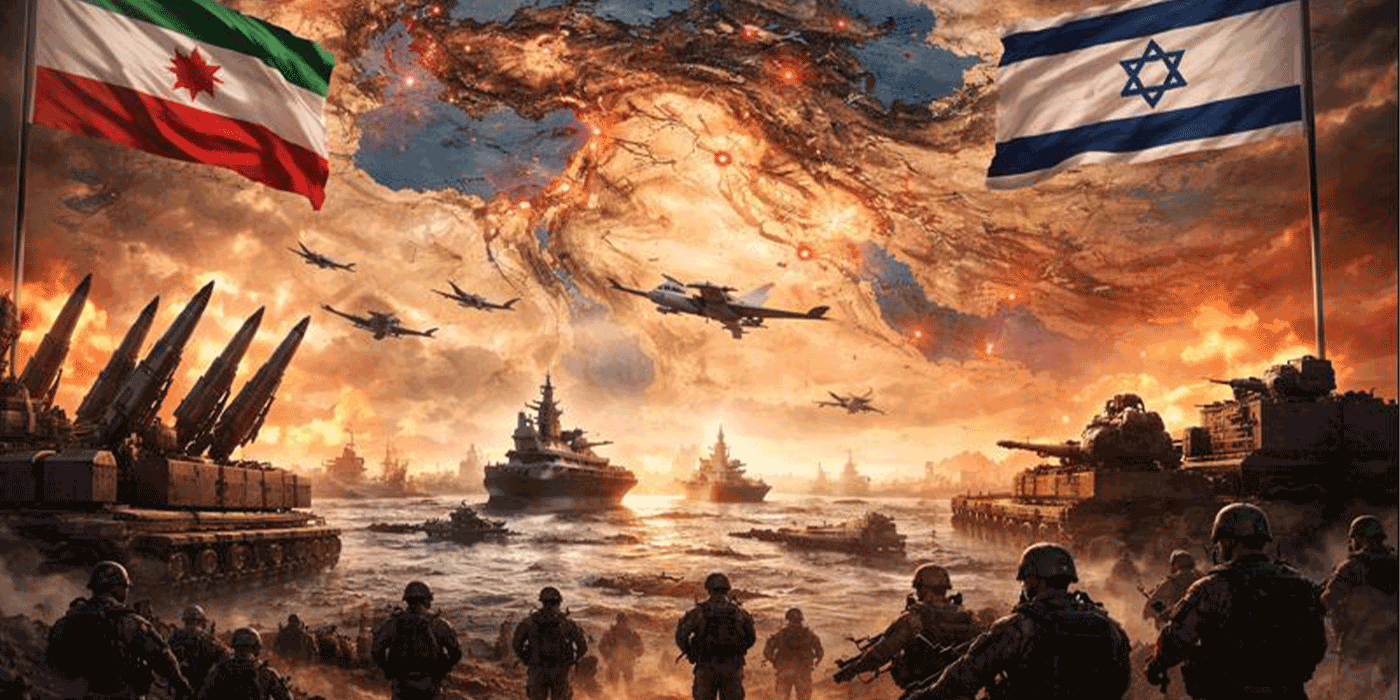
Iran, Israel, and the Erosion of Western - Seyed Marandi
The Insider and His Judgment
After years of direct insight, Marandi does not offer a prediction, but a structural judgment.
Seyed Mohammad Marandi is an Iranian political scientist, university professor, and former advisor to Iran’s nuclear negotiation team. He teaches at the University of Tehran and is widely regarded as one of Iran’s most prominent academic voices on international security, U.S. foreign policy, and regional power projection in the Middle East.
Educated in the United States, Marandi has first-hand familiarity with Western political, media, and strategic frameworks. His analyses combine institutional knowledge of Iran with a critical examination of Western narratives, particularly in the context of sanctions, deterrence policy, and information warfare.
💬 “Time is not working in favor of the Israeli regime.”He regularly appears in international media, academic forums, and political discussion formats, and is known for a sober, structured mode of argumentation that consistently prioritizes power relations, material capabilities, and geopolitical logic over moral rhetoric or public-relations narratives.
Between Ceasefire and Escalation
The current ceasefire does not mark de-escalation, but an unstable transitional phase.
The ceasefire in Gaza is not the end of the war, but its interim phase. While Israel continues military strikes and Iran consolidates its strategic posture, the decisive battlefield is quietly shifting in the background: Washington itself.
Calm in the Middle East is deceptive. Despite the official ceasefire in Gaza, Palestinians and Lebanese continue to be killed by Israeli attacks on a daily basis. At the same time, both Israel and Iran are preparing for a potential next escalation — while a notable political shift is unfolding in Washington, one that could alter the region’s entire balance of power.
The Illusion of the Ceasefire
What is described as de-escalation is, in reality, a fragile transitional phase without a political or military solution.
Professor Seyed Mohammad Marandi, a former advisor to Iran’s nuclear negotiation team at the University of Tehran, describes the Gaza ceasefire for what it is: an illusion.
💬 “This will not hold,”Marandi states in a conversation with political scientist Glenn Diesen. The root cause of October 7, he argues, lay in Israel’s sustained strangulation of the Palestinian population — and under this false ceasefire, the same policy continues, only more intensely.
The situation is escalating across multiple fronts simultaneously. Lebanon is under increased bombardment, proxy forces are being mobilized in Syria, and in a remarkable turn, the former ISIS leader Ahmed al-Sharaa (also known as Abu Mohammed al-Jolani) was invited to the White House. At the same time, reports are mounting of a revived Iranian nuclear program.
The so-called ceasefire fails to meet core criteria of sustainable de-escalation:
- Continued Israeli airstrikes resulting in civilian casualties in Gaza and Lebanon
- No political or security guarantees for the Palestinian population
- Absence of enforceable international mechanisms
- A recurring cycle of limited violence followed by formal ceasefire declarations
The pattern is unmistakable. Israel carries out sporadic bombardments, civilians are killed, and the ceasefire is subsequently declared intact — a cycle that repeats itself daily. This condition is barely survivable for the Palestinian population and recreates precisely the conditions that led to the events of October 7. The international community appears largely passive in the face of this dynamic.
For Hamas and Palestinian Islamic Jihad, this phase paradoxically represents an opportunity for consolidation. In the absence of a sustained Israeli ground offensive, they are able to expand tunnel systems and reorganize operational structures. According to Marandi, Iran supplies everything required — support that largely goes unnoticed under the cover of the fragile ceasefire.
Syria as a Covert Front
Syria is once again emerging as a geopolitical lever, where internal fragility enables external power projection.
The invitation extended to Jolani in Washington is more than a diplomatic gesture. The United States seeks to use Syria, after the fall of Assad, to exert pressure on Lebanon and Hezbollah. Marandi cautions that such a move would not go unanswered.
💬 “The Iranians would not remain passive in such a case,” he warns.Jolani, Marandi argues, would have to think twice before attempting to attack the axis of resistance from the east.
The situation inside Syria itself is precarious. The country is fragmenting, the economy is collapsing, and Jolani is rapidly losing legitimacy — precisely because he is doing what Iran and Hezbollah have predicted for more than a decade: yielding to the United States and cooperating with Israel. His extremist supporters are increasingly disillusioned, as he neither carries out ethnic cleansing nor confronts Israel, but instead seeks normalization with the West.
A destabilization of Syria would have predictable regional consequences:
- Iran’s direct security interests would be affected
- Land supply routes to Hezbollah would come under pressure
- New front lines could further destabilize Lebanon
- Proxy conflicts would expand across multiple actors
Jolani’s territorial control is far more fragile than it appears. The south of Syria is slipping from his authority, chaos dominates the east, and even in the north the security situation remains tenuous at best. Various militias and tribal leaders retain autonomy, while ethnic and sectarian tensions continue to simmer beneath the surface. Jolani is sitting on a powder keg that could explode at any moment.
Paradoxically, Jolani has approached Iran both directly and indirectly in search of normalization. Syria is economically dependent on Iran: its refineries are designed for Iranian oil, its power grid relies on Iranian technology, and many spare parts must be sourced from Iran. “If he were truly in a strong position, he would not need to turn to Iran,” Marandi remarks.
Iran’s Strategic Realignment
Iran’s military strategy is aimed less at symbolic adversaries than at structural vulnerabilities of Western power.
What many Western observers overlook is that Iran’s military capabilities are not primarily directed at Israel. The overwhelming focus lies on the Persian Gulf, the Gulf of Oman, and the Indian Ocean. When the United States occupied Afghanistan and Iraq, effectively encircling Iran, Iranian deterrence was built around the prospect of a direct American attack.
💬 “For every missile that can be fired at Israel, dozens can be directed at targets in the Persian Gulf,”Marandi explains the strategic logic. Short- and medium-range missiles are more mobile and available in significantly larger numbers. In the event of a conflict, Iran would be capable of targeting U.S. naval forces at sea as well as military bases across the region — a scenario that would have immediate consequences for the global economy.
Iran’s deterrence posture is therefore not based on symbolic strikes, but on systemic regional superiority:
- Large numbers of mobile short- and medium-range missiles
- Focus on U.S. bases and naval forces in the Persian Gulf
- Geographic advantages created by narrow sea lanes and wide area coverage
- Limited effectiveness of Western air and missile defense systems
Geography strongly favors Iran in this regard. The Persian Gulf is not particularly wide, but it is long — an ideal environment for swarms of drones and missiles, against which there is virtually no effective defense. U.S. aircraft carrier groups and military bases in Saudi Arabia, the United Arab Emirates, Qatar, and Bahrain would be highly vulnerable.
This reality makes it increasingly difficult for the United States to commit to a confrontation with Iran. Especially at a time when Washington is sustaining heavy losses in Ukraine and is forced to negotiate with China, a war with Iran would not only endanger global energy supplies but would also place all U.S. allies in the Gulf region at severe risk — a price Washington appears increasingly unwilling to pay.
Russia and China — The End of the Sanctions Order
Western sanctions architecture is losing effectiveness as alternative power centers deepen their cooperation.
A decisive turning point came with the joint declaration by the foreign ministers of Iran, Russia, and China at the UN Security Council: they no longer recognize UN sanctions against Iran. In practical terms, Moscow and Beijing are now free to export whatever they choose to Iran — and they are doing so.
Russia’s foreign minister Sergey Lavrov recently confirmed, without hesitation, the delivery of Sukhoi fighter jets and S-400 air defense systems to Iran. No denial, no diplomatic evasion — a remarkable shift in the balance of power. As political scientist Glenn Diesen observes, in the past Russia would have been forced to deny or conceal such actions.
💬 “Now there is no reason left to apologize.”Cooperation among these three countries is intensifying across all levels. It extends beyond arms deliveries to include technology transfer, joint development projects, and the integration of supply chains. China is increasingly sharing high-end technologies with Iran that were previously reserved for the West. Russia, in turn, benefits from Iranian drone and missile technologies in its war in Ukraine.
While Israeli and American technologies are stagnating, Chinese development in particular is advancing at a rapid pace. “Israel’s technological edge is diminishing and could ultimately reverse,” predicts Seyed Mohammad Marandi. This trend also applies to Iran’s allies in Lebanon, Yemen, and Gaza. What was once a clear technological superiority on Israel’s side is gradually turning into a more balanced competitive landscape.
“America First” Turns Away
Within the American Right, a fundamental reassessment of unconditional support for Israel is underway.
One of the most consequential developments is unfolding inside the United States itself. The “America First” movement originally mobilized by Donald Trump has taken on a life of its own — and in a direction that is increasingly problematic for Israel.
Figures such as Steve Bannon, Tucker Carlson, and Candace Owens have begun to openly criticize unconditional U.S. support for Israel. Bannon, Trump’s former chief strategist and a central figure within the MAGA movement, revealed after the twelve-day war that the United States intervened on Netanyahu’s behalf because Israel needed a ceasefire — Iran had gained the upper hand.
💬 “If Iran had not had the upper hand, why would the Israelis have ended the war?”This kind of public criticism from the right is historically unprecedented. While the American political left has criticized Israel for years, the conservative right had long been regarded as Israel’s most reliable partner. That support base is now eroding. Tucker Carlson has described unconditional U.S. backing as contrary to American interests, while Candace Owens has spoken openly about Israeli war crimes.
Marandi frames the issue bluntly. Had Israel truly held the upper hand, it could have continued bombing Iran. Instead, the United States was forced to engage Iran diplomatically to bring hostilities to an end. According to Bannon, this information came directly from within the White House — drawing on unusually strong sources in the Pentagon and the political establishment.
The Split Within the American Right
The ideological unity of the conservative movement is fracturing over whose interests truly take priority.
In the 1980s, Joe Biden famously stated:
💬 “If Israel did not exist, we would have to invent it,”arguing that Israel was an indispensable partner for U.S. power projection in the Middle East. That assumption is now eroding. An opposing view is gaining ground: that Israel increasingly undermines American interests in the region rather than advancing them.
In the era of “America First” and imperial decline, difficult choices are unavoidable. “For many, this leads to the conclusion that Israel is becoming a liability for the United States,” observes Glenn Diesen. Trump himself is losing control over the movement he created. For him, “America First” means standing firmly with Israel — but many of his supporters interpret it as putting America ahead of all others, including Israel.
Within the conservative movement, competing definitions of strategic loyalty are colliding:
- A growing segment interprets “America First” as strict national-interest policy
- Foreign policy commitments are increasingly perceived as burdens
- Military and financial support for Israel is openly questioned
- Identification with Israeli security priorities is visibly declining
The tension is unmistakable. Trump struggles to reconcile “America First” with unconditional support for Israel, yet the internal logic of the movement works against him. If America truly comes first, why should U.S. tax dollars flow to Israel? Why should American soldiers risk their lives for Israeli interests? These questions are now being raised by an expanding share of conservatives.
For Israel, this development is existential. While the Democratic base has already become largely critical, Republican support long represented the last secure political refuge. If that, too, erodes, Israel faces growing political isolation in the United States — regardless of which party holds power.
The Multipolar Trap
Simultaneous escalation across multiple global fronts is overstretching U.S. strategic capacity.
The United States has maneuvered itself into a state of strategic overextension. It is preparing for a potential confrontation with Venezuela, waging a costly war against Russia, gearing up for a possible conflict with China, and at the same time is expected to support Israel in yet another Middle East war. As Glenn Diesen warns, “When every corner of the world becomes a priority, nothing can be done properly.”
From an Iranian perspective, the situation has fundamentally improved. Twenty years ago, Iran was part of the “Axis of Evil” and the primary focus of U.S. containment policy. Today, there are many “bad actors” — some of them quite large, such as China or Russia — and the United States can no longer concentrate on Iran as it once did.
Simultaneous escalation across multiple global fronts produces strategic overstretch:
- Military resources are spread across too many conflict zones
- Political decision-making loses prioritization and focus
- Industrial capacity is insufficient to sustain multiple major conflicts
- Allies increase dependencies rather than sharing burdens
- Deterrence loses credibility when it cannot be credibly enforced
The U.S. industrial base is also showing worrying signs of strain. While Washington is engaged on several fronts at once, production capacity for weapons and ammunition is barely sufficient. The war in Ukraine has already depleted strategic reserves. A concurrent conflict with Iran would push military logistics to their breaking point.
“All of these countries are moving closer together,” explains Seyed Mohammad Marandi. “As U.S. capabilities are being divided, Iran’s capabilities are increasing.” U.S. sanctions and tariffs against China, Russia, and Iran are paradoxically creating incentives for deeper integration among these states. What was intended as a pressure tool is becoming the catalyst for an anti-hegemonic alliance.
The JCPOA Debacle and Its Consequences
The breach of international agreements undermines long-term trust, credibility, and negotiating power.
The legitimacy of Western sanctions against Iran is increasingly contested by Russia and China — for good reason. Iran agreed to the nuclear deal (JCPOA), renounced nuclear weapons, and complied with all transparency obligations. It was the United States, under President Trump, that unilaterally withdrew, arguing that the agreement failed to address ballistic missiles and Iran’s regional partnerships.
“In essence, they wanted to expand the nuclear deal into a form of capitulation,” summarizes Glenn Diesen. Iran was expected to sever all ties with its allies and curtail its conventional military capabilities. When Iran recently offered a new cooperation framework with the International Atomic Energy Agency, European states rejected it — despite having proposed it themselves.
💬 “Iran delivered — the West violated the agreement.”The irony is difficult to miss. Iran fulfilled its obligations, the United States broke the deal, and yet Iran was punished. The International Atomic Energy Agency repeatedly confirmed Iranian compliance. Nevertheless, Washington not only reinstated its own sanctions but attempted to coerce other countries into enforcing them as well.
“This strengthens Iran’s soft power, not only abroad but domestically,” observes Seyed Mohammad Marandi. “Iranians see that their government sought a solution, while the other side acted in bad faith.” The experience has profoundly eroded trust in Western agreements — not only in Iran, but globally. Countries such as China and Russia have drawn their conclusions.
The so-called “snapback” mechanism, through which the West attempted to automatically reimpose all sanctions, proved ineffective. Russia and China refused to recognize it, and after several turbulent weeks, Iran’s economy returned to relative normality.
💬 “There is no real fear of sanctions in Iran anymore,” Marandi notes.The psychological impact of this failure is hard to overstate. For years, Western Persian-language media warned of Iran’s economic collapse should snapback sanctions be triggered. When it happened, nothing followed. Iranian society has learned to live — and even prosper — under sanctions. The economy has diversified, new trade relationships have emerged, and sanctions pressure has increasingly functioned as a catalyst for innovation rather than paralysis.
Israel — A Hollow Shell Without Western Support
Israel’s structural dependency is becoming increasingly visible as political and economic backing erodes.
The fundamental difference between Iran and Israel lies in the sustainability of their respective positions. Iran purchases its weapons — from Russia and China, possibly on favorable terms, but it pays for them. Israel, by contrast, receives weapons as gifts from the United States and Europe, supplied to sustain its military campaigns.
“The Israeli regime is a hollow shell,” Seyed Mohammad Marandi states bluntly. “It is entirely dependent.” As Europe fragments — in relative terms — and the U.S. economy faces mounting challenges, these trends represent serious warning signs for Israel. In Marandi’s assessment, there is no long-term scenario in which Israel’s position improves.
Israel’s strategic posture is heavily reliant on external support:
- Military operational capability is sustained by continuous U.S. financial and weapons assistance
- Domestic industrial capacity is insufficient for a prolonged large-scale conflict
- Political backing in the West is showing visible fractures
- Economic strain is increasing due to prolonged crisis and mass mobilization
Israel’s economic dependency is structural. While the country produces advanced high technology, its military-industrial sector depends on ongoing American subsidies. Annual U.S. military aid of approximately $3.8 billion is not merely assistance — it is a lifeline. Without it, Israel’s military budget would collapse.
Israeli society is deeply traumatized, the economy has suffered significant damage, and the country faces growing international delegitimization. Hamas continues to exist, Hezbollah remains intact, Ansarullah in Yemen persists, and Iran continues to grow as a regional power. “Israel’s supporters in Washington, Brussels, London, Berlin, and Paris — all of them are facing serious problems,” Marandi concludes. “And these are not good developments for Tel Aviv.”
Time Is Not on the West’s Side
With each passing month, the balance of power shifts toward actors able to exploit time strategically.
The longer the conflict continues, the more the balance of power shifts. Hamas and Palestinian Islamic Jihad are expanding their tunnel networks and operational capabilities. Iran supplies what is required. Yemen is developing new technologies. In Lebanon, Hezbollah is preparing.
“The time is not working in favor of the Israeli regime,” emphasizes Seyed Mohammad Marandi. The more people are killed, he argues, the more is documented, the more anger accumulates — and the further the regime’s legitimacy is eroded.
💬 “The longer this continues, the worse it becomes for Israel.”Images from Gaza have triggered a global movement extending far beyond traditional pro-Palestinian activism. University campuses around the world are witnessing protests, labor unions are reassessing their positions, and even Jewish communities are fracturing over the question of unconditional support for Israel. Each additional day of the conflict deepens this process of delegitimization.
Two developments could prove decisive. A collapse of the front in Ukraine would carry enormous psychological consequences for the West. And the bursting of the AI-driven economic bubble would hit the United States and its allies — including Israel — particularly hard. Overvaluation in the tech sector and massive investment in AI infrastructure have created a bubble whose rupture could rival 2008 in scale — or exceed it.
The Unipolar Moment and Its Aftermath
The assumption of permanent global dominance continues to shape Western political miscalculations.
In 1990, Charles Krauthammer coined the term “the unipolar moment,” arguing that the United States should govern the world for as long as the distribution of power allowed it. One day, he suggested, the system would become multipolar again — and the United States would then adapt.
“This pragmatism was fundamentally flawed,” argues Glenn Diesen. “You cannot guide a political class for three decades on the assumption that it is a God-given right to lead the world — and then simply accept the rise of China, Russia, and Iran.”
💬 “The United States came to see itself as the owner of the entire world.”The hubris of this era is visible in virtually every major foreign-policy decision since 1990. The United States bombed Yugoslavia, invaded Afghanistan, destroyed Iraq, and overthrew Gaddafi in Libya — all seemingly without serious consequences. This perceived impunity produced a generation of policymakers and strategists who regarded resistance as impossible.
Seyed Mohammad Marandi identifies two decisive turning points that reshaped U.S. behavior: the collapse of the Soviet Union and the rapid victory over Saddam Hussein in Kuwait in 1991. Suddenly, the ghosts of Vietnam appeared defeated, and the United States viewed itself as militarily superior to any other power.
💬 “This only made the United States more arrogant,” Marandi explains.“There was no longer any respect for adversaries. The United States saw itself as the owner of the world.” As the multipolar order began to emerge, Washington no longer behaved toward rising powers as it once had toward the Soviet Union. Instead, they were to be dealt with by force.
The Paradox of American Power
The inability to accept gradual shifts in power intensifies global confrontation.
Ironically, the United States was better equipped during the Cold War to deal with a powerful adversary than it has been with smaller or emerging challengers since 1991. Intolerance toward the gradual rise of countries in the Global South has sharpened confrontation and acted as a catalyst, drawing these actors closer together.
💬 “This accelerates the decline of the United States and the West while making the world a far more dangerous place,” warns Seyed Mohammad Marandi.Maxvimal sanctions imposed simultaneously on multiple actors — China, Russia, Iran, Venezuela — ultimately isolate not the sanctioned states, but the United States itself.
Current U.S. strategy reinforces the very dynamics it seeks to contain:
- Sanctions encourage economic and technological integration among alternative power centers
- Political pressure accelerates security cooperation between Russia, China, and Iran
- Diplomatic maneuverability shrinks under moral maximalism
- Global partners pursue strategic autonomy rather than alignment
During the Cold War, the Soviet Union was an ideological rival but also a predictable negotiating partner. Red lines existed, de-escalation mechanisms were in place, and both sides acknowledged each other’s right to exist. That maturity is largely absent in today’s multipolar environment. Instead, a zero-sum logic prevails: every gain by China is perceived as a loss for the United States, and every Russian partnership as a threat.
Figures such as Steve Bannon, Tucker Carlson, and other “America First” advocates are increasingly recognizing that this is not a simple “us versus them” issue. The central question is whether such policies actually serve American interests. The answer is becoming increasingly negative. The costs of global presence are beginning to outweigh the benefits, and allies contribute less than they cost.
Outlook: The Next War
Preparations for the next escalation are already underway as political solutions move further out of reach.
Will Netanyahu escalate again? Probably — “that is simply his nature,” as Seyed Mohammad Marandi puts it. Whether in Gaza, in Lebanon, or directly against Iran remains unclear. What is clear, however, is that over time it is becoming increasingly difficult for Israel to confront Iran directly.
Iran has prepared extensively since the last confrontation. Air defenses are being reinforced, internal security against sabotage and terror attacks has been strengthened, and new missile systems are under development. Israel, by contrast, lacks the means to intercept Iranian missile capabilities, while Iran continues to improve the effectiveness of its arsenal.
Israeli military doctrine is built on rapid, decisive strikes and technological superiority.
- Yet both assumptions are eroding.
- The war against Hezbollah in 2006 lasted longer than anticipated and ended without a clear victory.
- The war in Gaza demonstrates that even vastly inferior adversaries can endure for months.
- Against Iran — with its long-range missile capabilities and its ability to threaten the entire Persian Gulf — there is no quick military solution.
The fragile ceasefire does not conceal the underlying reality: both sides are preparing for the next conflict. But while Iran can rely on growing support from Russia and China — and while time works in its favor — Israel faces diminishing Western backing, mounting economic strain, and increasing international isolation. The question is not whether the next escalation will come, but when — and whether the United States will still be willing to pay the price.
Thank you, Seyed Mohammad Marandi.
Sources & Geopolitical References
Substack – US-Edition
This article is also available as a English-language edition on Substack:
Iran, Israel, and the Erosion of Western Deterrence - Seyed Mohammad Marandi
Original conversation (video)
YouTube-Interview:
Israel & Iran Prepare for War - Seyed M. Marandi
Support Independent Journalism
If you find my work valuable, you can support it with a voluntary contribution here:
Voluntary support via PayPal
Voluntary support via Buy Me a Coffee
Many thanks for your support!

More Articles
How Israel Sells Conflicts - Seyed Marandi
Iran, Israel, and the Erosion of Western - Seyed Marandi
Green Beret on war in Gaza - Tony Aguilar

investigative commentary.