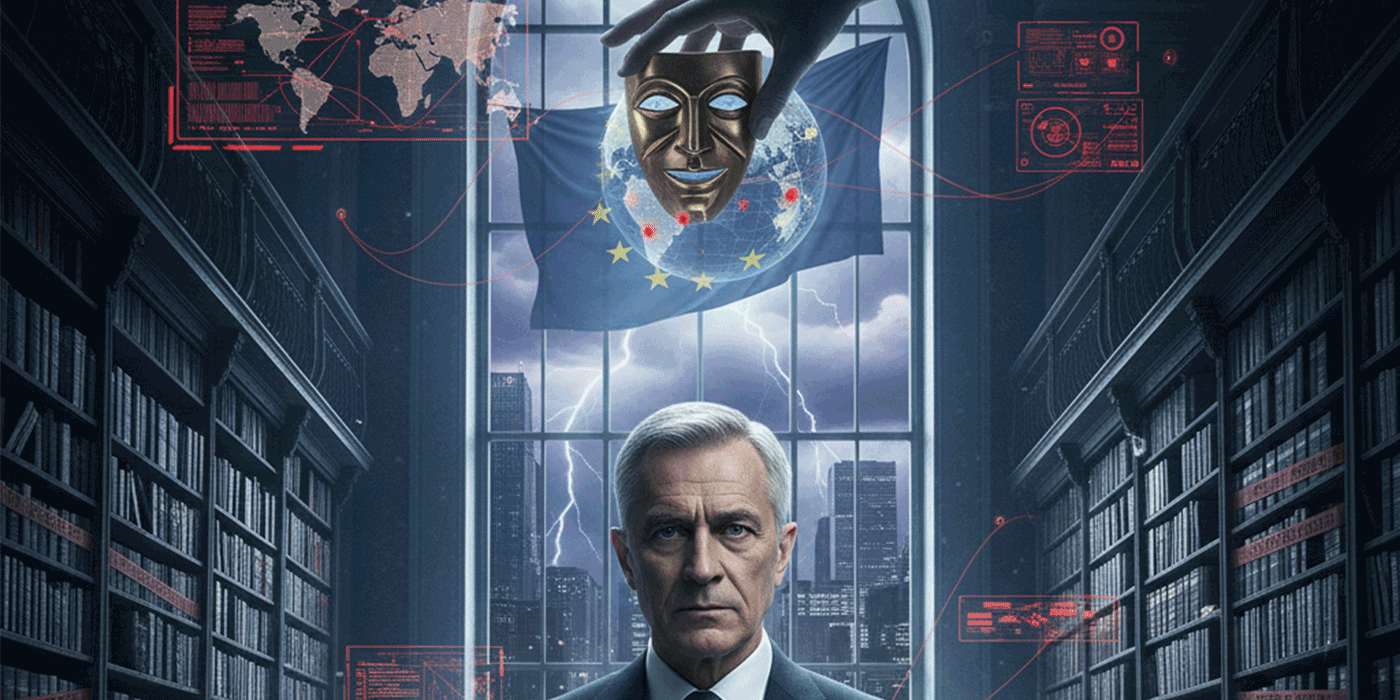
Is Israel’s Existence at Stake? - Jacques Baud
The Insider and His Verdict: Biography and an Uncomfortable Truth
Experience becomes dangerous when it no longer fits political narratives.
Jacques Baud — a man who has experienced intelligence work, peacekeeping operations, and geopolitical analysis from close range.
Born in 1955, he holds a Master’s degree in Econometrics and a postgraduate degree in International Security and International Relations.
He served as an analyst at the former Warsaw Pact desk of the Swiss Intelligence Service and later rose to the rank of Colonel in the armed forces — credentials that place him among the elite of strategic observers.
During the 1990s and 2000s, he worked for the United Nations, helping to establish the first multidimensional UN intelligence center for peacekeeping missions. He also led programs on demining and small-arms control. He later moved on to international institutions, including participation in NATO-related missions in the context of Ukraine.
Baud is the author of numerous books and analyses on intelligence services, terrorism, asymmetric warfare, information warfare, and geopolitical conflicts.
💬 “True power lies not in the noise of weapons, but in the quiet knowledge no one wants to hear.”His experience — spanning the Cold War, UN peacekeeping missions, and contemporary conflicts such as Ukraine — places him at a rare intersection of classical intelligence analysis, strategic thinking, and geopolitical critique.
Prologue – The Wrong Question
It is not external enemies that determine a state’s survival, but internal false assumptions.
The question of whether Israel’s existence is at stake strikes many as provocation or alarmism. In political talk shows it is reflexively dismissed; in opinion columns it is rejected as exaggerated. For Jacques Baud, however, the question is neither emotional nor polemical. It is analytical — and for that very reason, dangerous.
States rarely disappear because an enemy suddenly becomes stronger. They fail because, over years, they make false assumptions, ignore warning signs, and replace reality with narratives. Baud’s analysis begins precisely here: not with rockets, not with terror attacks, not with military headlines — but with the structural foundations of statehood.
Baud’s analysis therefore focuses on two levels:
- the erosion of political self-correction under a permanent state of emergency
- the gradual loss of structural legitimacy, both internally and externally
According to his thesis, Israel has lived for decades in a permanent state of emergency. This condition has not merely been accepted, but elevated to a political norm. Security replaced strategy, military superiority replaced diplomacy, and moral immunity replaced law. For a long time, this model functioned — not because it was stable, but because it was sustained by external factors.
Today, those supporting pillars are beginning to erode.
💬 “When a state defines its existence solely through escalation, it is not a sign of strength, but of strategic exhaustion.”A State in a Permanent State of Emergency
The state of emergency is not an accident — it has become political normality.
Jacques Baud describes Israel not as a state in a temporary crisis, but as a political system that has operated in a permanent state of emergency since its inception. This condition is not a historical accident, but a deliberately cultivated form of governance.
The state of emergency serves several functions simultaneously: it justifies extraordinary violence, suspends political normality, and shifts responsibility outward. Security becomes a universal justification — for military escalation, special legal regimes, and the restriction of internal debate.
Baud makes clear that this condition no longer responds solely to external threats, but has become internally operative. Criticism of the government is not treated as a legitimate element of democratic contestation, but as a security risk. Opposition falls under suspicion of disloyalty; protest is equated with disloyalty.
💬 “When security replaces politics, power becomes uncontrollable.”The permanent state of emergency thus acts like a political solvent: it dissolves boundaries without creating a new order. What suggests short-term decisiveness destroys, in the long run, the foundations of democracy, legitimacy, and trust. A state that defines itself permanently through alarm not only loses its capacity for self-criticism — it loses its sense of what normality even means.
The State of Emergency as a Permanent Political Logic
Where permanent alert prevails, political proportionality disappears.
The permanent state of emergency generates a dangerous psychological dynamic. Societies that live under constant alarm lose the capacity for differentiation. Everything becomes existentially charged; every decision is framed as a question of survival. Within such a logic, proportional responses cease to exist — leaving only escalation or capitulation.
Baud points out that Israel does not merely accept this condition, but actively reproduces it. Military mobilization, constant threat scenarios, and the continual invocation of historical trauma stabilize a system that would be politically difficult to sustain internally without external pressure.
This state of emergency is not maintained by chance, but systematically reinforced through:
- permanent military alertness
- the political instrumentalization of historical trauma
The state of emergency thus becomes a governing technique. It allows political errors to be obscured, structural problems to be deferred, and power to be preserved. But this mechanism comes at a cost: the longer a state lives in emergency mode, the less capable it becomes of returning to normalcy.
💬 “A state that no longer knows peace forgets how to do politics.”For Baud, this is precisely the core of strategic overstretch. Israel has grown accustomed to a mode that suggests short-term stability but blocks every form of self-correction in the long run. The state of emergency no longer protects — it binds the state to a logic of escalation from which there is scarcely an exit.
The Birth of the State of Emergency
The logic of exception did not emerge in war, but before the state itself.
Jacques Baud locates the origins of today’s crisis not in the current war, not on October 7, and not even in recent decades — but prior to the actual founding of the State of Israel. For him, the logic of exception begins in the 1940s, before Israel formally existed.
Even the pre-state Zionist organizations operated outside prevailing legal norms. Attacks on civilian targets, targeted killings, acts of sabotage against the British Mandate authorities — methods Baud explicitly classifies as terrorism. What matters to him, however, is not the moral judgment of this phase, but its structural effect: violence was not treated as an exception, but established early on as a legitimate political instrument.
Key findings from this early phase:
- violence was normalized early as a political tool
- legal boundaries were considered negotiable from the outset
With the founding of the state in 1948, this logic was not abandoned but institutionalized. Israel did not enter the international order as a state submitting to its rules, but as a state that claimed special rights from the very beginning — and received them.
A central point in Baud’s analysis is Israel’s admission to the United Nations in 1949. Unlike almost all other states, this admission was tied to an explicit condition: Israel had to publicly commit to respecting international law and future UN resolutions. This requirement was exceptional — and legally unambiguous.
💬 “No other state was admitted to the United Nations under such a condition.”UN Resolutions Without Political Consequences
Law loses its meaning when violations carry no consequences.
What followed, in Baud’s view, constitutes a historical precedent. Since 1949, more than 150 UN resolutions have been adopted assessing or seeking to correct Israel’s actions as violations of international law. None of these resolutions produced substantive consequences. Neither sanctions, nor isolation, nor serious political enforcement followed.
It is precisely here that what Baud describes as a special status emerges — not only factually, but psychologically. A state that experiences for decades that rule violations remain without consequence internalizes this reality. Law becomes relative, norms become optional, and criticism is externalized.
The consequences of this special status are structural:
- violations remain without consequence
- norms lose their binding force
Baud points out that within international legal debates there are indeed voices arguing that Israel, through the systematic disregard of its 1949 commitments, may have forfeited its status within the United Nations. These debates exist — but they are not pursued politically, because the West has never been willing to even contemplate such a step.
For Baud, this is the decisive point. For historical reasons — the Holocaust, guilt, the Cold War — the West consciously refrained from compelling Israel to comply with international law. What was intended as protection became a structural distortion. Israel did not learn to operate within the order, but above it.
💬 “Law exists only where it is enforced.”This early exception continues to shape the state’s self-understanding to this day. International criticism is not perceived as a legitimate element of the order, but as a hostile act. Legal proceedings are not regarded as binding, but as politically motivated. The state defines its own norm.
Baud draws a clear conclusion from this: Israel’s current overstretch is not a deviation from its history — it is its logical continuation. The birth of the exception was also the beginning of a long-term problem that is now coming fully into view.
The Special Status as a Self-Imposed Trap
What once offered protection now blocks every form of self-correction.
Israel’s special status was not accidental over decades, but a politically maintained arrangement. It drew on two sources: the historical guilt of the Holocaust and Israel’s strategic role during the Cold War. Both provided the state with a moral and political credit no other country possessed.
Jacques Baud emphasizes, however, that credit is finite. It is not renewed through repetition, but sustained through responsible conduct. This, he argues, marks the turning point. The special status meant to protect Israel has, over time, undermined its capacity for self-correction.
💬 “Moral credit does not shield a state from strategic reality.”The Holocaust thus became — unspoken yet effective — a kind of permanent immunity card. Criticism of Israeli actions could at any time be dismissed as morally illegitimate. The accusation of antisemitism replaced engagement with concrete facts. International norms were relativized because historical context was treated as overriding.
In this way, the special status shifted from a protective mechanism to a self-imposed trap. What was meant to create space for security gradually stripped the state of the corrective mechanisms that stabilize political systems. Criticism lost its function, law its binding force, and responsibility its addressee. The cost of this special path is not immediately visible — but it accumulates. And at some point, moral credit turns into strategic debt.
The Tipping Point in the International Perception of Israel
Moral credit is finite — and it has largely been exhausted.
Baud speaks here of a perceptual tipping point. What was once regarded as “tough but necessary security policy” is increasingly seen as systematic violations of law. Images from Gaza, statements by Israeli officials, and open contempt for international institutions have not merely strained Israel’s moral credit — they have largely depleted it.
This tipping point is most evident in two developments:
- security measures are increasingly perceived as systematic violations of law
- moral credit is no longer granted automatically, but actively questioned
The special status begins to reverse itself. What once offered protection now produces isolation. A state that places itself permanently above rules will eventually discover that other actors no longer apply those rules in its favor. The loss of moral credibility cannot be compensated by military strength.
Baud draws a sober conclusion: Israel’s crisis is not primarily military, but one of legitimacy. A state may possess weapons, maintain alliances, and win battles — yet once it loses the backing of international norms, its strategic room for maneuver shrinks dramatically.
💬 “Immunity becomes a trap when it is no longer shared.”The special status meant to secure Israel’s existence has thus become a self-imposed trap. The longer it is defended, the more obvious it becomes that it no longer holds. And the more forcefully it is defended, the faster the very process it was meant to prevent is accelerated.
When Strategic Value Turns into a Liability
Geopolitical value shifts when stabilization turns into a permanent crisis.
Jacques Baud places Israel’s role in the Middle East within a historical framework — arriving at a sober assessment: what long functioned as a strategic advantage has increasingly become a burden for the West.
During the Cold War, Israel fulfilled a clear function. As a militarily strong, Western-aligned state, it helped stabilize a region at the center of systemic confrontation. Israel served as a forward outpost, a deterrent, and a security multiplier for Western interests.
With the end of the Cold War, this role lost its foundation. Arab states developed their own economic and military capacities, diversified their alliances, and emerged as autonomous actors. The Middle East became more complex — and less controllable.
Israel’s strategic value thus became context-dependent — and increasingly contradictory. What once promised stability now generates friction, costs, and political blockages. In a multipolar order, the forward outpost loses its function when it polarizes rather than integrates. Geopolitical capital turns into strategic liability — not because of weakness, but because the framework conditions have changed.
Israel’s Declining Strategic Value
Indispensability is not a constant, but a function of interests.
In this new order, Israel’s position has shifted. Rather than being perceived as a stabilizing force, it is increasingly seen as a permanent source of crisis. Military escalations strain Western relations with the region, complicate economic cooperation, and undermine diplomatic initiatives.
Baud emphasizes that Israel’s strategic value has not disappeared, but has been relativized. Today, the West depends on energy, markets, and political stability — not on perpetual conflict. Israel’s policies increasingly collide with these interests.
💬 “The West needs the Middle East — but it does not need Israel’s escalations.”This also alters the logic of protection. Support becomes more costly, politically riskier, and harder to justify internationally. Israel remains militarily strong — but it is losing its status as an indispensable partner.
From asset to liability: this shift does not mark a rupture, but a gradual transition. And therein lies its danger. Those who ignore it continue to act according to rules that no longer apply.
War as an Instrument of Domestic Political Survival
The conflict stabilizes power, not security.
Jacques Baud describes the current war not primarily as a security-driven response, but as a strategy of domestic political survival. The conflict serves not only external deterrence, but stabilizes a political system that would scarcely remain viable under normal conditions.
At the center stands Benjamin Netanyahu. Baud speaks unusually openly of a “private war.” This does not imply personal impulse, but a structural reality: Netanyahu’s political survival is closely tied to the continuation of the state of emergency. Once the war ends, the questions currently suspended return — corruption proceedings, political responsibility, and societal reckoning.
- The war shifts time.
- It shifts responsibility.
- And it shifts power.
Yet Netanyahu does not act alone. His government depends on ultra-right and religious-fundamentalist coalition partners such as Bezalel Smotrich and Itamar Ben-Gvir. Baud does not describe their role as opportunistic, but as ideologically driven. While Netanyahu conducts a private war of power, these actors wage an ideological private war.
Their agenda is unambiguous:
- complete control over Palestinian territory
- permanent settlement presence
- de facto annexation
- no negotiable political solution
These actors derive their political existence from escalation. Peace would destroy their very foundation. The war thus becomes the glue of a coalition that would otherwise collapse.
Escalation Without a Realistic Exit Strategy
Where no political exit exists, escalation becomes a substitute action.
Baud draws an explicit parallel to Ukraine. In both cases, he identifies governments trapped in a dead end: under military pressure, politically exhausted, and without a realistic exit strategy. In such situations, escalation is not chosen because it promises success, but because every alternative appears more dangerous.
💬 “When peace is more dangerous than war, politics is blocked.”Added to this is internal pressure. Patience within the Israeli population is wearing thin, as is the willingness to accept endless sacrifices. At the same time, discontent is growing within the armed forces themselves. Baud refers to reports of exhaustion, doubt, and increasing criticism within the IDF — a signal rarely addressed openly, yet of high strategic relevance.
The war thus fulfills several domestic political functions simultaneously:
- it binds the opposition
- it delegitimizes criticism
- it justifies emergency legislation
- it delays political reckoning
Yet this stabilization is deceptive. It functions only as long as the war continues. Precisely therein lies the risk: the end of the conflict would not bring relief, but a concentration of all accumulated crises.
Baud therefore warns of a dangerous dynamic. The longer the war lasts, the greater the dependence on it becomes. The conflict shifts from means to purpose — and the state loses the ability to even imagine a condition beyond escalation.
💬 “A war that secures power destroys the state it claims to protect.”Military De-Restriction
When military means lose their limits, the state loses control.
Jacques Baud discusses Israel’s military conduct not as a political commentator, but as a former officer. This is precisely what gives his analysis its weight — and its severity. What he describes is not normal warfare, but a systematic removal of restraints, in which classical principles of the law of war have lost their relevance.
At the center is the dissolution of the distinction between military targets and the civilian population. Infrastructure essential for survival — hospitals, schools, water and energy supply, food logistics — is no longer regarded as protected, but as a legitimate part of the operational space. The justification given is “counterterrorism.” Operationally, however, this amounts to collective punishment.
This is particularly evident in two aspects:
- civilian infrastructure is systematically integrated into the military target catalogue
- the distinction between combatants and civilians is effectively abolished
Baud goes further here than many Western critics. He emphasizes that this brutality is not new, but is now openly displayed and politically justified. Whereas Western armies in earlier wars often concealed or denied violence, in Israel it is increasingly communicated as a necessary strategy — in some cases even as morally justified.
What Baud finds particularly disturbing is the qualitative dimension of this violence. He refers to testimonies by Israeli soldiers from earlier years describing how Palestinian children were deliberately shot — not out of military necessity, but out of indifference or even a form of cynicism.
Cases such as the killing of children playing on the beach in Gaza, he argues, are not exceptions, but symptoms of an unrestrained operational culture.
💬 “I am ashamed that such people call themselves soldiers.”Military De-Restriction and the Loss of Internal Order
External de-restraint always has a destructive effect internally.
Baud makes a decisive point: military de-restriction does not only act outwardly, it corrodes the armed forces from within. Where rules are permanently ignored, they lose their binding force. Discipline is replaced by ideology, restraint by hardness, professionalism by dehumanization. An army may appear effective in the short term — but in the long run it loses its strategic judgment.
Additionally, Baud identifies a factor he describes as historically new: total visibility. The current war is likely the most comprehensively documented in history. Every strike, every massacre, every destroyed school is disseminated, commented on, and archived in real time. Under such conditions, legitimacy can no longer be controlled or “communicated.”
The consequences of this de-restriction are not only external, but structurally internal:
- rules lose their binding force
- professional distance is replaced by ideological hardness
Baud sees this as a strategic own goal. An army that delivers daily images to the world reminiscent of the darkest chapters of the twentieth century destroys its own international backing. Even traditional supporters come under pressure to justify their position — not because of political opponents, but because of their own populations.
Military de-restriction grants Israel short-term operational freedom. In the long term, however, it produces the opposite of security: growing isolation, increasing radicalization, and resistance that continually regenerates. From a strategic perspective, Baud argues, this is not a sign of strength — but of loss of control.
💬 “An army can act militarily — and lose everything politically.”Terrorism as a Political Weapon
Terms replace analysis when politics no longer has answers.
Jacques Baud criticizes the Western handling of the term “terrorism” as strategically reckless. What was once an analytical category has become a political buzzword — used to reduce complexity and to morally delegitimize any form of resistance or criticism.
In the Israeli–Palestinian context, nearly every action by the opposing side is subsumed under this label. As a result, crucial distinctions blur: between guerrilla warfare and terrorism, between political movements and transnational jihadism, between resistance and arbitrary violence. For Baud, this is not conceptual imprecision, but deliberate simplification.
💬 “When everything is terrorism, nothing needs to be explained.”Baud reminds readers that many historical liberation movements were initially classified as terrorist — from the French Resistance to the anti-colonial movements of the twentieth century. The terrorism label consistently served to depoliticize the opponent: once marked as a terrorist, an actor no longer needs to be understood, only fought.
This semantic narrowing carries strategic consequences. When terrorism is no longer described but merely asserted, all political connectivity disappears. Analysis is replaced by moralism, negotiation by annihilation. The term no longer serves to understand violence, but to legitimize it — thereby closing precisely those paths that would make long-term de-escalation possible in the first place.
The Refusal of Differentiation in the Hamas Discourse
Those who refuse differentiation produce endless escalation.
In the case of Hamas, Baud points to an empirically documented development. The organization employed terrorist methods in its early phase, but later altered its structure, participated in elections, entered into ceasefires, and increasingly operated as a political-military actor. This differentiation is systematically excluded from Western discourse — not out of ignorance, but because it is politically inconvenient.
The result is an escalation logic without an exit. If every form of Palestinian action is classified as terrorism, repression remains the only response. Negotiations become impossible, political solutions are delegitimized, and violence reproduces itself.
💬 “Those who replace analysis with labels produce escalation.”For Baud, the inflationary use of the terrorism label is therefore not a linguistic detail, but a central element of the strategic dead end. It justifies de-restriction, normalizes violence, and prevents precisely what it claims to combat: lasting instability.
The refusal of differentiation thus functions like a political short circuit. By excluding every development, every change, and every internal dynamic, only a static enemy image remains. This image legitimizes permanent violence, blocks political movement, and renders the conflict insoluble — not because solutions are lacking, but because they are conceptually ruled out.
Economic Erosion Under a Permanent State of Emergency
Permanent war destroys not only infrastructure, but predictability.
Jacques Baud emphasizes that Israel’s crisis is not only military or political, but increasingly structural in economic terms. War does not merely destroy infrastructure — it destroys trust. And trust is the true currency of modern economies.
Central economic nodes come under pressure. Ports are blocked or operate with severe restrictions, supply chains are disrupted, and insurers classify transport to the region as high risk. Investments are postponed or abandoned altogether — not out of short-term fear, but because predictability has disappeared.
This economic erosion is gradual, yet profound. Companies make decisions not based on present destruction, but on anticipated uncertainty. Where the state of emergency becomes permanent, long-term investment horizons vanish. Growth is replaced by crisis management, innovation by risk avoidance.
The war thus turns the economy into a reactive system. State resources are diverted toward security and compensation rather than development and future viability. The longer this condition persists, the more an economic model solidifies that is no longer oriented toward productivity, but toward endurance — with all the structural consequences for stability and social cohesion.
Economic Erosion and the Loss of Trust
Capital does not respond to morality, but to predictability.
Tourism, a key economic sector, has collapsed dramatically. Yet this is not only about security concerns. Baud emphasizes that moral distancing is playing an increasing role: companies, institutions, and private individuals avoid engagement in order not to incur political or reputational costs.
💬 “Capital does not flee danger — it flees unpredictability.”Particularly severe is the loss of human capital. Israel’s high-tech sector depends on internationally networked, highly mobile professionals. These are precisely the groups that react fastest to instability. Emigration, temporary relocation, and capital flight are quiet processes — but devastating in the long term.
This economic bleeding amplifies all other crisis fields: it weakens social cohesion, increases political dependencies, and reduces strategic room for maneuver. A state can escalate militarily — but it cannot bleed economically without limit without undermining its own foundations.
This economic erosion acts as a force multiplier for all other crises. It deprives the state of the resources needed to develop political alternatives and cushion social tensions. The more trust is lost, the narrower the space for action becomes — until economic constraints themselves begin to drive political decision-making.
When Society Begins to Fracture
Internal tensions become visible under a state of emergency, but they are not resolved.
Jacques Baud describes Israel’s internal condition as a gradual erosion that is not caused by the war, but exposed by it. The permanent state of emergency conceals social fault lines — yet it does not heal them.
At the center lies the question of burden-sharing. While large parts of the population bear military, economic, and psychological costs, certain groups — particularly ultra-Orthodox communities — remain largely exempt from military service. What was long politically tolerated becomes an open strain in times of crisis.
💬 “A state does not collapse first at the front, but from within.”The war intensifies these imbalances. Demands on reservists increase, families face sustained pressure, and economic prospects shrink. At the same time, there is no unifying social contract that explains why sacrifices are necessary — and for whom they apply.
This internal fragmentation undermines long-term resilience. Where sacrifices are unevenly distributed and meaning is no longer communicated, loyalty dissolves into individual survival strategies. The state of emergency holds the system together outwardly — but inwardly it accelerates the loss of shared bonds and political coherence.
The Loss of Society’s Future-Bearing Classes
A state loses its future when its sustaining strata depart.
Particularly problematic is the loss of future-bearing groups. Highly qualified, mobile segments of the population — engineers, IT specialists, academics — possess alternatives. Baud notes that precisely these groups are increasingly emigrating or losing their attachment to the state. This is a process that cannot be compensated militarily.
Added to this is a growing ideological hardening. Criticism is labeled as disloyalty, doubt as a security risk. Where debate is replaced by loyalty tests, society ossifies.
💬 “When ideology replaces cohesion, disintegration begins.”The societal damage does not arise from a single war, but from the prolonged strain of a system that no longer knows any condition beyond escalation. Israel does not immediately lose its security — it loses its social foundation.
The outflow of these societal pillars is quiet, but irreversible. Knowledge, innovation, and critical thinking cannot be coerced or quickly replaced. When those who generate alternatives and sustain systems depart, what remains is a state that still wields power — but possesses ever less future.
The West’s Diplomatic Vacuum
The absence of politics has an escalatory effect.
Jacques Baud does not see the West’s behavior as a side issue of the conflict, but as a central accelerator. Not because Europe or the United States actively seek to prevent peace, but because they have become politically incapacitated.
Europe, Baud argues, objectively had the opportunity to assume a mediating role. Unlike the United States, it is historically less directly embedded in the conflict, economically deeply interconnected with the region, and not existentially dependent on escalation in security terms. Yet precisely this position went unused.
Instead of active mediation, political convenience prevailed:
- alignment with U.S. narratives instead of an independent strategy
- moral rhetoric instead of credible diplomacy
Instead, Europe followed Washington reflexively. Narratives were adopted rather than scrutinized. Sanctions replaced diplomatic initiative. Moral rhetoric substituted for strategic thinking. The result is a diplomatic vacuum: no actor speaks with all sides, and no credible paths toward de-escalation are developed.
The United States, in turn, acts as Israel’s political shield — militarily, diplomatically, and rhetorically. At the United Nations, it systematically blocks resolutions, supplies weapons, and adheres to a logic based on deterrence rather than conflict resolution. This approach may have worked during the Cold War. In a multipolar world, however, it is losing its effectiveness.
💬 “Where diplomacy is absent, escalation takes command.”The Failure of the American Deal Logic
Complex conflicts cannot be negotiated like business transactions.
Baud is particularly critical of the American tendency to reduce complex conflicts to deals: apply pressure, dictate conditions, present a “win.” Actors such as Iran, Hezbollah, or Hamas, however, can no longer be forced into this framework. The greater the pressure, the stronger the resistance.
The West’s failure therefore does not stem from malicious intent, but from strategic emptiness. Those who fail to formulate an independent policy become part of the escalation logic of others.
💬 “The West is not neutral — it is absent.”This diplomatic vacuum further exacerbates Israel’s crisis. It empowers those forces in Jerusalem that see escalation as the only way out, and weakens all actors seeking political solutions. Instead of fostering stability, the West thus prolongs a conflict it neither controls nor can bring to an end.
The deal logic ultimately collapses under its own simplification. Where power relations, historical experience, and ideological motives are ignored, pressure does not produce solutions, but hardening. Diplomacy becomes a transaction without trust, and politics turns into the management of permanent crisis. In such structures, no equilibrium can emerge — only an escalation that continuously reproduces itself.
Al-Aqsa as a Geopolitical Flashpoint
Religious symbols operate globally, not locally.
In Western analyses, the religious core of the conflict is often marginalized. Jacques Baud considers this a serious mistake. The Temple Mount — Haram al-Sharif, Al-Aqsa — is not a symbolic detail, but one of the most dangerous geopolitical triggers in the world.
For Muslims, Al-Aqsa is the third holiest site in Islam. Its significance extends far beyond Palestine — across North Africa, the Middle East, and into Asia. Any alteration of the status quo is perceived not locally, but globally. Baud emphasizes: whoever touches this site touches the entire Muslim world.
At the same time, fundamentalist Jewish groups in Israel are gaining influence and openly speak of building a Third Temple. What long remained a fringe fantasy has now become politically viable. Parts of the settler movement, religious parties, and ideological networks no longer view the Temple Mount as a fragile equilibrium, but as a historical objective.
Religion as a Geopolitical Tipping Point
Ideological de-restraint makes control impossible.
This dynamic is highly explosive. Should there be a permanent restriction of Muslim access, damage to the Al-Aqsa Mosque, or even its destruction, the reaction would no longer be controllable. States that today still act with tactical restraint could be forced to respond — regardless of their relations with Washington or Tel Aviv.
💬 “The Temple Mount is not a political space — it is a religious tipping point.”Baud sees here the real possibility of a regional conflagration. Not as a planned scenario, but as the consequence of ideological de-restraint. This is precisely why he criticizes Western discourse: those who ignore this factor do not understand the conflict — and inadvertently contribute to its escalation.
Religion thus becomes a strategic unknown. It eludes classical calculations, diplomatic arrangements, and military deterrence. Those who underestimate or attempt to instrumentalize this factor set in motion processes that can no longer be politically contained. In such a constellation, a single step may be enough to render regional escalation irreversible.
All or Nothing: The Logic of Maximum Escalation
Maximalism emerges from the loss of real options.
Jacques Baud describes Israel’s current situation as a classic all-or-nothing configuration. It does not arise from strength, but from the loss of viable courses of action. Those who believe they have no possibility of retreat resort to escalation — not as a means, but as a necessity.
Political rhetoric from Jerusalem shows that the war is no longer justified purely in defensive terms.
It is framed as a historical opportunity:
- to permanently destroy Gaza,
- to eliminate Hamas not only militarily, but structurally,
- to strategically weaken Iran,
- to deter Hezbollah or force it into open confrontation.
These objectives are maximalist and mutually interlinked. If one fails, all are destabilized. This is precisely what drives the escalation spiral. The higher the stakes, the lower the willingness to acknowledge reality.
💬 “Those who must win everything cannot stop escalating.”This logic has no stable endpoint. Maximalist goals exclude compromise and turn any pause into defeat. The further escalation advances, the more the space for action narrows — until violence is no longer employed to achieve something, but to mask the loss of control.
Escalation as a Substitute for Political Agency
Where politics is blocked, risk takes the lead.
Baud sees a clear parallel to Ukraine: governments that can no longer translate military reality into political outcomes increase risks in order to buy time. Not because victory is realistic — but because failure cannot be politically acknowledged.
Within an all-or-nothing logic, rationality shifts. International isolation, economic damage, and moral loss are accepted as long as they preserve the appearance of control. Escalation replaces strategy.
The regional dimension is particularly dangerous. Every move by Israel reverberates through a dense network of state and non-state actors. What is intended as a display of power can at any moment trigger a chain reaction.
💬 “All or nothing is not a strategy — it is a symptom.”Israel’s escalation is meant to secure existence, yet in the long term it undermines it. Those who believe survival is possible only through maximum force have already passed the point at which politics was still an option.
Escalation thus becomes the last remaining mode of action for a politically blocked system. It creates motion where decision-making capacity is absent, and activity where strategy no longer exists. But the longer risk replaces politics, the higher the probability of losing control — not as an accident, but as the logical consequence of an order that has overstepped its own limits.
Existence Without War?
Existence requires legitimacy, not merely military strength.
At the end of his analysis, Jacques Baud poses a question that is rarely asked in political Israel today: can Israel exist without permanent escalation? Not militarily, but structurally, socially, politically.
Existence, Baud argues, means more than territorial control or military superiority. It requires legitimacy — internally and externally. A functioning social contract. An economic perspective. International integration that does not rely exclusively on security guarantees.
Without these prerequisites:
- existence remains militarily defined
- and politically unstable
This is where Baud identifies the core problem: Israel has increasingly equated its existence with military dominance. Security has become a substitute for politics. Yet military strength cannot replace legitimacy — it can only conceal its absence for a limited time.
A genuine alternative would require a radical course correction:
Recognition of international law not as a tactical instrument, but as a foundation.
This question does not aim at a short-term policy shift, but at the long-term viability of the state. Without a return to political, legal, and social foundations, existence remains bound to violence — and thus fragile. A state may survive militarily without truly existing; endurance, however, requires more than deterrence.
The End of the Permanent Occupation Logic
Without political order, security remains a temporary fix.
Integration into a regional order that treats Israel not as an exception, but as one actor among others.
Politically, this option is currently blocked. Israel’s internal political structure rewards escalation, not compromise. Those who call for de-escalation risk losing power. Those who express doubt are labeled security risks.
💬 “A state can be militarily undefeated — and still lose its future.”Baud is therefore pessimistic. Not because Israel’s existence will end tomorrow, but because the structural prerequisites for long-term stability are eroding. A state does not cease to exist abruptly. It first loses trust, then cohesion, then its future.
The logic of permanent occupation thus prevents any real normalization. As long as control outweighs integration, no political order can emerge — only a state of perpetual suspension. Security is managed, not shaped, and remains dependent on military superiority rather than on accepted rules.
Without a break from this logic, the future continues to narrow. Escalation may stabilize power relations in the short term, but it merely postpones the fundamental question of legitimacy and coexistence. What is lacking is not military capability, but the political will to let security emerge from order — rather than order from violence.
Epilogue – A State at the Crossroads
States do not disappear abruptly, but step by step.
Israel’s existence is not threatened tomorrow — but structurally. A state can vanish long before its flag falls: through internal erosion, international delegitimization, and strategic self-deception.
💬 “Those who unconditionally support a self-destructive policy are not allies — they are accomplices.”The crossroads Baud describes is not a dramatic moment, but a process. Decisions are postponed, contradictions covered over, escalation normalized. This is precisely where the danger lies: the loss of the future does not occur through a single act, but through the persistent refusal to acknowledge political reality.
A state may endure militarily and still fail strategically. When power becomes an end in itself and criticism is treated as a threat, the space for correction contracts. What remains is an existence under permanent exception — sustained by force, but without a viable perspective beyond it.
Thank you, Jacques Baud.
Sources & Geopolitical References
Substack – US-Edition
This article is also available as a English-language edition on Substack:
Is Israel’s Existence at Stake? - Jacques Baud
Original conversation (video)
YouTube-Interview:
Israel May Cease to Exist - Jacques Baud
Support Independent Journalism
If you find my work valuable, you can support it with a voluntary contribution here:
Voluntary support via PayPal
Voluntary support via Buy Me a Coffee
Many thanks for your support!

More Articles
How Israel Sells Conflicts - Seyed Marandi
Iran, Israel, and the Erosion of Western - Seyed Marandi
Green Beret on war in Gaza - Tony Aguilar

investigative commentary.